
Category: Fragments of Ungoránë

  • Hunting the Past

    Hunting the Past

    The fire crackled low, soft punctuation to the quiet rhythm of Ungoránë’s whetstone as it moved against the edge of his axe. The sound was steady and deliberate, each scrape against the steel pulling his focus tighter. The axe gleamed in the firelight, its edges catching orange and gold, but Ungoránë barely saw it. His mind drifted, his thoughts unmoored, while his ears were attuned to the faint rasping noises from the other side of the camp.

    Thordur was at work on his bow again. The occasional tension creak punctuated the string waxing as he tested it. The careful rotation of arrows in his hand followed, each receiving the same meticulous attention. Then came the faint snap of fletching being pressed back into place, a sharp but soothing sound that felt oddly constant against the shifting murmur of the camp. Together, it formed a rhythm of its own, subtle yet distinct, a counterpoint to the scraping of the whetstone.

    Ungoránë listened without meaning to. The rhythm wrapped around him, weaving through the stillness of the night and pulling him deeper into its cadence. His hands continued their motions automatically, but his thoughts slipped past the present moment, carried by the quiet insistence of Thordur’s movements.

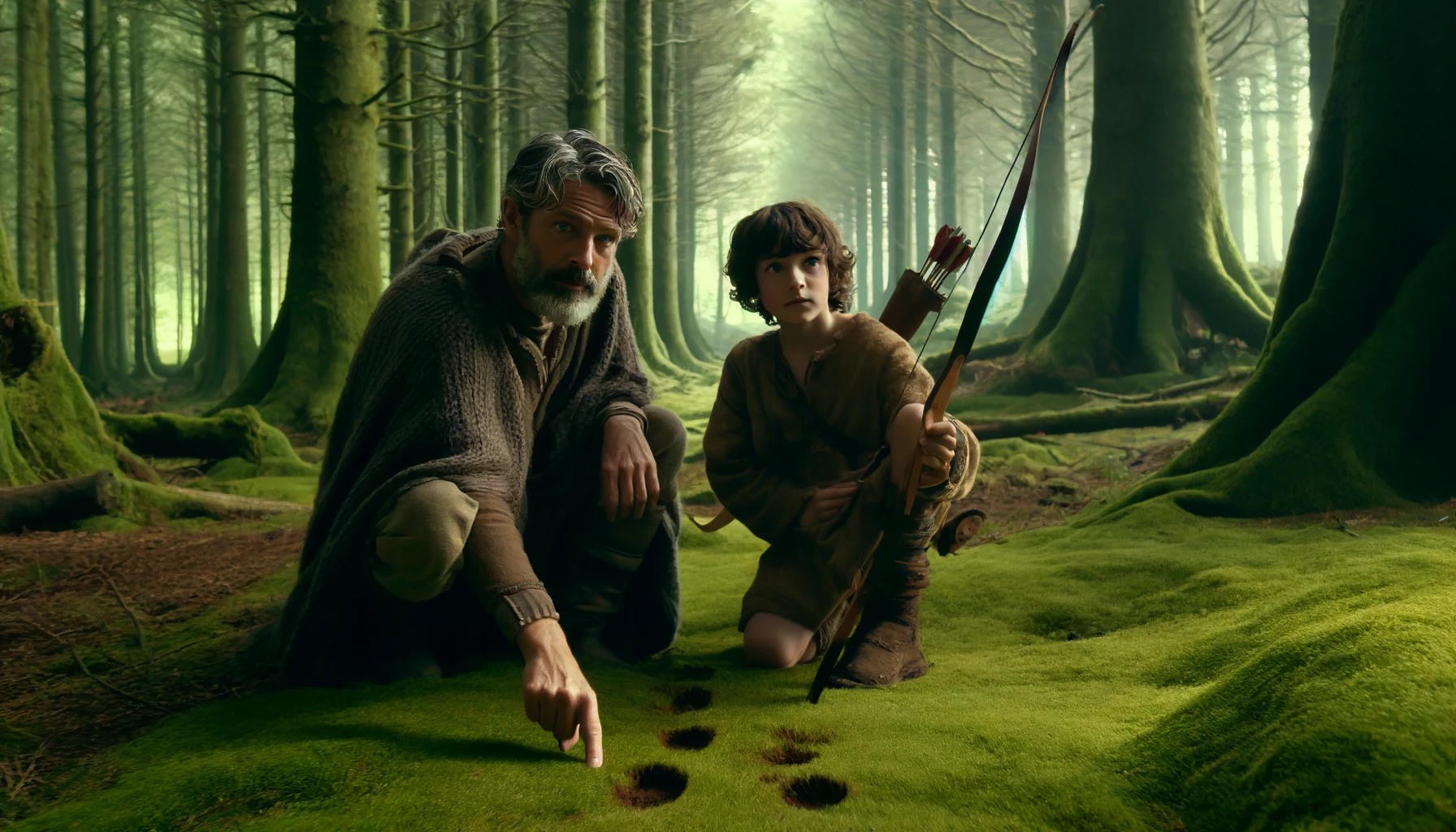
    When he was a boy, the woods felt impossibly large, each towering tree a sentinel standing watch over the narrow path they trod. His father moved ahead, quiet as a ghost, his long strides seeming to vanish into the underbrush. The little shadow struggled to keep up, the bow heavy in his hands. He tried not to let the string creak as he carried it, but it was awkward and unwieldy. His fingers ached slightly from holding the nock too tightly.
    “Quiet now,” his father said, the word more felt than heard, settling over the boy like a second skin. The boy stilled, watching as his father crouched low to examine a faint track pressed into the damp earth. The air was alive with smells: the sharp tang of moss, the rich scent of turned soil, and the faint sweetness of pine resin.

    “Come close. See this?” His voice was low and steady, each word slipping into the still forest air like a leaf drifting on water. He knelt low, his broad frame blending into the underbrush as if he belonged there. His hand hovered over the faint impression in the damp soil—a perfect crescent of a hoof, edges softened by the recent rain. He beckoned the boy forward without turning, his finger pressing lightly against the track as if drawing attention to something sacred.

    The boy crept closer, his bare feet brushing the cool moss. His steps wavered initially, but eagerness pushed him to match his father’s steady stride. His chest swelled with the thrill of the hunt—each track, each whispered instruction feeding a growing sense of pride. He was part of this, a hunter like his father. He didn’t need to be told twice; the tension in the air was enough. The forest held its breath, its usual chorus silenced. Even the boy’s shallow breathing felt loud.

    “That’s a stag,” his father said softly, the calm in his voice edged with something sharper—something keen. He brushed a hand over the track, measuring its depth and the space between impressions. “Big one, too. Look at the spread here—strong legs, walking steadily. Tracks this fresh mean we’ve got to be close.”

    The boy’s heart quickened. The bow in his hand felt impossibly heavy now, the string taut under his grip. His father straightened, his sharp eyes scanning the thicket ahead. The man’s movements were unhurried but precise, with every shift of weight purposeful. The boy mirrored him as best he could, though his limbs felt clumsy in comparison.

    “Look at that. See how the track sinks deep here?” his father asked, his tone soft but instructive. “That’s where he stopped; maybe he caught a whiff of something. But see? He didn’t take off.” He glanced at his son, his expression firm yet encouraging. “That tells you he’s close. Close. Keep quiet now—and mind the wind.”

    The boy nodded, his throat dry and his pulse pounding in his ears. His hands trembled slightly as he adjusted his stance, the bow feeling heavier with each passing second. He glanced up at the swaying branches, biting his lip as he fought the creeping doubt: Could he do this without failing? His father had drilled this into him—stealth was not just silence but patience and awareness. A misplaced step or a careless wind shift could mean an empty quiver and a hungry night.

    They moved together, the man leading with the ease of experience, the boy following in his wake. His father’s shadow stretched long against the patchy sunlight filtering through the canopy, his outline blending seamlessly with the muted greens and browns of the forest. To the boy, he seemed part of the woods, a living embodiment of its quiet power.

    A faint rustle ahead froze them both in place. The boy’s breath hitched, and his father’s hand rose instinctively to signal stillness. Between the brambles, the stag emerged, its antlers twisting like branches in the dappled light. Its movements were fluid, and its dark eyes scanned the clearing.

    His father lowered himself slowly, his hand gesturing for the boy to follow. He did, his bow trembling slightly as he nocked an arrow. His father’s voice, barely audible, reached him. “Forget the head. Always aim for the lungs. It’s the cleanest kill, and it’s over quickly. Wait for your moment. Breathe. Steady hands make a clean shot.”

    The boy nodded, his fingers tightening around the string. He could feel the tautness against his calloused fingertips, the arrow’s weight poised like a held breath. He sighted along the shaft, his target clear. The stag shifted, its ears flicking. His heart pounded. His father’s advice echoed in his mind: Patience. Closer is easier.

    For a moment, everything else faded—the ache in his arms, the weight of the bow, the world around them. All that remained was the stag, framed by the shifting light and unaware of the hunters just beyond the brambles.

    Its antlers seemed to reach toward the sky, tangled in the branches above, as though the forest had crowned the stag its king. The boy’s fingers tightened around the bowstring, his knuckles white with effort. He drew it back slowly; the tension in the string was matched only by the tremor in his arm. His breath came shallow and uneven; the moment’s weight pressed on his chest like a stone.

    His father’s voice was a faint echo in his mind: “The lungs. Always the lungs.” But as the stag shifted, its massive head dipping to graze, the boy’s instincts faltered. The broad chest, steady and rhythmic with breath, seemed too far, too uncertain. With its sharp eyes and regal antlers, the head appeared closer and more prominent—a target he couldn’t ignore.

    He sighted along the shaft, holding his breath as he aimed for the head. For a heartbeat, the world stilled. The woods seemed to hold their breath with him, the air thick with potential.

    Then he released.

    The bowstring snapped against his forearm, a sharp sting that startled him more than the motion itself. The arrow flew, its path unsteady and uncertain. The stag’s ears flicked, and its head turned just in time. The arrow whistled harmlessly past, vanishing into the trees with a hollow thunk.

    The stag bolted. Its hooves tore into the forest floor, scattering leaves and dirt as it disappeared into the underbrush. The boy froze, his breath lodged in his chest as the hollow thunk of the missed arrow echoed in his ears. His arm burned where the bowstring snapped, but that pain was nothing compared to the weight settling in his stomach—a cold, sinking shame. He blinked rapidly, fighting back the sting of tears as his father’s heavy sigh reached him.

    Behind him, his father exhaled a heavy sigh. It wasn’t anger, but the weight of disappointment carried just as much force. “I told you,” his father said, his voice low and steady, “and I keep telling you. Never aim for the head. You aim for the lungs, not the head. That is the cleanest shot there is. The animal will run a bit but drop quickly every time.”

    The boy didn’t dare look up. He nodded mutely, his hands gripping the bow tightly as though it might steady him. His father stepped forward, his movements calm and unshaken, as though the miss hadn’t mattered. The boy followed with his head bowed, his cheeks hot with failure. Every step felt heavier, each a reminder of what he had done wrong. Yet, when his father glanced back, there was no anger—only that quiet patience. It should have comforted him, but it only cut the boy’s shame deeper.

    At the place where the stag had stood, his father crouched low, his fingers brushing the disturbed earth. The faint outline of the stag’s hooves and the scuff of its retreat told a story his father read like a map. He frowned slightly, his brow furrowing in thought. After a moment, he straightened and shook his head.

    “Too fast to bother tracking,” his father muttered, his tone not unkind but resolute. The boy nodded, swallowing the tight lump of disappointment that had lodged itself in his throat. His father straightened, his tall frame outlined by the muted green light filtering through the canopy above. He gestured with a tilt of his head, his voice calm and steady. “We’ll find another.”

    They moved on, the forest folding around them like a living thing. His father’s every step was purposeful, a masterclass in quiet movement. The boy followed as best he could, trying to mimic how his father placed each foot softly on the earth, avoiding the dry snap of twigs and the loud rustle of leaves.

    The woods were alive, not with noise but with signs. A faint rub against the rough bark of a tree marked where antlers had scraped during the rut. A snapped branch here, a patch of disturbed soil there, each a piece of a puzzle his father assembled with practiced ease. The boy watched him closely, his hands moving lightly over the bark, and his sharp eyes scanned the thickets ahead as if he could see what lay beyond.

    His father stopped suddenly, his hand raised. The boy froze, his pulse quickening. His father turned slightly, pointing to the faint impression of hoofprints in the soil. “Look here.” His voice dropped to a whisper, his hand hovering over the tracks. “See how the back hooves dig in deeper? That means he’s taking his time and isn’t spooked.”

    The boy crouched beside him, his young hands mimicking his father’s movements. The tracks seemed ordinary to him—just marks in the dirt—but he nodded anyway. He wanted to see what his father saw, to understand what made these faint signs so important.

    They crept onward, each step deliberate. The air seemed to change as they went, the sounds of the forest sharpening and softening simultaneously. A distant birdcall echoed, and the boy thought he could feel the tension in his father’s shoulders. His breathing felt too loud like it might carry across the woods.

    Then they saw it.

    The stag stood in a clearing; its great head lowered to graze. Sunlight filtered through the canopy above, catching on its broad shoulders and the gentle curve of its antlers. The boy’s breath caught in his throat. The stag was massive, even larger than the first, and its coat was a deep, rich brown that blended with the shadows of the underbrush.

    His father held up a hand, signaling for him to stop. Slowly, he unslung his bow, the motion so fluid it seemed a part of him. He nocked an arrow, drawing it back with a quiet strength that felt effortless. The boy watched, his eyes wide, every part of him focused on the scene before him. He loosed the arrow with a quiet twang that seemed to blend with the sighing of the wind. The stag jolted as the arrow struck true, its body tensing before it bolted into the trees. It ran, its hooves pounding against the soft forest floor, scattering leaves and snapping twigs beneath its weight. But the run was short-lived. The boy watched, breath held, as the stag faltered, stumbled, and finally collapsed, its legs crumpling beneath it, folding awkwardly as if some unseen force had yanked its support away. The woods fell silent again, save for the faint rustle of leaves stirred by its fall.

    “Come,” his father said, already stepping forward. His voice was calm and steady, like his hand on the bow. The boy followed, his heart thudding in his chest—part exhilaration, part awe.

    They approached cautiously, his father’s every movement deliberate and quiet. The boy’s eyes were wide, fixed on the massive creature lying still among the underbrush. Its coat gleamed in the dappled light filtering through the canopy; each rise and fall of its chest weakened as the blood loss did its work.

    His father knelt beside the stag, placing a steadying hand on its side before inspecting the wound. The arrow had pierced the lungs cleanly, just as he’d said it would. The blood was bright against the animal’s fur, vivid and stark against the muted colors of the forest floor.

    “That’s it. Perfect shot.” His calm words carried a quiet certainty, not seeking praise but stating a truth about the woods. His tone reflected a caring approach to showing his son the right way.

    The boy crouched a few steps away, watching as his father pulled a knife from his belt. The blade shimmered in the sunlight, its edge sharp and purposeful. His father worked methodically, removing the parts of the carcass they wouldn’t take home. Each motion was practiced and efficient, as though this act was as natural as breathing.

    “The heart,” the boy piped up, his voice cracking through the quiet rhythm of his father’s work. His hands clenched at his sides, not from fear but from anticipation. “Are you going to smoke it?”

    His father paused, the knife still mid-cut, and glanced at him with a faint smile. The kind of smile that seemed not to belong in the woods, surrounded by blood and the faint metallic scent of the hunt. His father paused, glancing at him with a faint smile—small but warm, like the first crack of fire in a cold hearth. “You’ve got a taste for it, huh?” His voice was light and teasing.

    “It’s the best part,” the boy said quickly, his words tumbling out in a rush of earnestness. His voice gained strength, even conviction, as he continued. “You always said that.”

    His father chuckled softly, the sound low and rich, like the crackle of a fire on a cold night. His hands resumed their work, steady and precise, the blade moving through sinew and muscle with practiced ease. His father chuckled softly, the sound like boots crunching over dried leaves. “Best part, indeed,” he agreed, his tone softening. “It takes a sharp knife and a careful hand to handle it right. Lucky for you, I’ve got both.”

    The boy grinned with a small, private smile and crouched closer, watching as his father set the heart aside carefully and deliberately. It was a moment as rich as the woods around them, full of unspoken understanding. Here, in the stillness of the hunt’s aftermath, they weren’t just hunters and learners—they were father and son, bound by a shared tradition and the quiet trust of the life they carried together.

    On the way back, they spoke little, their words unnecessary amidst the rhythmic sounds of the forest at dusk. The weight of the carcass, suspended between them by a sturdy pole, shifted slightly with each step. The boy’s smaller frame strained against the load but refused to complain. His father bore the heavier portion with practiced ease; his movements were steady and unhurried, as though he could carry the world without faltering.

    The forest grew darker; the canopy overhead thickened until only faint ribbons of twilight filtered through. The boy focused on his footing, careful not to trip over the gnarled roots or hidden rocks that jutted from the uneven path. His hands gripped the pole tightly, and his arms ached, but the weight felt like a badge of honor—a shared burden that made him feel older, stronger, and closer to the man who walked beside him.

    Their breaths mingled with the night sounds: the rustle of unseen creatures, the occasional hoot of an owl, and the soft crackle of dried leaves underfoot. The forest smelled different now: cooler and richer, layered with the musk of the hunt. The boy inhaled deeply, letting the scents anchor him as if to forever fix this moment in his memory.

    When they reached the edge of the woods, their home appeared. It was small and sturdy against the vastness of the land, and the firelight from the windows glowed like a beacon, a soft amber warmth that promised safety and rest. Smoke curled lazily from the chimney, its scent mingling with the earthy aroma of damp wood and pine.

    Abrazân was the first to appear, his broad frame silhouetted in the doorway, curiosity plain on his face. Their mother followed, wiping her hands on her apron, her expression equal parts relief and exasperation.

    “You’re late,” she called, though her voice carried no real reproach.

    The boy glanced at his father, who smiled only faintly—the one that said everything and nothing at once. Together, they hefted the carcass higher, carrying it toward the glow of home and the promise of warmth within.

    Thordur’s knife scraped against the wood, the sound sharp and steady, dragging Ungoránë from the past. The ache in his chest lingered, as vivid now as it had been then, the memory of that missed shot cutting through him like a wound that refused to heal. He flexed his hand unconsciously, the ghost of that boy’s trembling grip still with him. He blinked, the flickering firelight stinging his eyes as the ruins of Osgiliath revolved around him. His axe rested across his knees, the whetstone still in his hand, its rough surface pressed lightly against the edge. He realized he hadn’t moved it for some time.

    “You’ve been quiet,” Thordur said, his tone carrying that easy warmth he wielded so naturally. He didn’t look up from the stag he was carving, his knife moving in precise, unhurried strokes that peeled thin curls of wood from the block.

    “Just thinking,” Ungoránë replied softly. His voice was neutral, edged with a quietness that could have been mistaken for disinterest, but Thordur wasn’t fooled. There was a weight behind those two words, something heavy enough to anchor them in the space between the fire and the shadows.

    Thordur glanced up briefly, his gaze catching Ungoránë’s face. His expression shifted slightly, tempering his curiosity with restraint before he gave a slight nod and returned to carving. The stag in his hands was taking shape—a rough but recognizable form. Its head turned as if caught mid-motion, listening for some distant sound in the quiet woods.

    Ungoránë tilted his head back, letting the cool night air brush against his face. Above him, the sky stretched out in a vast indigo expanse, and the stars were scattered like shards of broken glass. They blinked coldly, steady and indifferent, their light reaching a distance too great to fathom. The sight calmed and unsettled him, reminding him of how small he was beneath that infinite sprawl.

    In his mind, another voice stirred—not Thordur’s, not his own. It was deep and steady, with the cadence of the woods woven into it. Slow your breath. Focus on the mark. The closer you are, the fewer chances it has to escape.

    Ungoránë’s grip on the whetstone tightened, the memory sharpening like the axe’s edge across his knees. He could feel the bow in his young hands again, the string biting into his fingers as he pulled it back, his father’s hand firm on his shoulder. Watch its legs, not its head. You miss the head; it runs. You aim for the lungs, not the head. That is the cleanest shot there is. The animal will run a bit but drop quickly every time.

    The scent of damp earth and pine needles rose unbidden in his mind, mixing with the tang of smoke from the fire. He closed his eyes briefly, letting the memory settle, and when he opened them, the stars above seemed just a little closer.

    “Stars, have you thinking, or is it that axe?” Thordur’s voice pulled him back again, lighter this time, with an edge of teasing. His knife paused, and the stag turned in his hands as he studied it.

    “Neither,” Ungoránë said, but his voice carried something that made Thordur’s grin fade into something quieter. Thordur didn’t press; he only shrugged and resumed carving.

    Ungoránë’s gaze dropped to the axe across his lap. It gleamed faintly in the firelight, catching flickers of orange and gold. He ran the whetstone along its edge; the scrape of metal grounded and anchored him in the present. The rhythm felt familiar, connecting him to something older and more straightforward that carried him through the world’s chaos.

    Thank you, Ungoránë thought, the words meant for a man no longer there. For everything you taught me. For everything that keeps me alive now. The gratitude in the thought was genuine, but it carried a shadow of guilt with it, a reminder of choices made and paths taken. His chest tightened briefly; the feeling was sharp and fleeting before he exhaled slowly, letting the breath leave him like a sigh. The fire crackled softly beside him, and Thordur’s carving knife continued its steady rhythm while the stars above remained cold yet constant.

    Ungoránë gazed at the axe in his lap, its sharp edge sparkling like the stars. This stirred calm within him.
  • The Rooster and the Axe

    The fire struggled and flickered, its faint light dancing over the broken stones of Osgiliath. Shadows stretched toward the unseen edges of the ruins, their shifting shapes mirroring the weight of the night. The air was damp and heavy, carrying the smell of wet leaves and the sharp tang of burning sap. The Anduin murmured low and steady somewhere in the distance, threading its quiet melody through the darkness.

    Ungoránë sat just beyond the firelight’s warmth, his axe resting across his knees. Its broad head gleamed faintly as the flames licked the air, its solid weight grounding him against the drift of his thoughts. In his hand, the whetstone moved in slow, deliberate strokes, each pass leaving a whisper of stone on steel—a steady rhythm that filled the quiet between his memories.

    Nearby, Thordur worked on a wood block with his knife, the blade flashing in the firelight with each precise motion. Thin slivers curled away, gathering at his boots like fallen leaves. The shape emerging from the wood—a rooster—was rough but unmistakable. Its proud neck curved with defiance even in its unfinished state. The firelight played along its uneven edges, lending it a life it hadn’t yet earned.

    His hands moved quickly from years of habit, each motion flowing into the next as if carving were intuitive, like drawing breath. Thordur didn’t seem to think much about it; his eyes rarely left the block of wood, though the faintest smirk tugged at the corners of his lips whenever a particularly stubborn splinter gave way.

    Thordur was the first to break the silence, as he always was. He leaned back, holding the half-finished rooster aloft so it caught the fire’s flickering light. The wood’s rough edges gleamed faintly, its wings still blocky and unformed, but its proud neck arched just enough to suggest defiance. His grin was boyish, and his tone was light with mischief. “What about this, Ungoránë? If you were surrounded by Southrons and had to choose between this fine rooster and that axe of yours, which would you pick?”

    Ungoránë didn’t look up immediately; his focus was still on the slow, deliberate strokes of the whetstone against his axe. The rhythmic scrape filled the pause between them, steady and sharp. Finally, he glanced at the carving in Thordur’s hand, his expression unreadable. When it came, his voice was quiet but laced with dry humor. “The axe. Always the axe.”

    Thordur’s grin widened as though he had expected the answer but couldn’t resist teasing anyway. “No faith in the rooster?”

    “It doesn’t cleave through armor,” Ungoránë replied, letting the whetstone scrape again. The sound carried through the cool night air, clean and precise, like the note of a blade drawn from its sheath. The faintest twitch of a smirk played at the corner of his mouth, gone almost before it appeared.

    Thordur chuckled, shifting his weight as he tossed the carving lightly into the air, catching it with a flick of his wrist. “True enough. But this one’s special. My father swore by it back at the inn. Called it the ‘Feathered Guardian.’ Said it scared off drunks, rats, even a tax collector once.”

    The whetstone paused mid-stroke, the sound of stone on steel giving way to the soft crackle of the fire. Ungoránë tilted his head slightly, his gray eyes flickering toward Thordur. When it came, his voice was low and even, like the Anduin in its quietest stretches. “Did your father run an inn?”

    “In Lossarnach,” Thordur said, his tone warming with the memory as he turned the wooden rooster in his hands. The carving was still rough, its edges catching the flickering light, but the fondness in Thordur’s voice lent it life. “A little place off the old road. Not much to look at—low ceilings, creaky floors—but it was home. My father ran it like a captain runs a ship. Spill your ale; you mop it up. Break a stool; you fix it. Can’t pay? You shovel dung until you can.”

    A faint smirk tugged at Ungoránë’s lips, there and gone before it could fully take shape. “Sounds like he’s kept better order than most captains I’ve met.”

    Thordur’s laugh came quickly, soft and genuine—the kind of sound that carried warmth through the cold stones of Osgiliath. His grin widened as he leaned forward, elbows resting on his knees. “Careful, Ungoránë. Talk like that, and you’ll be peeling potatoes until next winter.”

    The fire popped suddenly, a spray of sparks spiraling upward to join the canopy of stars. Ungoránë returned to sharpening his blade, the whetstone resuming its steady rhythm. Thordur, however, leaned back, stretching his legs toward the fire’s warmth. His face was relaxed and open, but a glimmer in his eyes betrayed the mischief that always simmered beneath his words.

    “Once, my brother thought he was quite clever,” Thordur started, his voice adopting the rhythm of a cherished story. “He watered down a barrel to extend the ale and served it to a traveler. Naturally, my father caught him and forced him to drink it all.”

    A laugh escaped Ungoránë before he could stop it—a rough, quiet sound that startled even him. It was rusty and unused, like an old hinge forced to move. “He actually did it?”

    “Halfway,” Thordur said, his grin widening, his teeth flashing in the firelight. “Then he staggered into the yard and started serenading the chickens in Elvish. He passed out in the hay. We still call him the Bard of the Barnyard.”

    A quiet laugh escaped Ungoránë before he could stop it, rough and rusty like an old hinge forced into motion. He shook his head, dark hair falling into his face momentarily before brushing it back. “Elvish, huh? That’s impressive.”

    “Is it?” Thordur shot back, tossing the wooden rooster lightly into the air and catching it again. “Don’t tell me you’ve never spoken it. I thought all you soldier types picked up some poetry between the drills and the drinking.”

    Ungoránë smirked faintly, though his gaze flickered toward the firelight, shadows playing across his face. “Not quite,” he said, his tone clipped. “It didn’t come easily to me; it never has.”

    Thordur leaned forward slightly, curiosity glinting in his eyes. “You mean to tell me the Shadow Wanderer, wielder of mighty axes, stumbled over a few fancy words?”

    Ungoránë paused, his fingers brushing absently along the blade of his axe. “More than a few,” he admitted, his voice quiet but carrying the weight of old frustration. “There was a captain during my training in Minas Tirith—Valhir. He believed every soldier should know Elvish, not just for tradition, but because it was the language of Gondor’s heart. ‘The language of light,’ he called it.”

    “Sounds poetic,” Thordur said, his grin widening. “Not what you’d expect from a grizzled old captain.”

    “He wasn’t a poet,” Ungoránë said, the faintest shadow of a smirk tugging at his lips before it faded. His tone softened, and his gaze was fixed on the flickering firelight. “He’d seen more battlefields than I can count. He believed that knowing the language wasn’t just about words but discipline—understanding what we fight for and why. He said it kept us closer to something worth protecting.”

    For a moment, Ungoránë shifted slightly, his fingers brushing the axe’s edge as if to steady himself. The weight of the vivid and raw memory lingered, pulling him back to the cold stone halls of the barracks.

    “I wasn’t the best student,” he said finally, his voice quiet as though testing the weight of his words. “The words twisted in my mouth like they didn’t belong there. Every mistake felt like a failure—proof that I didn’t deserve my uniform.”

    Thordur’s grin faltered slightly; his teasing tone was tempered by curiosity. “Valhir didn’t let that slide, did he?”

    Ungoránë let out a faint, humorless chuckle. “No. He was relentless. When I stumbled, he called it pride. When I avoided the lessons, he made me stay longer. He said a soldier who couldn’t master himself couldn’t hope to master anything else. I hated him for it at the time.” His voice dropped lower, almost to a whisper. “But I respected him, too, because he was right.”

    He paused, a faint breeze stirring the damp air as the shadows cast by the fire shifted, restless and flickering, while his thoughts drifted more deeply into the memory. “There was one night—after I’d fumbled another lesson—when he kept me behind after the others had gone. I was furious, but he wasn’t angry. He stood there and said, ‘You can leave, Ungoránë, if you can say one thing properly: Estelë tulya. Hope endures.’

    “One night, after I’d fumbled another lesson, Valhir made me stay behind after the others had gone. I was furious. But he wasn’t angry. He stood there and said, ‘You can leave, Ungoránë, if you can say one thing properly: ‘Estelë tulya. Hope endures.’”

    Ungoránë paused, his grip tightening briefly on the axe as the memory settled deeper into his thoughts. Even now, in the ruins of a city Valhir had fought to protect, he could hear the captain’s voice—steady, unyielding, like the Anduin itself. Valhir’s lessons had seemed harsh at the time, his words cutting as sharply as the blade he carried, but they had stayed with him, echoing in moments like this when the weight of shadow pressed hardest.

    He glanced at the fire, its flickering light casting uneven shapes across the stones. Hope endures. The words felt fragile here, surrounded by ruins and fading embers, but they lingered all the same.

    “And did you?” Thordur asked, leaning forward, his tone softer now, the mischief in his eyes replaced by genuine interest.

    “Eventually,” Ungoránë replied, his lips twitching into a faint, fleeting smirk. “I think he let me go more out of pity than pride. But those words… they stayed with me.”

    Thordur raised an eyebrow. “The lesson or the language?”

    Ungoránë’s gaze dropped to the axe in his lap, the firelight glinting along its edge. His voice, when it came, was quieter than before. “Both.”

    Thordur laughed again, the sound warm and genuine, though it lingered a moment too long, like a note that didn’t quite resolve. “Well, good for you for sticking with it. It sounds like Valhir was the kind of man who got what he wanted from people, whether they liked it or not.”

    For a brief moment, his grin faltered, and something flickered in his eyes—quick and faint, like a shadow crossing the firelight. He glanced down at the wooden rooster in his hands, his knife moving slower now as if the task had become less about precision and more about keeping his hands busy. Then, with a quick shake of his head, he flashed another grin, mischief back in full force. “Maybe I should’ve had someone like that when I was growing up—might’ve saved me from a few bad decisions.”

    The joke landed lightly enough, but Ungoránë caught the edge in his tone, the brief crack in the usual easy warmth. He didn’t press, though. Thordur had a way of sidestepping conversations when they cut too close.

    “He was.” Ungoránë’s gaze returned to the axe in his lap, his voice dropping softer. “He said it wasn’t about perfect words. It was about meaning them. That’s the part I’ve never been sure of.”

    Thordur caught the note in his voice but chose not to prod. Instead, he smiled, his grin easy and warm as he leaned forward, holding the wooden rooster between his fingers like a trophy. “Maybe my father should have been a captain,” he said lightly, humor softening the air between them.

    The comment caught Ungoránë off guard. He tilted his head slightly, his gray eyes narrowing as he studied the carving in Thordur’s hand. After a moment, he let out a faint, humorless chuckle, a sound barely passing beyond the space between them. “Might’ve saved some of us from worse mistakes.”

    Thordur’s grin faded, the easy mischief in his eyes giving way to something quieter and more thoughtful. He glanced at Ungoránë, his expression uncharacteristically serious. When he spoke again, his voice was low—a tone meant for one man and no one else. “And maybe you should save yourself from some of your own.”

    The whetstone paused in Ungoránë’s hand, the rhythmic scrape of stone on steel falling silent. The stillness was sudden, almost jarring, as though the world held its breath. The weight of Thordur’s words settled heavily between them, unspoken yet undeniable.

    Ungoránë stared at the axe resting in his lap, its edge gleaming faintly in the wavering firelight. The weapon felt heavier than it should have, its heft pressing against him like the weight of his name. Shadow Wanderer. The man who walks in darkness. The name whispered through his mind, carrying the memories of choices made and paths taken that he could never undo.

    He didn’t answer. He couldn’t. The words stuck in his throat, unformed and jagged, like shards of something broken. The silence stretched between them, vast and empty, like the space between stars—a distance that could be felt but never crossed.

    Thordur broke the silence first, his voice lighter now but edged with something softer—an undertone of understanding or maybe just curiosity. “Enough about me. Tell me—what’s the story behind that name of yours? ‘Ungoránë,’ meaning Shadow Wanderer. It sounds like something out of a sad old song.”

    Ungoránë’s fingers tightened briefly around the axe’s handle resting across his lap. The motion was small, almost invisible, but Thordur caught it. Ungoránë muttered something under his breath, his voice low and indistinct; the words were too vague to matter. It was a habit he’d honed—a way of saying just enough to turn the conversation away without giving anything up.

    Thordur laughed anyway. He always laughed, the sound loose and easy, as if it cost him nothing to find humor even in the cracks of a somber moment. The firelight caught the lines of his grin as he turned the carved rooster over in his hands, the unfinished figure catching the flickering glow.

    Ungoránë didn’t join in. His gaze fell to the blade resting on his knees, the firelight running in liquid streaks along its edge. The axe was new to him, heavier than he preferred, and its weight felt alien in his hands. Still, something grounded him in its presence; its solidity was a quiet anchor in the shifting landscape of his thoughts.

    The night stretched around them, vast and silent, save for the fire’s soft crackle and the distant murmur of the Anduin weaving through the dark. The other men had quieted, their conversations fading into the lull of tired bodies and restless dreams. The stillness felt strange, almost fragile, like something that could break if either of them pushed too hard.

    Ungoránë didn’t look at Thordur, though he could feel the man’s eyes on him, bright with the curiosity that rarely let go once it took hold. Thordur didn’t press the question, though. He never did, not when it counted. Instead, he leaned back against the stones, his knife glinting in his hand as he idly smoothed another edge of the wooden rooster.

    Ungoránë let the faint scrape of steel on wood fill the space between them. His grip on the axe loosened, and he let out a quiet breath he hadn’t realized he had been holding. He didn’t have an answer for Thordur’s question—not one he was willing to give, anyway. The name clung to him like the shadow it described, a mark of what he had become and a reminder of what he had lost.

    The fire burned low, its embers glowing faintly against the broken stones of Osgiliath. The ruins stretched endlessly into the dark; their jagged edges softened only by the faint, shifting light. For a moment, Ungoránë glanced at the axe in his lap, its weight solid and familiar, grounding him in the present even as the past tugged at the edges of his thoughts.

    He let his gaze drift to Thordur, who was now humming softly under his breath as he worked. The rooster in his hands was rough and unfinished, yet somehow alive with purpose in the flickering glow. The sound of the knife against wood was steady and unselfconscious—a quiet rhythm that seemed to hold the night together.

    Ungoránë loosened his grip on the axe, releasing a breath he hadn’t realized he was holding. Valhir’s words echoed faintly in his mind: Estelë tulya. Hope endures. In the ruins of Osgiliath, it felt like a fragile truth—no more substantial than the dying firelight. And yet, in the soft hum of Thordur’s tune and the steady scrape of steel on wood, there was something that felt like hope: small and imperfect but enduring all the same.

    Adequate for the time being.

  • The Ghost and The Axe

    The forest pressed around the camp like a living thing, its gnarled trees stretching their shadowy limbs toward the flickering light of the campfire. The air carried the damp chill of an autumn night, thick with the mingled scents of earth and smoke. The faint chirp of crickets punctuated the quiet, joined by the occasional rustle of leaves stirred by an unseen wind. Yet beneath the natural rhythm of the woods, there was an uneasy stillness—a tension that clung to the soldiers like a second skin.

    The squad moved with practiced efficiency, their murmured voices barely rising above the crackle of the fire. Here, a man secured his bedroll against the uneven ground; another inspected his blade for chips left by the day’s battle. The sharp scent of whetstone mingled with the faint iron tang of blood lingering in the air, reminding them of the skirmish they’d barely survived.

    Ungoránë sat apart from the others, his posture deliberate, his back against a tree at the edge of the firelight’s reach. The faint orange glow illuminated the blade in his hands as he drew the whetstone across its edge in a steady, rhythmic motion. Scrape. Scrape. The sound was sharp yet soothing, the only sign of movement in his otherwise still figure. His unkempt hair fell over his eyes, casting shadows on his face as he worked, his expression blank but for the faint tension in his jaw.

    The quiet was deceptive, masking the restless energy beneath the camp’s surface. It wasn’t just the aftermath of the ambush that weighed on them—their losses, though light, had been a sobering reminder of the enemy’s growing strength. Unspoken things gnawed at the edges of their thoughts: the glances cast toward the dark woods, the knowledge that they were far from reinforcements, and the lingering bitterness between some of the men.

    A twig snapped somewhere beyond the fire’s glow, and heads turned sharply, hands instinctively drifting to weapons. But it was only Haldir stepping into the circle of light with the quiet authority of someone who commanded respect without asking for it. His gaze swept the camp, taking in the men, the fire, and finally, Ungoránë. Without a word, he approached the younger soldier, his boots crunching softly against the forest floor.

    “I have something for you,” Haldir said, his tone calm but carrying the weight of command, the kind of voice that required attention without asking for it.

    Ungoránë set the whetstone aside, the motion deliberate as if laying down a burden. He rose smoothly to his feet, his movements marked by caution rather than eagerness. His expression remained unreadable, a mask he had perfected, but his sharp, restless eyes flicked up to meet Haldir’s. Those eyes, pale and keen, seemed to search the captain’s face for answers before the question could even form.

    Haldir held out the axe, the blade catching the light from the campfire in a brief, fiery gleam. Its broad, double-headed edge was brutal in its simplicity, designed for crushing shields and splitting helmets. The handle, a polished dark wood wrapped in worn leather, bore nicks and scratches—marks of battles long past. It was a weapon with a history, a tool that demanded strength and presence.

    Ungoránë’s gaze lingered on it, his lips tightening in a subtle line. He didn’t immediately reach for it. Instead, his head tilted slightly, a flicker of unease crossing his features. “An axe?” he said at last, his tone flat but edged with quiet disbelief.

    Haldir stepped closer, waiting to answer. He extended the weapon farther, forcing it into Ungoránë’s reach. “It’s good practice to learn different weapons,” he said, his voice calm but carrying an unmistakable authority. “You never know when your sword will fail you. Or when something heavier will serve you better.”

    The words hung between them as Ungoránë hesitated, finally taking the axe. Its weight settled awkwardly in his hands, heavier than he’d expected. He turned it over slowly, testing the balance, his fingers brushing the worn leather wrapping. The heft of it felt wrong, alien—as though the weapon rejected him as much as he did it. This wasn’t a tool for precision or stealth; it was built for brute force, for cleaving through armor and bone.

    He adjusted his grip, feeling the strain on his wrist. “It’s unwieldy,” he muttered, more to himself than to Haldir.

    “It’s different,” Haldir replied, his tone neutral. “That’s the point.”

    Ungoránë’s frown deepened, his fingers tightening on the handle. He glanced up, meeting Haldir’s gaze with a flicker of defiance. “Why an axe?” His voice was low steady, but something was in it—an undercurrent of challenge, perhaps, or a faint hint of accusation.

    Haldir studied him for a long moment, the firelight reflecting in his eyes. His expression was unreadable, but his voice almost imperceptibly softened as he answered. “You’re light on your feet, Ungoránë. That’s not a bad thing. But you’re too used to disappearing when it suits you. An axe forces you to stay. It demands presence.”

    The words landed with more weight than the axe itself. Ungoránë’s jaw tightened, and his gaze returned to the weapon. Was that how Haldir saw him? A man who vanished into the shadows, slipping away from his comrades when they needed him most? He wanted to protest and deny the unspoken accusation, but the truth gnawed at him. Hadn’t the whispers after the ambush said the same thing?

    Haldir stepped closer, his voice dropping lower, quieter. “You’ve got potential, Ungoránë. But you’re reckless. You don’t fight like you belong to this squad. And that needs to change.”

    The accusation stung, sharper than the edge he’d been sharpening moments before. Ungoránë’s chest tightened, his grip on the axe firming as if bracing against the weight of Haldir’s words. Reckless. Alone. Not part of the squad. The truth of it lingered, undeniable, as vivid as the memories of the ambush. He had acted—not out of fear, but out of instinct—and still, they saw it as running.

    He stared at the axe again, its polished wood catching faint streaks of firelight. Heavy. Foreign. Yet something about it resonated—a challenge, perhaps, or a test. It didn’t feel like an offering but a demand.

    Finally, Ungoránë raised his eyes to meet Haldir’s, his expression unreadable, his voice low but steady. “I belong to Gondor.”

    The words carried a quiet resolve as if voiced more for himself than the captain. He didn’t elaborate, didn’t try to explain. Instead, he shifted his grip on the axe, squaring his shoulders as if preparing to shoulder a burden he hadn’t asked for.

    Haldir studied him for a moment longer, his expression softening enough to hint at understanding. He dipped his chin in a slight nod before turning away, his boots crunching softly on the forest floor as he returned to the fire. The faint glow of the flames swallowed his silhouette, leaving Ungoránë alone with the axe—and the weight of its purpose.

    As Haldir’s shadow disappeared into the glow of the flames, Ungoránë looked down at the axe again. He let out a slow breath, shifting the weapon in his hands. Heavy, cumbersome. The kind of weapon you couldn’t wield without being seen or heard. Haldir had handed him a challenge he didn’t want to face. But the words stayed with him, echoing like a quiet drumbeat in his chest.

    You don’t fight like you belong to this squad. That needs to change.

    The campfire crackled softly, embers spiraling upward into the dark canopy above. The soldiers had gathered in a loose circle, their faces lit by the flickering orange glow. The fire softened their sharp edges, casting them in shades of warmth and humanity often absent in the harsh light of battle. Despite the calm, an invisible tension hung in the air, thin as smoke but impossible to ignore.

    Ungoránë sat apart from the group, his shadowed figure blending into the trees at the camp’s edge. The axe rested beside him, its polished handle catching stray glimmers of firelight. He could hear the others clearly, their voices carrying in the still night as they shifted from murmurs to more open grumbling. The camaraderie they shared—laughing over inadequate rations, joking about Gamil’s inept attempts at cooking—felt like a world apart, one Ungoránë could see but not touch.

    The conversation quickly turned darker. The unease from the day’s ambush lingered, and frustration demanded an outlet.

    “Broke the line, that’s what he did,” Gamil muttered, his voice heavy with disdain. He poked at the fire with a stick, his movements sharp and irritated. “He left us holding the line while he chased glory.”

    The words struck like a stone, and though Ungoránë’s shoulders tensed, he didn’t move. His fingers tightened on his knee, and his jaw clenched, but his gaze remained fixed on the ground before him.

    Elar nodded hesitantly, his voice quieter but no less accusatory. “He’s always doing that. It’s like he doesn’t trust us to hold our own.”

    Another soldier chimed in, his voice rough and bitter. “Glory? That wasn’t glory—it was a fool’s gamble. He ran off, left us to bleed while he played the lone hero.”

    There were murmurs of agreement, low and resentful. The grumbling gained momentum, like embers catching on dry kindling. Gamil leaned forward, his voice rising. “What kind of soldier abandons his squad in the middle of a fight? It doesn’t matter what he did after that—he ran when it counted.”

    The word hung in the air, sharp and damning. Ran. It wasn’t correct, yet stung, carving through Ungoránë’s carefully cultivated indifference. His hand drifted to the axe’s handle, the polished wood cool beneath his fingers, grounding him against the rising tide of accusations.

    “I’ll tell you what kind,” Gamil continued, his tone laced with contempt. “A craven. A man who fights for himself and no one else.”

    Ungoránë’s breath hitched, and his chest tightened. Craven. The word struck deeper than the others, cutting past the armor of his silence. Still, he didn’t look toward the fire. He forced himself to stay still, though his grip on the axe’s handle tightened until his knuckles ached.

    The murmurs grew louder, a rising tide of frustration and bitterness, until Thordur’s voice cut through like a blade.

    “He didn’t run,” Thordur said sharply, his tone firm and unyielding. The grumbling ceased almost immediately, the crackle of the fire filling the sudden quiet. “He was there till the end. Fighting.”

    Thordur’s gaze swept over the group, his eyes hard. “Or did you miss the part where he cut down those orcs before they reached our flank? You wouldn’t be sitting by this fire now if he hadn’t been there.”

    Gamil snorted, his dismissal sharp and bitter. “Doesn’t matter what you call it. He acts like he’s not part of this squad. It’s like he’s better than the rest of us. Haldir can keep him if he wants, but don’t expect me to trust him with my back.”

    “You think trust is earned by whimpering like a child?” Thordur shot back, his voice colder now. “We don’t have to like each other, but we answer to Haldir. If he trusts Ungoránë, that should be enough for you.”

    The silence that followed was heavy, the air thick with unspoken tension. Gamil muttered something under his breath, but he didn’t press further. Elar glanced away, his discomfort clear, while Darin shifted uneasily, his eyes lingering on Ungoránë’s shadowed form at the firelight’s edge. The tension remained, taut as a bowstring, before the group shifted uneasily, the conversation turning to safer topics—complaints about the stale bread in their rations, jokes about who snored loudest, and idle speculation about when they’d next see a warm bed.

    Away from the group, Ungoránë sat unmoving, his shoulders hunched. He had heard every word, but his gaze stayed fixed on the ground. The axe rested beside him, its polished handle a weight he couldn’t yet carry. The laughter around the fire felt like a distant echo, unattainable, like a memory of something he’d never honestly known. The voices blurred together, a murmur of camaraderie that only deepened his sense of isolation.

    His gaze drifted to the axe beside him. Its weight felt strange in his hands earlier, an unwelcome companion that didn’t fit. He thought of Haldir’s words, the way they lingered in his mind: An axe forces you to stay. It demands presence.

    Presence. The word echoed in his thoughts, heavy and unrelenting. Did they think he wasn’t present? That he hadn’t been there when it mattered? The memory of the ambush burned bright in his mind—the chaos, the clash of steel, the choices he’d made. He hadn’t run. He had acted. But to them, it was all the same.

    The ache in his chest deepened. He tightened his grip on the axe’s handle, his fingers tracing the worn leather. I belong to Gondor, he thought. But even as the words surfaced, they felt hollow. Belonging wasn’t just a matter of place or duty—it was trust. And trust, he realized bitterly, was far more challenging to earn than a victory.

    Thordur glanced toward the shadows, his eyes landing on Ungoránë’s hunched form. He considered walking over for a moment, breaking the quiet with a word or a joke. But something in Ungoránë’s posture—his head bowed, his shoulders heavy—stopped him. Instead, Thordur sighed, turning back to the fire, his hand brushing idly at the fletching of an arrow. The laughter of the others grew louder, blending into the crackle of the flames, but his thoughts lingered on the man sitting alone in the dark.

    Gamil was reenacting his doomed attempt to cook, the younger soldiers laughing hard enough to drown out the crackle of the flames. Thordur forced himself to smile, to join in their cheer, even as the image of Ungoránë lingered at the edge of his mind—a figure etched in shadow, alone not because he had to be but because he thought it was where he belonged.

  • Ambush

    Ambush

    The squad moved cautiously through the dense forest, their steps muffled by the thick carpet of moss and fallen leaves. The air was heavy with the earthy scent of damp wood, and the occasional call of a bird echoed through the trees, sharp and fleeting. It was late afternoon, but the canopy overhead turned the light into a dim green haze, making everything feel closer and more suffocating.

    Thordur kept his bow in hand, his fingers brushing the fletching of an arrow, a steadying habit he had developed over the years in the field. Haldir led the squad ahead of him, his sharp eyes flicking between the trees, scanning for any signs of movement. Gamil walked just behind Thordur, his shield slung across his back, his boots crunching softly against the forest floor. At the rear, Azrak trailed, his sword in hand, the blade wobbling slightly as he fought to keep his grip steady. His eyes darted nervously to every shifting shadow and every gust of wind rustling the leaves.

    It was Ungoránë, though, who held Thordur’s attention. He moved just ahead, his dark cloak blending with the underbrush. His steps were nearly silent but not unnaturally so; the occasional scrape of his boot against stone or the faint rustle of a branch made him feel less spectral and more grounded. Ungoránë paused often, his head tilting slightly as if listening for something beyond the range of Thordur’s hearing. His movements weren’t as fluid as a phantom’s but carried an efficiency born of years of necessity—an instinct sharpened by trial and error. He crouched low to brush the moss from a rock or pressed a hand lightly to a tree trunk, the subtle gestures of a man reading his surroundings like a book.

    Still, there was a quiet intensity about him that unsettled Thordur. Ungoránë had the air of someone who trusted the forest more than the men walking beside him, as though he found solace in its secrets. It wasn’t that Ungoránë seemed fearless—Thordur had seen fear before, and it was absent here. No, it was something else—a grim focus, perhaps, or a weariness that left no room for hesitation.

    He’s not fearless, Thordur thought, watching the way Ungoránë glanced back over his shoulder before slipping between the shadows of two trees. He’s just tired of caring about what happens.

    Ahead, Ungoránë raised a hand, signaling for the squad to halt. Thordur stiffened, his heart leaping slightly at the sudden motion. Haldir stopped immediately, his body tensing as his hand fell to the hilt of his sword. The forest held its breath momentarily, the oppressive quiet settling over them like a heavy shroud.

    Ungoránë turned his head slightly, his voice low and barely above a whisper. “Something’s wrong.”

    It wasn’t dramatic, nor was it meant to be. Thordur didn’t even think Ungoránë was trying to sound ominous. It was just a statement of fact, spoken with the weight of someone who had been in enough ambushes to recognize the silence that preceded them.

    Thordur frowned, his fingers tightening around his bow. He says it like it’s weather. It’s as if he’s just pointing out that it might rain.

    “Keep your eyes open,” Haldir muttered, his voice like the scrape of steel against stone. “And stay close.”

    The squad moved forward again, slower now, their steps even more cautious. Thordur’s gaze flicked between the trees, his mind spinning. Ungoránë wasn’t wrong—something about the forest felt off. It wasn’t just quiet; it was watchful as if the trees were waiting for something to happen.

    Thordur’s eyes found Ungoránë again. The man crouched low, his shortsword drawn now, the edge catching the dim light. Ungoránë didn’t move like a man expecting a fight; he moved like a man resigned to it, his body braced, his hand steady, his expression unreadable.

    He’s no shadow, Thordur thought, his chest tightening—just a man who is too good at hiding what’s broken.

    Thordur glanced ahead at Haldir, who gestured for the group to slow down. The forest grew thicker here, the trees pressing closer together, their gnarled roots twisting across the path like veins. The air felt heavy, with an almost unnatural stillness, and Thordur’s hand tightened spontaneously on his bow. Something wasn’t right. He noticed Ungoránë had slowed too, his movements deliberate, his sharp eyes scanning the shadows.

    Then Ungoránë stopped.

    Thordur, following closely behind, barely caught himself from walking into him. He hissed under his breath, “What is it?” His gaze shifted toward the shadowy figure, who stood unnaturally still, like a statue carved from the night itself. Ungoránë didn’t answer. His head tilted slightly as if straining to catch a sound just out of reach. His lips moved, forming words too faint for Thordur to hear.

    “What?” Thordur repeated, sharper this time, his voice barely above a whisper.

    Silence. Ungoránë remained fixed in place, his posture taut with an unreadable tension. Frustration prickled at Thordur’s nerves, but before he could say anything more, Ungoránë was gone.

    The space he’d occupied was empty. The underbrush showed no signs of disturbance. It was as if he had dissolved into the shadows themselves, leaving only silence behind.

    Thordur’s stomach tightened, a knot of confusion and unease coiling deep within him. Did he run off? Into the trees? His mind churned, replaying the last few seconds and searching for an explanation. The squad was still moving cautiously ahead, unaware of Ungoránë’s sudden disappearance. A sound shattered the stillness before Thordur could decide whether to alert Haldir.

    A guttural roar, low and raw, tore through the forest.
    Branches clattered as they snapped, followed by heavy footfalls pounding against the earth. The roar was unmistakable—a battle cry, primal and bloodthirsty. Thordur’s blood turned cold as he heard it answered by more voices, harsh and snarling, from all around.
    Chaos erupted.

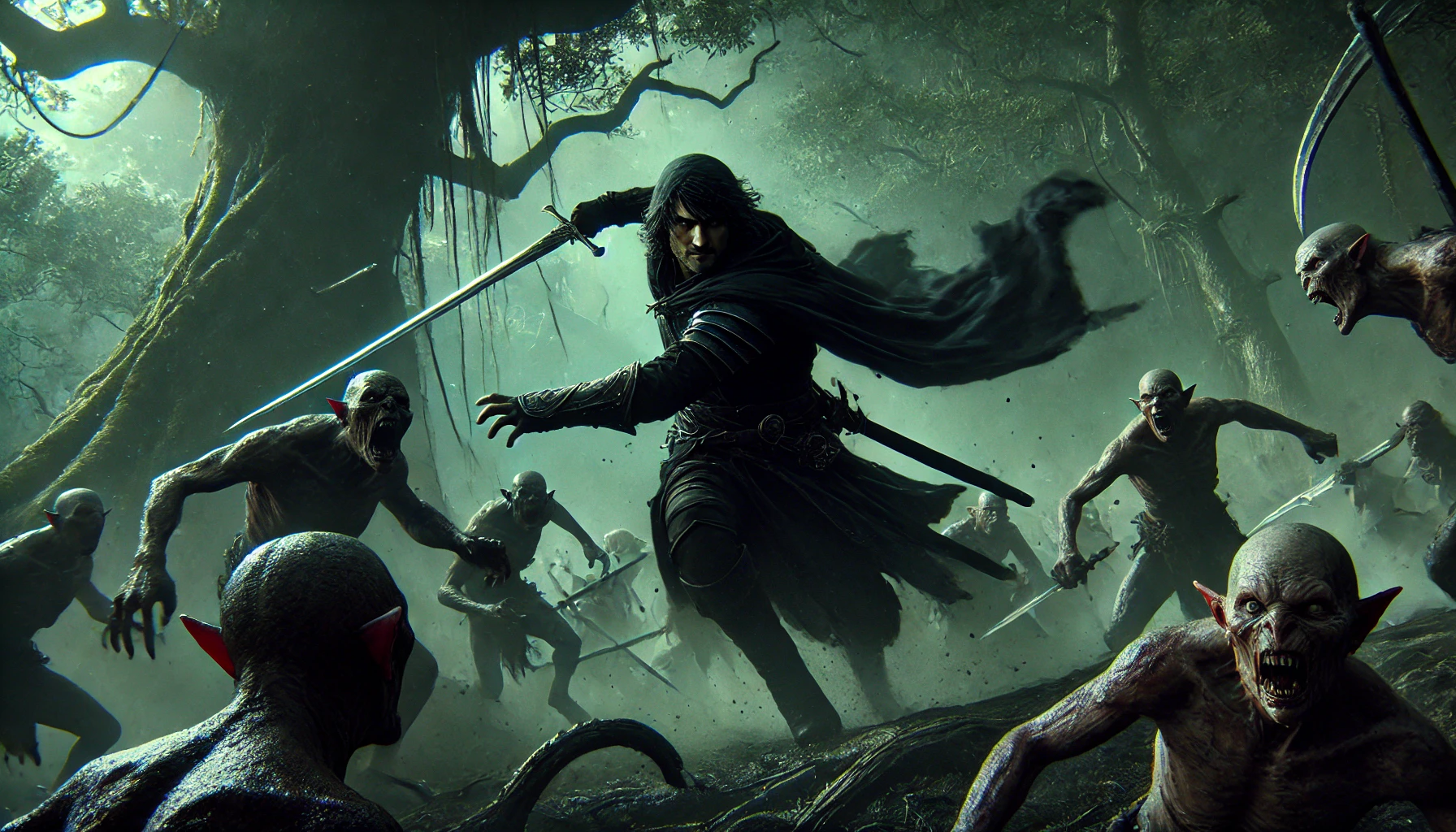
    The forest roared to life around them, the clash of steel and guttural cries of orcs shredding the quiet like an axe through bark. The orcs burst from the trees, their blackened blades glinting in the muted light. Haldir shouted, his sword flashing as he stepped forward to meet the charge. “Ambush!” Haldir’s voice rang clear over the chaos, sharp and commanding. Haldir’s blade flashed like a shard of sunlight through the canopy as he drove it deep into an orc’s chest, twisting before yanking it free. Blood spattered across his tabard, but he didn’t flinch. He turned, already striking again, his movements forming a deadly rhythm. Gamil roared in response, raising his shield just in time to deflect the downward swing of an axe.

    Thordur’s hand moved reflexively, drawing and releasing an arrow in a single fluid motion.
    The shaft struck true, burying itself deep in the throat of an orc mid-charge. It fell in a heap, but the shadows were alive with more. Behind him, Azrak’s voice rang out, high-pitched and panicked. “They’re everywhere!”

    Thordur spun to see the boy fending off a snarling orc, his sword trembling in his grasp. Another arrow left Thordur’s bow, striking the orc in the side and buying Azrak a moment to regain his footing. The squad formed a loose line, each man fighting desperately to hold back the overwhelming tide of enemies.
    But even as Thordur loosed arrow after arrow, his thoughts raced back to Ungoránë. Where had he gone? And why had he left without a word?

    To Thordur’s left, Gamil was a battering ram of flesh and steel. With a sickening thud, his shield cracked into the nearest orc, sending the creature sprawling backward into its kin. He stepped forward without hesitation, his sword cutting a clean arc through the air and biting into another enemy’s gut. The orc crumpled, and Gamil stepped into the space it left behind, planting his shield to block another attack.

    Azrak, standing just behind Gamil, was as pale as new snow. His knuckles whitened around the hilt of his blade as he swung it wildly, desperation edging every motion. One swing struck home, grazing an orc’s arm, but it wasn’t enough to slow the creature. Azrak stumbled back, his foot catching on a root, but Gamil shifted to cover him, his shield smashing into the snarling orc.

    “Azrak! Keep your footing, damn it!” Gamil barked, his tone more teacher than that of a commander.

    Thordur’s fingers found another arrow, and the motion, so practiced, felt reflexive. He nocked, aimed, and released, the string thrumming against his fingertips. The arrow struck an orc in the shoulder, staggering it just as it raised its blade toward Gamil’s unprotected flank.

    “Gamil, to your left!” Thordur called, already drawing another arrow. Gamil caught the warning in time, turning with a roar as his shield connected with the wounded orc’s chest. He shoved it backward, following up with a brutal stab that silenced its snarling cries.

    The orcs kept coming, pouring from the trees as if summoned by the forest. They were everywhere—jagged, blackened blades glinting in the dappled sunlight, teeth bared in feral grins. Thordur’s gaze darted across the chaos, his mind racing. For every orc they struck down, two more seemed to appear, their momentum pressing the squad tighter into the clearing.

    Haldir held the line with a precision that bordered on the impossible. Each swing of his sword was a study in efficiency, a deadly arc that found its mark without fail. But even he was tiring; the orcs sensed his slowing pace and pressed harder.

    “We’re not holding on much longer!” Thordur shouted, his voice cracking over the din. He loosed another arrow and another, his arm burning from the strain.

    Then, out of the corner of his eye, Thordur saw movement—fast, fluid, and unmistakable—Ungoránë.

    He emerged from the underbrush like a shadow slipping through cracks in the light, his dark cloak swirling around him. The longsword in his right hand gleamed faintly in the fractured sunlight, its edge already darkened with blood. In his left hand, a shorter blade moved like an extension of his arm, precise and unrelenting.

    Ungoránë struck without hesitation, driving the shortsword deep into the back of an orc that had turned to bark orders. The creature staggered forward, choking on its snarl, but Ungoránë didn’t wait for it to fall. He pivoted, his longsword slashing across the chest of another orc—not deep enough to kill, but enough to make the beast howl in pain and wheel toward him.

    Before the wounded orc could retaliate, Ungoránë ducked low, his shortsword slicing across the back of its knee. It crumpled with a guttural scream, clutching its ruined leg. The sound sent ripples of unease through the horde, their formation faltering as heads turned toward this new threat.

    Thordur’s breath caught as he loosed another arrow, his target falling with a wet thud. What in the name of the Valar is he doing back there? The thought was sharp and skeptical, but it was quickly swallowed by something closer to awe—or disbelief.

    Ungoránë moved with terrifying efficiency, his blades a blur of silver and red. An orc lunged at him with a jagged axe, but he stepped aside with an almost effortless fluidity. His longsword came up, the blade’s flat smashing into the side of the orc’s head, dazing it. As it staggered, he lifted the shortsword in a quick, brutal arc, severing its weapon arm at the elbow. The orc howled, clutching its stump, but Ungoránë was already moving, fading back into the chaos.

    The orcs hesitated, their guttural cries mingling with confusion as they turned to face this ghost. Ungoránë didn’t strike to kill every time. A slashed thigh here, a shattered shoulder there—enough to maim and make the creatures turn their attention to him and away from the squad. The calculated violence fractured their ranks, confusion rippling outward.

    Thordur saw the opening before anyone else. The orcs’ attention was now divided, their tight formation crumbling as they tried to deal with the squad and the phantom cutting through their rear.

    “Haldir!” Thordur shouted, his voice cutting through the chaos. “He’s breaking them!”

    Haldir’s sharp gaze flicked toward Ungoránë for the briefest moment, his lips curling into something like a grim smile. “Press forward! Now!”

    The rallying cry galvanized the squad. Gamil surged ahead with a roar, his shield smashing into the nearest orc like a battering ram. The impact sent the creature sprawling, and Gamil finished it with a swift thrust of his sword.

    Azrak, encouraged by the sudden shift in momentum, found his footing. His strikes, once wild and hesitant, became more deliberate. He parried an orc’s blade, twisting his weapon into an upward strike that sent the creature reeling.

    Thordur, his bowstring humming with tension, loosed another arrow, taking down an orc that had turned to flee. He glanced back at Ungoránë, now a whirlwind of steel and shadow. Ungoránë’s longsword came down in a powerful diagonal strike, biting deeply into the shoulder of the nearest orc. As the creature staggered backward, his grip on the weapon shifted seamlessly—one hand releasing to free his left arm. His shortsword darted forward in the same fluid motion, his movements precise and controlled. The blade slipped under the next orc’s guard, slicing across its exposed belly before it had time to react.

    The orcs panicked. They roared and snarled, but the confusion was palpable. Some tried to rally, barking guttural commands, but Ungoránë cut them down with cold precision before their voices could rise above the din. The tide was turning; the squad was pushing forward against the faltering enemy.

    For a moment, Thordur paused, his bow lowering slightly as he watched Ungoránë fight. Reckless. Insane. The thought came unbidden, but then another followed: effective. He’s giving us the chance to win.

    “Thordur!” Gamil’s voice snapped him back to the present. “Keep shooting, or I’ll use you as my shield!”

    Thordur smirked faintly, drawing another arrow. “Don’t get ahead of yourself, Gamil. I’d make a terrible shield.”

    As he loosed the arrow and it found its mark, he couldn’t help but glance back at Ungoránë, who seemed more shadow than man, his blades carving chaos into the orc’s ranks. For the first time, Thordur wondered if there might be more to this Shadow Wanderer than madness.

    Thordur caught sight of Ungoránë again, his movements more methodical than fluid, though no less effective. There was nothing surreal about the way he fought—not like a ghost, but like a man who had practiced each strike a thousand times. He darted between orcs, his cloak billowing as he moved, and his breath was visible in the cold air. His longsword came down hard, cleaving into an orc’s shoulder, enough force to make Ungoránë stumble slightly as he wrenched it free. His shortsword followed with a quick slash that caught another orc across the thigh, dropping it to one knee.

    Ungoránë adjusted his stance, shifting his weight as he sidestepped an incoming blow. His movements were no longer elegant but were grimly efficient. His breathing was ragged, and his strikes were precise yet deliberate, each a calculated risk.

    For a moment, their eyes met across the chaos. Ungoránë’s face was pale, smeared with dirt and blood; his expression was hard to read—focused, yes, but not detached. There was something raw there, something desperate.

    Then he was gone again, ducking behind the towering bulk of a fallen orc and out of sight, his dark cloak folding into the shadows.

    The squad pushed forward, their renewed assault forcing the remaining orcs into retreat. The snarls and guttural cries faded as the creatures fled into the trees, leaving the forest heavy with the stench of blood and sweat. Thordur lowered his bow, his hands trembling as he scanned the area.

    “Everyone accounted for?” Haldir’s voice cut through the stillness, rough yet steady.

    “Here,” Gamil grunted, leaning on his shield, a fresh cut streaking blood down his arm. Azrak raised his hand shakily, his sword still clutched in a white-knuckled grip. The rest of the squad called out, but Thordur’s gaze darted to the trees where he had last seen Ungoránë.

    He appeared moments later, stepping into the clearing with his weapons in hand. He didn’t look triumphant, only tired. His torn cloak billowed as his chest rose and fell while he surveyed the squad. Without a word, he cleaned his blades on the cloak of a fallen orc and sheathed them.

    The battle’s aftermath settled over the squad like a heavy fog. Orc bodies littered the ground, their black blood soaking into the forest floor. The squad was alive—battered and bloodied but alive. That alone should have been cause for relief. Yet, the tension remained, crackling in the air like an unseen storm.

    “Ungoránë!” Haldir’s voice sliced through the quiet, sharp, and commanding. The squad fell silent as the captain strode toward him, his expression a storm cloud of barely contained fury.

    Ungoránë crouched over a fallen orc, tugging a dagger free from its belt. He didn’t flinch at the sound of his name or stand. He simply wiped the blade clean on the orc’s tattered cloak, his movements methodical.

    “What the hell were you thinking?” Haldir demanded, coming to a stop just short of Ungoránë. His sword was still drawn, the blade glinting dully in the weak light. “You ran off. Disappeared. You don’t do that. Not here. Not ever.”

    Ungoránë stood slowly, his expression calm, almost detached. He met Haldir’s furious gaze with a quietness that only seemed to stoke the captain’s anger.

    “You put us all at risk,” Haldir continued, his voice rising. “We didn’t know where you were, what you were doing. I could have ordered a retreat; for all I knew, you were dead. And what for? So you could play the lone hero?”

    Ungoránë said nothing, his face a mask of indifference. The silence stretched thick and heavy until Haldir stepped closer, his voice dropping to a dangerous growl. “Do you even understand what you’ve done?”

    Ungoránë’s eyes flickered momentarily with something—perhaps guilt or something more profound, more challenging to name. But he didn’t defend himself. He didn’t argue or explain. He simply said, “I saw an opening.”

    “An opening?” Haldir echoed, incredulous. He threw up his hands. “An opening doesn’t mean you abandon the squad! You don’t get to make those decisions alone.”

    Still, Ungoránë didn’t reply. He stood there, silent and unyielding, his gray eyes fixed somewhere just past Haldir’s shoulder. It was as though the words were bouncing off him, unable to penetrate.

    Thordur watched from a few paces away, his chest still heaving from the fight. He couldn’t deny that Ungoránë’s actions had turned the tide. The orcs had been confused, faltering, their focus divided. The squad had taken full advantage of the chaos, cutting through the enemy and forcing their retreat. But that didn’t erase the recklessness of what Ungoránë had done. It didn’t make it right.

    He’s not a hero, Thordur thought, studying Ungoránë’s stoic face. He’s something else. But what?

    Haldir let out a sharp breath, shaking his head. “You’re lucky we came out of this alive,” he said, his voice quieter now but no less harsh. “Do that again, and you won’t be so lucky. None of us will.”

    With that, the captain turned away, barking orders to the rest of the squad to regroup and move out. Ungoránë remained where he was, his hands resting lightly at his sides, his shortsword and dagger still streaked with dark blood.

    Thordur hesitated, then stepped closer, lowering his voice so only Ungoránë could hear. “What were you thinking back there?”

    For a moment, Ungoránë didn’t respond. When he did, his voice was low, almost too quiet to hear. “I wasn’t.”

    Thordur frowned, unsure how to take that answer. It wasn’t defiance, nor was it regret. It was just a statement, plain and unadorned as if Ungoránë himself weren’t sure what had driven him.

    Thordur shook his head and stepped back, falling into line with the rest of the squad as they prepared to move. But his eyes lingered on Ungoránë, the question circling in his mind like a restless bird. Whatever had driven him into the fray wasn’t for glory or strategy; it was something else—something Thordur couldn’t quite put into words.

    And maybe that was what unsettled him most of all.

  • Night Raid

    The ridge overlooked the Easterling camp like the prow of a great ship suspended in the sea of night. Tents sprawled haphazardly, their canvas sides glowing faintly from the fires within, while the shadows of men moved between them, dark shapes against the amber light. The faint clink of metal on metal carried through the crisp air, accompanied by the soft crackle of distant flames. Overhead, the stars were sharp pinpricks in a sky so clear that it felt as if it could shatter under the weight of silence.

    Captain Hadron’s voice was calm yet firm, allowing no protest. “The officers’ deaths will hinder their advance. The horses will slow them down. Fail, and Osgiliath may fall.” Hadron had ruthlessly chosen his men. Ungoránë didn’t flinch or protest when called. He crouched at the ridge, staring down at the camp with an expression as distant as the stars. Moonlight edged his sharp, pale face, but his gray eyes were shadowy pools.

    “As good as done,” Ungoránë said finally, the words sheared through the tension, sharp and unrelenting. His tone carried no trace of fear, no hesitation—just a quiet certainty, as though he had already made peace with the risk.

    Thordur wasn’t so composed. He straightened abruptly, his shoulders taut, and his hand twitched toward his quiver before stopping halfway. His mouth opened; a protest formed on his lips, but the weight of the captain’s gaze silenced him. He let out a quiet breath instead, shaking his head in frustration.

    “Madness,” he muttered under his breath; the word was more for himself than for anyone else. His voice was low, but the bitterness in it was unmistakable. “The whole thing.”

    Hadron didn’t acknowledge him. His focus remained on Ungoránë, the unspoken understanding passing between them like the snap of a bowstring. Finally, he nodded, his voice dropping to a quieter, sharper tone. “Keep it quiet. No chainmail, no shine. Dark cloaks. In and out, no trail. We’ll wait here until you return.”

    Thordur gritted his teeth but nodded, his fingers brushing the fletching of his arrows in a habitual gesture that was more nervous than deliberate. The leather straps of his quiver creaked softly as he adjusted them, the only sound in the charged stillness. He turned toward Ungoránë, his eyes narrowing as he studied the other man.

    To Thordur, something was unnerving about Ungoránë’s calm. It wasn’t the steady confidence of an experienced soldier nor the numbness of fear tamped down too tightly. No, it was something else entirely—something darker. Ungoránë moved like a man who had already accepted the worst outcome, who carried it with him like a shadow—the kind of calmness that wasn’t born of courage but of resignation.

    Madness, Thordur thought again, this time letting the word settle, heavy and cold in his mind. Ungoránë had just been transferred to their squad, yet his composure in the face of danger was unsettling. He couldn’t decide whether Ungoránë’s composure made him braver or simply forsaken. Perhaps it was both.

    The two men exchanged no words as they stood, shrugging off their chainmail and rolling it quietly into the packs they left behind. The metallic weight was gone, leaving them lighter but more vulnerable. The dark cloaks they pulled on draped over them like shadows given form, blending them into the night as they moved toward the ridge’s edge. In the moonlight, Ungoránë’s gray eyes were devoid of reflection, as if they absorbed the light rather than reflected it. Thordur looked away quickly, disturbed by what he saw—or perhaps by what he didn’t.

    A gust of wind stirred the campfires below, sending sparks into the dark. To Thordur, it looked like a warning—one they would both ignore. The two descended into the darkness, leaving behind the ridge, the captain, and the rest of the squad to wait in the heavy silence of the cold night air.

    Stripped of their armor, Ungoránë and Thordur moved through the underbrush with the practiced silence of men who had too often crept where death lingered close.
    The night was thick around them, the cool air carrying the faint crackle of the enemy’s fires and the occasional burst of laughter or muttered conversation.
    Their cloaks clung to the dark like second shadows; the underbrush whispered and cracked beneath their boots, the sound quickly swallowed by the oppressive hush of the forest.

    A distant owl called, its cry slicing through the night. The forest seemed alive with whispers, then fell silent again. Thordur’s gut twisted. It was a silence that didn’t feel empty; it felt like it was waiting.

    Thordur’s gaze flicked toward Ungoránë as they moved closer to the ridge’s edge; his expression was masked, but his thoughts brimmed with doubt. Something was disquieting about the other man—how he moved as though danger didn’t quite touch him as if he had made peace with whatever might come. Ungoránë’s focus never wavered; his eyes were fixed on the flickering glow of the camp below, each movement precise and deliberate. Yet, to Thordur, that calm felt wrong, almost reckless, as though he had stepped into this mission not out of duty but for something far darker.

    The clink of chainmail echoed through the camp as guards moved in the firelight, accompanied by the aroma of spiced stew in the cool night air. Above, banners rippled in the breeze, their sigils illuminated by flickering flames like sentinels over the uneasy sprawl. Ungoránë stopped, his dark hair brushing against the cowl of his cloak as he surveyed the camp below, crouched at the camp’s edge, utterly still, his focus unshaken. His fingers rested lightly on the hilt of his shortsword, not gripping but ready, his posture loose and composed. It was a tranquility Thordur couldn’t trust, a composure that spoke of a man who had already seen the worst—and made peace with meeting it again. Thordur crouched beside him, his gaze scanning the scene with more tension than he cared to admit. Guards moved in lazy patterns around the fires, their movements growing looser with the lateness of the hour. The horses shifted restlessly in their pen, the occasional clatter of hooves blending with the low murmur of voices.

    Ungoránë broke the silence first, his voice a whisper but steady, like the words had already been decided long before. “I’ll handle the officers. You take the horses. We’ll meet back at the ridge.”

    The simplicity of the plan belied its dangers, but Ungoránë’s tone left no room for argument. Thordur felt his jaw tighten. “Try not to get yourself killed, eh? I’m not dragging your dead body back.”

    A flicker of something—amusement, maybe—passed across Ungoránë’s face, though it never reached his eyes. He didn’t answer. Instead, he rose in a smooth, silent motion, his cloak settling around him like the night itself. Within moments, he was gone, disappearing into the dark with an unnatural grace.

    Thordur let out a quiet breath, forcing himself to focus on his task. That man had something broken in him, he thought grimly, his eyes flicking toward the restless shapes of the horses. And if I’m not careful, it will shatter me too. Thordur’s jaw tightened as he watched Ungoránë vanish into the dark. That man was a puzzle he couldn’t solve—a soldier who fought as if he didn’t care whether he lived or died. And yet, wasn’t that the kind of man this war needed? The thought chilled him more than the night air.

    The camp’s stillness wrapped around Ungoránë like an additional layer. He navigated the darkness as if it were his natural habitat, each step purposeful, his breath unwavering despite the tension tightening in his chest. The air carried the combined scents of burning firewood, sweat, and a sour odor—likely remnants of poorly stored provisions. Each inhalation held a subtle metallic taste as if the ground itself breathed decay. Ahead, the central tent stood like a looming shadow, towering over the others, its boundaries dimly illuminated by flickering firelight. Two spears guarded its entrance, their polished tips shimmering softly—a quiet warning to anyone daring to enter uninvited.

    Crude banners hung limp in the still air, their crimson sigils of a jagged sun half-obscured by ash and soot. Around the central tent, small altars held offerings—shards of obsidian, charred bones, and bowls of blackened earth.

    Ungoránë paused at the tent’s edge, his fingers brushing the short sword’s hilt at his side; the low murmur of voices filtered through the heavy canvas, the tone of men lost in strategy. He closed his eyes briefly, drawing in a slow breath. His pulse was steady now, and each beat measured like a countdown to an inevitable end.

    He slipped to the side of the tent, crouching low. The soft earth beneath him muffled his footsteps, but his ears were attuned to every rustle, creak of leather, and clink of metal in the distance. He drew a throwing knife from his belt, testing its balance in his palm. The blade felt cold and reassuring, as if it were an extension of him.

    They won’t hear it coming, he thought. The realization was as cold as the steel in his hand.

    With the knife in one hand, he drew the edge of the blade across the canvas, slicing a small, clean slit. The faint glow of a lantern spilled out, and Ungoránë pressed his eye to the opening.

    Inside, two men sat hunched over a low table. The older officer’s face was a study in stone, his gray hair cropped close, and his armor polished yet plain. His younger counterpart leaned forward, gesturing animatedly at a map between them. His features were sharp, and his armor was more ornate—a man who likely believed his position made him untouchable.

    Ungoránë’s gaze flicked over their helmets resting on the table, then back to their weapons—a sword leaning against the table leg and a dagger on the younger man’s belt. Neither was within easy reach. Ungoránë’s lips pressed into a thin line. Good. That gives me the edge.

    The older officer grunted something, leaning back slightly, his hand reaching for the mug at his side. The younger man’s voice rose, excitement tinging his words. Ungoránë didn’t understand their language, but their postures spoke volumes. The younger officer pitched a plan, his arrogance evident even in the tilt of his head.

    It was the opening Ungoránë needed.

    The knife left Ungoránë’s hand with the calm precision of a craftsman laying a chisel to wood. It spun once, a brief glint of inevitability, before finding its mark in the soft hollow of the younger officer’s throat. There was a moment—brief as a held breath—when the world seemed to pause. Then the man jerked, his eyes wide and wild, and his hands clawed uselessly at the hilt as though he could pull back what had already been claimed. Blood welled dark and heavy, spilling over his collar, soaking his tunic, and dripping onto the map splayed beneath him. It spread like a spilled secret, staining everything it touched.

    He gurgled, the sound wet and desperate, his life fleeing in uneven bursts as it frothed at his lips. His knees buckled, and he fell forward, the table shuddering under his weight. The map crumpled beneath him, the ink from his blood soaking through its careful lines and borders.

    The older officer moved in an instant, a shout of fury tearing from his throat. His chair clattered backward, its legs tangled in the edge of the rug, but his movements were sure and practiced. His hand found his sword with the ease of long familiarity; the blade rasped free in a single motion, its edge flashing like a promise.

    Ungoránë stepped into the dim light, his expression unreadable, his movements fluid as a shadow slipping through cracks in stone. The officer’s blade cut through the air, a wide, brutal arc aimed at cleaving Ungoránë where he stood. He did not flinch. Instead, he moved—low and quick, the swing slicing through the space he’d just abandoned, the blade hissing its frustration past the nape of his neck.

    He surged forward, his short sword rising in a motion so deliberate it felt inevitable. The strike was not wild or dramatic, but measured, finding the vulnerable gap beneath the officer’s ribs. The blade bit deep, sliding through padded layers and into flesh. The officer’s breath hitched, a sharp intake that was more shock than pain. His free hand grabbed Ungoránë’s arm, the grip iron-strong for an instant before faltering, strength spilling away with the blood pooling at their feet.

    Ungoránë’s gaze didn’t waver. His face betrayed nothing as he twisted the blade with cold precision. The sound that followed was thick and wet, a grotesque harmony of torn sinew and steel scraping against bone. The officer’s knees buckled, his sword clattering to the floor, and Ungoránë pressed forward, controlling the collapse as if guiding the fall of a felled tree. He lowered the man to the ground, his motions devoid of ceremony or hesitation.

    The officer’s breaths grew shallow, each one a rasping whisper. His eyes fluttered, unfocused; his lips formed soundless words. Then, like a candle extinguished by a sudden wind, he stilled. Ungoránë lingered only long enough to yank his blade free. The motion was practiced; the blood slicking the steel was no more significant than rain on stone. He wiped it clean on the officer’s cloak, his hands moving with mechanical efficiency, and his eyes were already scanning the tent.

    The younger officer lay motionless where he’d fallen, blood pooling around him in still, quiet testimony. The knife jutted from his throat, its hilt glinting faintly in the low light. Ungoránë spared it a glance before turning his attention outward, his ears straining against the silence for any hint of voices or hurried footsteps.

    But there was nothing. Only the soft drip of blood and the faint, steady creak of the canvas in the wind.

    For a moment, he stood there, his breaths shallow but steady, the rhythm of exertion betrayed only by the faint tremor in his chest. The world had narrowed to this—a single purpose, sharp and focused. He was no more than a tool in this moment; tools did not dwell, think, or feel; they acted.

    Satisfied by the silence, Ungoránë slid his sword back into its sheath, the motion quiet and sure, as natural as a sigh. Without a backward glance at the bloodied map or the crumpled bodies, he slipped into the night, the shadows swallowing him whole.

    Small altars of dark stone scattered around the central tent held offerings—bowls of ash, shards of obsidian, and the skeletal remains of birds arranged in precise patterns. The faint scent of incense clung to the air, acrid and unsettling.

    Ungoránë rose, retrieving the throwing knife with a sharp tug. The blade came free with a sickening wet noise, and he wiped it clean with the same methodical efficiency. His eyes lingered on the blood pooling beneath the map. For a moment, he saw another battlefield, another death—one he couldn’t prevent. He blinked, and the memory was gone, swallowed by the numb reality of the present.

    The entire encounter was over in less than a minute.

    One minute to unmake their plans, he thought, glancing at the blood-soaked map—one minute to turn their order into chaos.

    He slipped out of the tent stealthily; the darkness swallowed him once more. Behind him, the lantern’s glow flickered over the two lifeless figures, casting long, jagged shadows that stretched like fingers reaching for a war they would no longer fight.

    Thordur moved through the night with far less ease than Ungoránë. His steps felt loud despite his effort to keep them quiet, and every faint ripple of motion was amplified in the silence. The horses were already restless, their hooves shifting against the hard-packed earth, with the occasional snort or heavy exhale breaking the quiet. The enclosure loomed ahead, its wooden rails silhouetted faintly against the pale moonlight.

    A grizzled warrior crouched by the fire, his fingers methodically braiding a length of horsehair into a cord. Lines and scars marked his face; his gaze drifted distantly as if he had endured too many nights like this one.

    His heart pounded as he crouched near the pen, and his grip tightened on the knife. The ropes securing the enclosure were thick and coarse, fraying in some places from wear. Thordur set to work, sawing carefully to avoid the telltale snap that could give him away.

    The ropes were frayed and stiff, their fibers catching against Thordur’s fingers as he worked. The odor of the day gone by, combined with horse manure, hung heavy in the air. Every snap of a rope strand cracked like thunder in the quiet night.

    Calm. Just keep calm, Thordur told himself, his eyes flicking up to the camp. A guard stood not far off, his silhouette sharp against the faint glow of a distant fire. The Easterling’s back was turned, but his stance was still alert, like a predator poised for movement. He swallowed hard and continued cutting.

    The rope began to fray, each fiber snapping with a faint crackle that seemed far louder than it was. Thordur froze, holding his breath as the guard shifted slightly, tilting his head toward the noise. His hand hovered near his bow, muscles tense. But the guard turned back, apparently dismissing the sound. Thordur let out a slow, measured breath and returned to his task.

    The final rope gave way, sagging with a soft groan. The horses stirred, their movements causing the rails to creak. Thordur reached out, his palm brushing against the flank of the nearest horse. The animal snorted, its muscles trembling, but it didn’t bolt.

    “Easy,” he whispered, his voice barely audible. The horse settled slightly, its ears twitching.

    Thordur stepped toward the gate, his knife ready to cut the last binding. As he reached for it, he saw movement out of the corner of his eye. The guard had turned again, his gaze sweeping the enclosure. This time, his posture stiffened, and his hand moved to the hilt of his sword.

    Damn it. Thordur froze, his mind racing. The shadows might conceal him, but the guard edged nearer, slow and deliberate. Thordur’s pulse pounded as he calculated his next move.

    The guard was only a few paces away when Thordur’s instincts took over. With practiced precision, he drew his bow and nocked an arrow in one fluid motion. The string thrummed as he released it, the arrow slicing through the air with deadly accuracy. It struck the guard in the throat, the impact muffled but unmistakable. The man staggered, his hand clawing at the shaft as he crumpled to the ground, his sword clattering dully against the earth.

    The sound startled the horses. One reared, its hooves striking the rail with a sharp crack. The others followed, and the pen erupted into chaos as the animals whinnied and shifted in panic. Thordur cursed under his breath and grabbed the gate, throwing it wide.

    “Go!” he hissed, slapping the nearest horse on its flank. The animal bolted, and the rest followed, spilling out of the pen in a frenzied mass of hooves and muscle. The ground seemed to shake beneath them as they charged into the camp, overturning tents and scattering supplies.

    The chaos spread like wildfire. Shouts erupted as Easterling soldiers scrambled to regain control, their orders lost in the clamor. Thordur didn’t wait to see the results. He turned and sprinted toward the ridge, his breath coming in ragged gasps. The upheaval of hoofbeats and panicked cries followed him, blending with the pounding of his own heart.

    As he climbed, he glanced back once. The camp was in disarray: tents collapsed, soldiers darted through the chaos, some trying to corral the fleeing horses, while others simply avoided being trampled. He allowed himself a grim smile, though it faded quickly as the weight of what he had just done settled over him.

    One step closer to surviving this damn war, he thought, pushing himself harder toward the ridge’s safety.

    Ungoránë stood at the rendezvous point, his figure barely discernible against the dense shadows of the ridge. His cloak, darkened with blood, clung to his frame in the damp night air. He was still as a stone, his gray eyes scanning the darkness below, where the Easterling camp remained chaotic. The faint shouts of soldiers and the distant thunder of hooves rose softly over the trees, carrying on the night wind like a warning that the work was not yet done.

    When Thordur emerged from the trees, his steps heavy and uneven, Ungoránë turned to regard him. Sweat and dirt streaked Thordur’s pale face as he gasped for air, his breaths short and ragged, as if he had run a mile uphill.

    “Any trouble?” Ungoránë’s voice was neutral, his tone unbothered, as though they were discussing the weather. The dark stains on Ungoránë’s cloak seemed to ripple like shadows alive, and Thordur wondered how much of it was from tonight—and how much was older, soaked into the fabric over time.

    Thordur stopped a few paces away, his chest still heaving. He glared at Ungoránë, gesturing sharply to the dark stains on the other man’s cloak. “What do you think?” he snapped. “And what about you? Did you fight the whole camp yourself?”

    There was silence between them for a moment, broken only by the rustling of leaves and the distant echo of a startled horse’s cry. Ungoránë tilted his head slightly as if considering the question. The corners of his mouth twitched in what might have been a smile, though it carried no warmth.

    “Only the ones who mattered,” he replied simply.

    Thordur shook his head, frustration tightening his jaw. “You’re reckless,” he said, his voice low but sharp. “You know that, right? Walking into their tent like you’ve got nothing to lose. You could have gotten us both killed.”

    At that, Ungoránë’s expression shifted. The faint smirk faded, replaced by something colder and heavier. His gaze turned distant; his gray eyes were shadowed by thoughts that Thordur couldn’t read but could feel pressing between them.

    “Maybe I don’t,” Ungoránë said softly, his voice carrying an edge that wasn’t anger but something much sharper.

    The words hung in the air, heavy as a stone. Thordur stared at him, his irritation giving way to unease. He opened his mouth, then closed it again, unsure of what to say. At that moment, he saw something in Ungoránë that unsettled him—not the calculated, quiet violence he’d witnessed tonight, but the emptiness that followed it. It was like staring into a deep well and realizing it had no bottom.

    Thordur threw up his hands, exasperation boiling over. “Fine. Be mysterious. Don’t expect me to feel sorry for you when your luck runs out.” Ungoránë’s smirk flickered to life, cold and fleeting. “I wouldn’t dream of it.” Finally, Thordur looked away, his shoulders sagging. “Let’s just get back,” he muttered, his voice quieter now. “I’ve had enough excitement for one night.”

    Ungoránë nodded, saying nothing as he turned toward the path leading back to their camp. They moved in silence, the broken remnants of the Easterling camp fading behind them. The forest swallowed them whole, its thick canopy blocking the moon’s pale light. Thordur glanced at Ungoránë more than once, watching how the man moved—fluid and deliberate, as though he were part of the shadows themselves.

    Thordur’s thoughts churned as he walked, his earlier frustration mingling with something he couldn’t quite name. Ungoránë was unlike anyone he’d ever met. He wasn’t fearless—no, there was something sharper than bravery in the way he carried himself. It was as if he courted death, daring it to come closer, almost inviting it.

    The kind of man you follow into danger, Thordur thought, or the kind you keep far away from.

    But tonight, Thordur had no choice. He had followed, and they had both survived. That, at least, was something.

    Thordur took one last glance at Ungoránë, a sense of unease pulling at him like the unyielding flow of the Anduin that he couldn’t escape. The campfires glowed faintly ahead, but behind them lay chaos and blood. Maybe that’s all survival is; he thought—just one man’s madness pulling another through the dark.

    “I don’t know what to make of you,” Thordur murmured, almost to himself.

    Ungoránë didn’t respond. If he’d heard the words, he gave no indication. His gaze was fixed ahead, his steps steady, and his bloody cloak blended into the night as though he’d been born of it.