Author: Ungoránë

  • The Cost of Command

    The ruined plaza had been a trap, but none of them had seen it in time. The signs had been there—the unnatural silence, the way the shadows clung too tightly to the cracks and corners of the crumbling stone—but the weight of exhaustion had dulled their instincts. The forest trail leading to the plaza had felt wrong from the beginning. No birdsong graced the canopy; even the wind seemed to hesitate, caught in the same stillness that gripped them all. Only the scrape of boots on ancient paving stones broke the stillness, each sound lingering in the air for a moment too long.
    Ungoránë sensed it- the creeping wrongness that prickled at the back of his neck. The light filtered strangely through the twisted branches, creating shadows that seemed to breathe. Moss-covered Gondorian stonework peeked through the forest floor like the bones of something long buried, remnants of roads and culverts now overtaken by Ithilien’s relentless growth. He exchanged a brief glance with Thordur, recognizing his own unease mirrored in his friend’s eyes, but neither spoke. What was there to say? They were committed now, tasked with escorting the scouts to survey the ruined outpost.
    Their bones still ached from the battle at Morgulduin Bridge just three days ago. Ungoránë’s shoulder burned where an enemy blade had grazed him, and Thordur slightly favored his left leg—remnants of wounds that hadn’t yet healed. What should have been a simple reconnaissance mission after their hard-won victory had turned into something far more treacherous. Hadron had assured them it would be safe ground—”Just a sweep and survey, nothing more.” But in these darkening days, nowhere in Ithilien was truly safe.
    Durathon had taken point, with Tarthorn ready at his side, the warhammer’s head gleaming dully in the filtered light. The big man moved surprisingly quietly for his size, scanning the undergrowth with the wariness of a predator aware that larger hunters were nearby. Behind him, Elaran drifted like a shadow among the trees, pausing occasionally to survey the ridgeline above. His keen eyes missed nothing, but his expression revealed no concern—only the same measured calculation that characterized everything he did.
    Perhaps if they had not been so weary from the battle at Morgulduin Bridge, they might have heeded the warnings. Perhaps if the scouts had not been so inexperienced and eager to prove themselves, they might have approached with greater caution. Yet exhaustion and inexperience were as lethal as any enemy blade, and when the Southrons surged from the hidden tunnels, it seemed as if the earth itself had opened its jaws to swallow them whole.
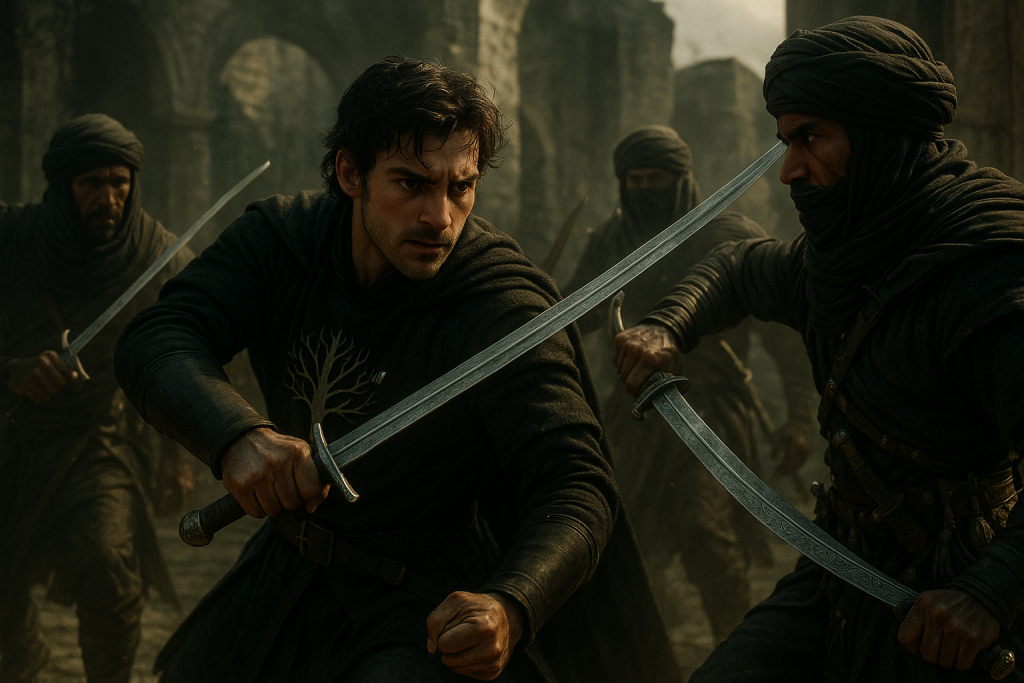
    They surged like a flood, spilling from the ruins in a torrent of steel and fury. The air filled with the guttural roars of battle cries and the rhythmic drumbeat of boots on stone. The dry, cracked plaza beneath their boots became slick with blood as the first strikes fell, dark stains spreading like an infection across the fractured ground.
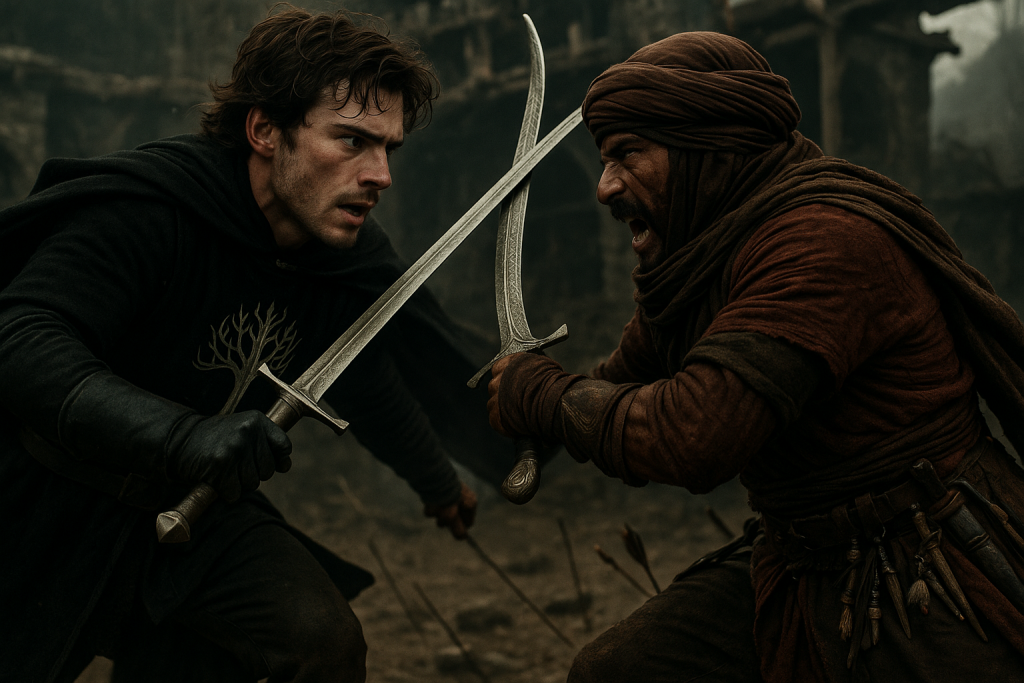
    The first Southron emerged from a crack in the stone barely wide enough for a man, his curved blade already in mid-swing. Durathon reacted with remarkable speed for someone of his size. Tarthorn whistled through the air, the hammer’s brutal arc catching the man squarely in the chest. The impact produced a sickening crack as ribs collapsed inward, the force of the blow lifting the Southron off his feet and throwing him back into two of his comrades as they clambered from the hidden passage.
    “Tunnel breach!” Durathon roared, already pivoting to meet three more warriors who scrambled up from the stone like ants from a disturbed hill. He planted his feet wide, Tarthorn whirling in a controlled figure-eight pattern that forced the attackers to yield. A Southron lunged with a spear, seeking the gap in Durathon’s defense. The big man twisted, catching the spear shaft with Tarthorn’s haft, then stepped in and drove the butt of his weapon up under the man’s chin. Bone shattered, blood sprayed, and the Southron dropped without a sound.
    From his vantage point on a half-crumbled wall, Elaran’s first arrow struck a Southron through the throat before most of the squad had even registered the attack. His second found the eye-slit of another’s helm, a shot so precise it seemed impossible. His movements were economical, almost mechanical—draw, aim, release, reach for the next arrow—each motion flowing seamlessly into the next with fluid grace. When three Southrons attempted to flank around Gamil’s position, Elaran’s next three arrows punched through flesh and bone, each shot landing with ruthless, unerring force that left the enemy crumpled before they could scream.
    “Second wave incoming, eastern approach,” he called, his voice steady despite the chaos unfolding below. “Seventeen hostiles. No, nineteen.” He sighed and loosed another arrow, the shaft embedding itself in a Southron’s throat with such force that it pinned the man to a wooden beam behind him. “Eighteen.”
    Smoke curled into the air, acrid and sharp, mingling with the coppery tang of spilled blood. The stench of death clung to everything, enveloping them like a shroud.
    “Move, now!” Hadron’s voice cut through the chaos, hoarse and commanding, with desperation sharpening each word. His blade flashed as he turned to deflect an incoming blow, sparks flying as steel scraped against steel. His shout rose above the cacophony, slicing through the din like a lifeline thrown to drowning men.
    The Gondorian scouts they had been escorting stumbled toward the narrow archway that marked their only chance of escape. Their faces were pale, their steps uneven, as though the sheer weight of terror had drained the strength from their legs. They were raw recruits, boys playing at war until it became real, and the brutal reality of it was written in the tremble of their hands and the wide, uncomprehending terror in their eyes.
    The squad formed a line, a desperate wall of flesh and steel against the onslaught. Gamil stood at the center, shield raised to catch the brunt of the Southrons’ advance. Each blow that struck his shield echoed like a hammer against an anvil, the force reverberating through his body. His face was a mask of sweat and grime, teeth bared in a snarl as he braced for the next impact.
    To his left, Thordur’s bow sang a deadly melody, each arrow loosed with precision, finding throats and hearts even amidst the chaos. Behind them, Azrak held the rear, his shield already splintered, his sword trembling in his grip.
    On Gamil’s right flank, Durathon planted his feet, his massive frame like a mountain of flesh and steel. His warhammer, Tarthorn, rose and fell in brutal arcs, each swing ending with the sickening crunch of bone or the piercing shriek of rent metal. While Gamil deflected and endured, Durathon smashed through, creating space with pure destructive force. His eyes were cold beneath his helm, and his breathing was measured and controlled despite the violence of his movements.
    “Left side coming apart!” Durathon bellowed, his voice carrying over the din as he spotted a new wave of enemies breaking through the left section of the plaza. He shifted his grip on Tarthorn, the weapon’s weight feeling negligible in his massive hands.
    From a half-crumbled section of wall behind them, Elaran’s arrows whistled through the air with deadly precision. Unlike Thordur’s rapid volleys, each of Elaran’s shots was patient and precise, slipping through seams in the armor as if he’d measured the gaps by hand—no rush, no waste, just the quiet certainty of a man who knew exactly where to kill. A Southron fell with an arrow through the eye-slit of his helm—an impossible shot for most, yet merely routine for Elaran. His lean form remained nearly motionless except for the fluid draw and release of his bow, positioned to provide him with the widest field of view.
    “Throat exposed at your three, Durathon,” he called out, his voice quiet but somehow carrying through the chaos. Durathon pivoted without looking, Tarthorn swinging in a precise arc that caught an advancing Southron just beneath his helm. The coordination between them spoke of a growing trust on the battlefield, each man complementing the other’s strengths.
    It wasn’t enough.
    The Southrons emerged from two directions: one wave pressed hard against their line while another poured from a concealed passage to the left. They moved with terrible, disciplined fury, their curved blades glinting in the dim light and their faces painted with blood and war markings. For every enemy that fell, two more seemed to take their place, their bodies littering the plaza like discarded kindling.
    “They’ll overrun us!” Gamil’s voice rose above the clash of steel and the guttural cries of battle- raw and desperate. His shield shuddered violently; each blow from the Southrons’ scimitars threatened to crack its battered surface. Sweat dripped from his brow, carving tracks through the grime that covered his face. His stance was a testament to pure determination, his legs braced wide as he absorbed strike after brutal strike. Yet, even his resilience had its limits. The shield splintered, cracks spreading like spiderwebs with every hammering blow.
    Ungoránë’s gaze darted across the battlefield, his mind racing as he tried to make sense of the chaos. The Southrons were everywhere, a tide of bodies pressing in from two sides. The bulk of them hammered at the front line, their savage strikes chipping away at Gondorian shields and armor like a relentless battering ram. On the left, more Southrons poured through a hidden passage, their sudden appearance cutting off any chance of retreat.
    His breath hitched as the realization sank into him like a dagger. They were not only outnumbered; they were trapped. The enemy had set the stage perfectly, transforming the ruined plaza into a killing ground with their ambush. Every step they took, every move they made, felt like sinking deeper into quicksand.
    And then his eyes found it. The tower.
    The tower loomed over the battlefield like a wounded beast, its cracked foundation groaning under the weight of decades. It leaned with agonizing deliberation, as if deciding whether to fall. The jagged stones at its base were splintered and loose, with fissures running like veins up its weathered frame. Dust drifted from its edges with every tremor of battle nearby, each grain a warning of its imminent collapse.
    Beneath the tower, Ungoránë caught the faint, sour smell rising from cracks in the plaza stones—an unnatural staleness that hinted at hidden spaces below. Now he understood. The Southrons weren’t just attacking from the visible approaches; they were emerging from ancient Gondorian tunnels beneath the plaza itself, from cisterns and storage chambers dating back to a time when this outpost stood proud against the shadow in the East. The ingenuity of it filled him with cold dread. They hadn’t stumbled into an ambush; they had walked into a carefully laid trap, with the tunnels serving as both a hidden approach and an escape route for the enemy.
    Ungoránë’s eyes traced the tower’s unsteady lines, his stomach twisting. It wasn’t just a structure anymore—it was a gamble, a lifeline wrapped in a death sentence. If the tower fell, it would block the narrow passage where the Southrons’ reinforcements were pouring through, cutting off their endless tide. But stone didn’t fall on its own. Someone would have to make the climb, drive steel into its fragile supports, and stay long enough to ensure it crumbled. There was no coming back from that.
    The realization settled in his chest like ice. Someone would have to die so the rest might live. In that moment, the weight of his sergeant’s rank pressed down on him, heavier than any armor. Abrazân had never spoken of this aspect; perhaps he didn’t understand it. The cruel arithmetic of command, where each man’s death incurred a cost and every decision was paid in blood.
    Hadron’s voice sliced through the din like a blade. “We need that tower down, Ungoránë.”
    The words weighed as heavily as the stones themselves. Hadron’s face was a study in grim resolve, his eyes fixed on the tower as if willing it to collapse through sheer force of will. There was no hesitation in his tone, no room for debate. This was not a suggestion or a plea—it was an order forged from the cold necessities of war.
    Ungoránë felt the battlefield narrowing around him, the sound dulling into a distant roar. Time seemed to slow, and each heartbeat stretched into eternity as he assessed their dwindling options. A part of him wanted to laugh at the cruel simplicity of it all—they needed the tower down, and someone would have to climb it, knowing they would never return. The question wasn’t if, but who.
    Ungoránë’s gaze flicked to the squad, and what he saw felt like a knife twisting in his gut. Thordur and Gamil stood shoulder to shoulder, their movements a brutal dance of survival. Gamil’s shield, battered and cracked, bore the scars of countless strikes, yet it still held, deflecting the relentless onslaught. His blade flashed in short, savage arcs, each swing aimed with grim precision. Beside him, Thordur fought with feral intensity, his dagger darting like a snake, seeking every unguarded gap in the enemy’s armor. The two moved with the practiced synchronization of men who had shared too many battles, their backs brushing against one another as they fended off the tide.
    Durathon had carved out a grim space around himself, Tarthorn’s bloody arc keeping the Southrons at bay through sheer brutality. But even his mighty swings were slowing, his breaths coming harder. A Southron blade had grazed his thigh, the dark stain spreading slowly across the thick wool of his breeches. He compensated by planting his wounded leg firmly, using it as a pivot point while his hammer continued its deadly work.
    “Can’t hold much longer!” he growled, not in fear but in cold assessment. His voice revealed no pain, only the tactical reality of their situation. Two Southrons attempted to rush him simultaneously, and he met them with a horizontal sweep that sent them both sprawling; however, the effort took a toll. His next swing came a fraction slower.
    Near the back, Elaran had abandoned his preferred perch as the Southrons closed in. His longbow was still in action, but he had been forced to shoot at near point-blank range, each arrow finding its mark with deadly precision before he was compelled to retreat another step. His quiver had grown perilously light, and his face showed the first hint of concern as he quickly glanced at his remaining arrows.
    “Eight left,” he called out, the first time uncertainty had crept into his voice. A Southron lunged at him, and in one fluid motion, Elaran nocked, drew, and released; the arrow punched through the man’s throat at such close range that blood spattered across Elaran’s cheek. “Seven,” he corrected, already backing toward their last line of defense.
    But even they were faltering. Sweat and blood streaked their faces, and their breaths came in ragged gasps. The Southrons pressed harder, their numbers seeming to multiply in the smoke-filled chaos. Each enemy cut down was replaced by two more, their cries a chilling crescendo that drowned out reason.
    At the rear, Azrak stood apart, his figure painfully out of place amid the carnage. His shield was little more than a splintered husk, dangling uselessly from his arm, and his sword trembled in his grip like a leaf caught in a gale. He wasn’t fighting—he was barely holding himself together. His wide, terrified eyes locked with Ungoránë’s for a brief, harrowing moment.
    He’s too young, Ungoránë thought, the words cold and unyielding in his mind. Too young, too green, too scared. He wasn’t ready for this, and he shouldn’t have been here. Yet here he was, thrown into the jaws of a war that devoured the unprepared without mercy.
    “Ungoránë!” Hadron’s voice pierced the din, sharp and commanding. It conveyed the weight of necessity, the kind of urgency that allowed for no doubt or hesitation. “The tower!”
    Ungoránë hesitated. The battlefield roared around him, a cacophony of death and desperation; yet in that moment, it felt as though the world had narrowed to a suffocating silence. His gaze darted among his men, and his mind was a frantic storm of possibilities and consequences.
    Thordur and Gamil were locked in the grim rhythm of survival. Thordur moved like water over stones, each strike of his blade or twang of his bow a calculated act of precision. Blood streaked his face, and his eyes burned with a focus that bordered on feral. Gamil, solid and unyielding, stood like a wall against the Southrons, his shield raised like a fortress gate. However, even fortresses can fall under enough pressure. Gamil’s shield was splintering, the cracks spreading like spiderwebs with every hammering blow. Thordur’s quiver was nearly empty, and his knife had become an extension of his bloodied hand.
    They couldn’t leave the line; they embodied the line.
    His eyes moved to Durathon, whose massive form was bleeding from more than just the thigh wound now. A fresh cut along his cheek dripped blood onto his already crimson-stained armor. The big man caught Ungoránë’s gaze for a moment, a flicker of understanding passing between them. Durathon gave a barely perceptible shake of his head—he knew what Ungoránë was thinking, and his response was clear: I can barely stand, let alone climb.
    Elaran had nearly backed against the wall now, his bow still singing but yielding diminishing returns. Six arrows left. Five. Each was precious and irreplaceable. His slender frame couldn’t push through the Southron line, even if Ungoránë ordered him to try. His arrows were needed here, supporting their increasingly desperate defense.
    Ungoránë’s gaze shifted to Azrak, who stood at the rear like a misplaced specter. The boy clutched the remnants of his shield as if it could still protect him, though it was barely more than a jagged piece of wood. His sword trembled in his hand, the blade catching faint glimmers of light as it wavered. His face was pale, and his lips parted in shallow, ragged breaths. He resembled more a cornered animal than a soldier—a boy thrust into the maw of something far larger than himself.
    The memory of the Morgulduin bridge flashed unbidden through Ungoránë’s mind—how he had broken formation to save Azrak when the boy’s shield had shattered under a Southron’s blow. How the boy had looked at him afterward, eyes filled with gratitude and something like devotion, saying “You saved me, Ungoránë. I… I won’t forget that.” The irony of it tasted like ash in his mouth. He had saved Azrak only to send him to his death days later.
    Ungoránë’s mind churned, each choice surfacing then sinking like stones in a poisoned well. I could send Thordur. He’d be fast enough, precise enough, but we would lose his bow. Gamil? No. The line would collapse without him. His thoughts turned inward, a biting whisper of self-recrimination. I should go. I’m the sergeant now. I make the decisions.
    But another voice, colder and more unyielding, cut through his resolve. If you go, the line breaks. They all die. The truth of it settled in his chest like a stone, crushing and immovable.
    His eyes flicked back to Azrak. The boy’s terror was palpable, a living thing that clung to him like a shadow. He wasn’t ready. Ungoránë knew that. Azrak knew that. But readiness didn’t matter. Not here. Not now. The tower had to fall. Someone had to make it fall.
    And no one else was present.
    The decision fell like a guillotine.
    “Azrak!” Ungoránë’s voice ripped through the chaos, sharp and unyielding. The boy’s head snapped toward him, his wide eyes reflecting the horror of the moment.
    “What?” Azrak stammered, the single word quivering on his lips.
    “The tower!” Ungoránë barked, pointing toward the crumbling structure. His tone, edged with authority, conveyed a command that allowed for no argument.
    Azrak froze, caught between instinct and the crushing weight of the order. His mouth opened, but no words emerged. Ungoránë saw the war within him—fear battling duty, a boy’s heart struggling against a man’s responsibility.
    From the side, Elaran loosed another arrow, buying precious seconds. “Covering the east approach,” he called, his voice calm despite the dire circumstances.
    “Go!” Ungoránë roared, his voice cutting like a blade. He pointed again, his arm trembling with the force of his own resolve. “Now!”
    For a moment, the battlefield seemed to hold its breath. The cries of the Southrons faded, and the clash of steel softened. It was as if the world itself had paused to bear witness. Azrak’s fear was evident on his face, with every muscle in his body screaming to flee. But then his jaw set, and something else flickered in his eyes. It was not the absence of fear, but the presence of something greater—determination.
    The boy nodded once, a small but resolute movement. He turned and ran, his boots skidding on the blood-slick stone as he made his way toward the tower.
    “Durathon, cover his flank!” Ungoránë commanded. The big man pivoted instantly, Tarthorn sweeping a deadly arc that cleared a path for Azrak’s desperate sprint. Despite his wounds, Durathon’s hammer struck with renewed ferocity, as if the protection of the younger soldier had awakened a second wind.
    Durathon roared as he crushed a Southron’s helm, the sound more animal than human. “For him!” It wasn’t clear if he meant Azrak or some ghost from his past, but the effect was the same—Tarthorn moved with murderous efficiency, creating a momentary corridor through which the boy could pass.
    A Southron captain, his armor adorned with crude iron spikes and painted with crimson war marks, barked orders to his men. Five warriors broke from the main force, their curved blades gleaming as they moved to intercept Azrak. Durathon met them head-on, Tarthorn not swinging in controlled arcs but transforming into a whirlwind of devastating force. The first attacker’s breastplate buckled under the hammer’s impact, driving the breath from his lungs. The second raised his blade to parry, only to have Tarthorn’s edge knock the weapon aside with enough power to send him staggering.
    The captain himself engaged Durathon, his scimitar a blur of deadly precision that found a gap in the big man’s defense. Blood welled from a fresh cut along Durathon’s forearm, yet he seemed not to notice. He countered with a brutal overhead swing that the captain barely avoided, Tarthorn striking the stone with enough force to send chips flying. The impact staggered the Southron, throwing him off balance just long enough for Durathon to bring his weapon around in a savage backhand that connected with the man’s ribs. Even through the chaos, Ungoránë heard the crack of bone.
    Ungoránë watched as Azrak bolted toward the tower, each step carving deeper into his chest like the bite of a blade. His breath hitched, a guttural sound lost in the chaos around him. He wanted to shout, to call the boy back, to undo what had just been set in motion. But it was too late. Azrak was already running toward what they both knew he wouldn’t return from.
    The Southrons noticed as well. Their shouts cut through the din, guttural and savage, as several of them broke away, their weapons gleaming with intent. Ungoránë surged forward, his sword already arcing toward the first of them. “Cover him!” he roared, the words raw and desperate.
    Thordur’s bow twanged, sharp as a whip crack. An arrow hissed past Ungoránë’s ear and buried itself in a Southron’s neck. The man gurgled, his scimitar falling from limp fingers as he crumpled to the blood-soaked ground. “I’ve got him!” Thordur shouted, already nocking another arrow. His face was streaked with blood and dirt, but his eyes burned with focused fury. “Keep moving, Azrak!”
    From his position, Elaran had the clearest shot at the Southrons pursuing Azrak. He abandoned his methodical approach and fired rapidly, each arrow still finding its mark despite the increased pace. A massive Southron wearing a hull-shaped helm charged toward Azrak, wielding a heavy maul that could crush the boy with a single blow. Elaran drew, aimed, and released in one fluid motion. The arrow struck the man’s knee at precisely the angle needed to sever the tendon beneath the joint of his armor. The Southron went down hard, his momentum carrying him forward into a tumbling slide across the blood-slick stones.
    With his quiver nearly empty, Elaran vaulted from his perch with unexpected athleticism, landing in a controlled roll and drawing his long knife in a single smooth motion. A Southron turned toward him, blade raised high, but Elaran was already inside the man’s guard. His knife flashed upward, finding the gap beneath the chin strap of the helm with surgical precision.
    “Out of arrows,” he called with clinical detachment, plunging into the fight with the same measured calculation that guided his archery.
    Gamil, locked in a brutal clash with an enemy twice his size, caught sight of the boy darting past. He slammed his shield into his attacker, the crunch of bone ringing out as the Southron staggered back. “Azrak!” he bellowed, his voice straining with something that wasn’t quite despair. “Don’t you stop, lad! Don’t you dare!”
    Azrak did not stop. He stumbled briefly, his foot catching on uneven stone, but quickly regained his balance. The tower loomed closer, its jagged edges clawing at the gray sky. Each step brought him nearer to the task that no one else could—or would—undertake.
    The tower groaned ominously as Azrak began his ascent. His hands gripped the crumbling stone, the rough edges biting into his palms and drawing blood. Dust stung his eyes, while gritty particles mixed with the sweat streaming down his face. His breath came in sharp, ragged bursts as every muscle in his body cried out, hoisting him higher.
    At the top, he turned, his figure stark against the swirling chaos below. For a moment, he hesitated, his wide eyes scanning the battlefield. They landed on Ungoránë, who was locked in a savage duel, his sword flashing like a beacon amidst the storm.
    “I didn’t let you down!” Azrak called, his voice cracking but resolute. He paused, then shouted again, louder, as if the words could carry him beyond the battlefield. “Tell them I mattered!”
    Ungoránë’s chest tightened; the boy’s words were a jagged blade twisting deep. He couldn’t reply- not with the Southron pressing him hard, their blades locked in a screeching bind. Yet the weight of Azrak’s plea settled on him, more crushing than any blow he’d ever taken.
    Elaran looked up from his own desperate combat, his face reflecting a flicker of emotion for the first time—recognition, perhaps, of the words’ significance. His knife moved like quicksilver as he fought his way closer to Ungoránë, providing cover while the sergeant battled through to a better position.
    “The boy has heart,” Durathon grunted, his voice carrying only to those nearest him. It was the closest thing to praise anyone had heard from the imposing warrior. Tarthorn rose and fell, each impact clearing space for his wounded comrades to maneuver.
    Azrak turned back to his task. His sword rose and fell with ferocity, striking at the weakened supports with every ounce of strength he could muster. Each swing reverberated through the stone, the cracks spreading wider and deeper, like veins under pressure. The tower groaned in protest, its structure shuddering with each strike.
    At the base, the Southrons swarmed, their weapons gleaming as they began to climb after him. One man reached for the first ledge, only to be met by a brutal arrow through his wrist, pinning him to the stone. Thordur let out a bark of triumph, but his quiver was nearly empty. “Move faster, Azrak!” he shouted, his voice edged with both urgency and fear.
    Durathon had forced his way to the tower’s base, his massive form creating a bulwark against the advancing Southrons. Despite the blood freely flowing from his wounds, he swung Tarthorn in sweeping arcs that cleared the lower levels. “Climb, boy!” he roared upward. “We’ll hold them back!” It was a lie—they couldn’t hold forever—but it was a necessary one.
    Elaran had joined him, his slender form a sharp contrast to Durathon’s bulk. Where the larger man crushed and battered, Elaran’s knife flashed with deadly precision, targeting the weak spots in enemy armor. Together, they formed a momentary barrier, buying Azrak precious seconds that felt like an eternity.
    Azrak didn’t need the encouragement. His breath came in heaving gasps now, and his arms trembled with the strain of each swing. His palms were slick with blood, the torn skin burning as he gripped the hilt of his sword. His boots slipped on the shifting stones, but he steadied himself; his resolve remained unyielding. The tower shuddered violently, and a groan like a dying beast echoed through the plaza.
    The supports buckled. Dust and debris rained down in thick clouds, choking the air and obscuring the battlefield below. Azrak’s movements remained steady; each strike was deliberate, and each blow stood as a testament to his will.
    The first Southron reached him, climbing through the chaos with a snarl. Azrak didn’t hesitate. He swung his sword one last time, the blade crunching through the man’s chest and sending him plummeting back to the ground.
    Then the tower collapsed.
    It came down with a deafening roar, the stones folding inward as though some great hand had crushed them. The sound drowned out the screams of the Southrons, the clash of blades, and even the shouts of his comrades. Azrak didn’t try to escape. He stood his ground, his sword still in his grip as the stones swallowed him whole.
    The passage was sealed, and the Southrons were cut off. The squad had their opportunity.
    “Fall back!” Hadron’s voice sliced through the aftermath, sharp and commanding. One by one, they withdrew, retreating from the crumbling plaza as the sounds of battle faded behind them.
    Durathon was the last to move, his massive frame silhouetted against the settling dust. His eyes lingered on the pile of rubble where the tower had stood and where Azrak now lay buried. Something passed across his face—not quite grief, but a recognition, as if he were witnessing something both terrible and worthy. He turned away, Tarthorn hanging heavily at his side.
    But for Ungoránë, the echoes of Azrak’s last words lingered: “Tell them I mattered.”
    That night, the camp lay cloaked in silence, a heavy, suffocating presence pressing down on every man like the weight of the dead. The air, though still, felt laden with unspoken grief, each breath thick and labored. Shadows flickered across weary faces around the small fire. The men moved sparingly, their exhaustion etched into their movements. No one spoke, but the absence of Azrak—young, wide-eyed Azrak—hung among them like a ghost.
    “Two scouts unaccounted for,” Hadron had reported earlier, his voice flat with forced detachment. “And the survey maps of the northern passes are gone. Three weeks of reconnaissance work lost.” The words settled like stones in Ungoránë’s gut. The missing scouts were almost certainly dead, and the partially completed maps—written in Gondorian cipher but still valuable—would ultimately yield their secrets to the enemy.
    Thordur sat on a jagged stone, his bow resting against his knees, his hands idle for once. He stared at the ground, his lips pressed into a thin line. Occasionally, his fingers brushed the edge of his tunic where Ungoránë knew he kept his lute wrapped in protective cloth—a gift from his father that he’d revealed to the squad only recently. The small wooden charm of a sailing ship that hung from the neck of the instrument had become a talisman for Thordur, a connection to the home and family he might never see again. Tonight, there would be no music. The weight of loss was too heavy for even that small comfort.
    Ungoránë found himself missing the soft melodies Thordur had begun playing during the quiet moments after the Morgulduin victory. That night, his music had drawn even the taciturn Durathon into their circle, the big man’s eyes closing briefly as if recalling something long lost. Now, that camaraderie, so recently forged, felt fragile in the wake of Azrak’s death.
    Thordur’s fingers began to move, almost unconsciously, tracing a melody in the air. A soft, halting hum escaped his lips—just a few notes before he stopped abruptly. His eyes lifted, suddenly bright with something dangerously close to tears.
    “He asked me to teach him that song,” Thordur said, his voice rough-edged. “Yesterday morning. Said he had a girl back home he wanted to impress.” He laughed, a broken sound that held no mirth. “I told him we’d start after this mission.” He fell silent then, his hands curling into fists, and said no more.
    Gamil, the shield-bearer, knelt a few paces away, his fingers brushing over the shattered remnants of Azrak’s shield that he had picked up from the battlefield. He held the splintered wood like a relic, his calloused thumb tracing the jagged edges with painful reverence. Suddenly, without warning, he slammed his palm against the trunk of a nearby tree, the impact splitting his skin. Blood welled between his fingers, but his expression didn’t change—just a brief fracture in his composure before he resumed his silent vigil over the broken shield.
    One of the remaining scouts murmured a soft prayer, the words barely audible over the crackling fire. The others did not join in, but their heads dipped slightly, their silence a solemn agreement. Each man was lost in his own storm, yet their grief was shared, a thread that bound them together even as it frayed.
    Durathon sat apart from the others, his massive frame hunched forward as he methodically cleaned Tarthorn. The warhammer’s head was caked with dried blood and fragments of bone, which he scraped away with practiced motions. His wounds had been hastily bandaged, dark stains seeping through the linen wrappings. He worked in complete silence, his face unreadable in the shifting firelight, but his hands moved with a gentleness that belied their size and the violence they had wrought.
    Nearby, Elaran knelt with his back against a tree, carefully inspecting the edge of his knife. Beside him lay a small bundle of straight branches he had gathered since making camp, along with a handful of feathers pulled from the lining of his cloak. With each slice of his blade, another crude arrow shaft took shape—far from the quality of his depleted quiver, but they would fly true enough at close range. His features were composed, almost serene, yet his eyes never settled, constantly scanning the darkness beyond their camp. When his gaze occasionally fell on the space where Azrak should have been, the slightest tightening around his mouth betrayed emotions that remained otherwise hidden.
    Ungoránë sat apart, as he often did, the sword resting across his knees. Its edge, dulled by the brutality of the day, caught the faint firelight; its flickering gleam served as a cruel reminder of its purpose. Dust and blood streaked its surface, marking a weapon that had performed its duty well. Too well, Ungoránë thought bitterly. He ran his thumb along the hilt, feeling the grooves smoothed by countless hands before his own.
    The fire’s warmth reached him, but it might as well have been a thousand miles away. The cold in his chest was deeper, heavier, and no flame could touch it. He stared into the embers, their glow pulling at his thoughts like a tide, drawing them to Azrak. The boy’s face rose unbidden—pale with fear, then set with grim determination as he climbed the tower. His voice echoed in Ungoránë’s mind, sharp and unrelenting: Tell them I mattered.
    The words dug into him, relentless. Did he matter? Ungoránë thought, his grip tightening around the sword’s hilt. Was one life enough to tip the scales? Could anything balance the weight of all those who had fallen?
    Hadron approached from the edge of the firelight, his steps deliberate yet quieter than usual. The captain’s shoulders seemed heavier than Ungoránë had ever seen; his armor was dull, marked by streaks of blood and soot. He crouched beside the fire, the flickering glow casting harsh lines across his weathered face. His gaze was steady, but something lingered behind it—something tired and worn, like a man who had carried too much for too long.
    “It had to be done, Ungoránë,” Hadron said after a moment, his voice low. There was no steel in it this time, only the weight of resignation. “You know that.”
    Ungoránë didn’t look at him. His jaw tightened, and his eyes were fixed on the fire as if the shifting embers might hold answers he couldn’t find. “He was a boy, Hadron,” he said, his voice flat but trembling at the edges.
    Hadron sighed, the sound heavy and drawn from somewhere deep within. He leaned forward, resting his forearms on his knees. “He was brave,” Hadron replied. His tone was steady, but his eyes betrayed him—a flicker of something raw, something he had buried too many times before. “He knew what was at stake. We all do.”
    From his position near the edge of the camp, Elaran’s voice carried softly through the night. “The young ones always pay.” The words were barely audible, spoken more to himself than to the others, but in the heavy silence, they seemed to pierce the darkness like arrows. He continued to inspect his knife, his face inscrutable, yet something in his tone suggested a personal knowledge of that loss.
    Durathon paused in his cleaning of Tarthorn, his massive shoulders tensing at Elaran’s words. For a moment, it seemed he might speak, but instead, he merely nodded once- a sharp, almost angry gesture of agreement- before returning to his task with even greater intensity.
    “He trusted me,” Ungoránë said, the words escaping with a harsh rasp. His throat tightened, each syllable dragging barbs against his chest. “I sent him to die.”
    Hadron didn’t flinch. Instead, he placed a hand on Ungoránë’s shoulder, his grip firm but gentle. “I’ve sent men to die too,” he said, his voice quieter now, almost a whisper. “Good men. Men who trusted me. It never gets easier. But it has to be done.”
    The fire crackled between them, filling the silence as Ungoránë struggled to find words that seemed to elude him. Hadron continued, his tone soft yet resolute. “Azrak saved us. He gave us this chance to breathe, to keep moving, to fight another day. Don’t let that be for nothing. Don’t let his sacrifice drown you.”
    Ungoránë nodded stiffly and reluctantly. Hadron lingered a moment longer, his hand offering a steadying presence before he rose to his feet and walked back into the shadows.
    Durathon watched Hadron leave, then set Tarthorn aside, the weapon now free of the residue of battle. He reached into a small pouch at his belt and withdrew a smooth stone, which he began to glide along the hammer’s edge with methodical strokes. The scraping sound cut through the silence, oddly comforting in its rhythm.
    “The boy showed courage,” he said without looking up, his voice low and graveled. “More than some veterans I’ve known.” Coming from Durathon, it was high praise indeed. “In Lossarnach, we remember our dead by their final act.” He paused, the whetstone momentarily still. “His final act was worthy of remembrance.”
    Elaran had finished his inspection and sat with his back against the tree, knife now sheathed. “It wasn’t just courage,” he added, his voice carrying the quiet authority of observation. “It was choice. When it mattered most, he chose.” He glanced toward Ungoránë, his gaze steady. “That’s why he asked you to tell them he mattered. Because he did.”
    Ungoránë’s gaze returned to the fire. The flames had burned lower, their light casting faint, wavering shapes against the darkness. His thoughts churned, chaotic and unrelenting.
    The camp was cloaked in a heavy silence, the kind that follows a day steeped in blood and death. Around the dying fire, the squad lay scattered like broken pieces of a once-whole thing. Men huddled in their cloaks, the faint rise and fall of their breathing the only sign that they still lived. The steep walls of the ravine rose around them, broken stone ridges and twisted vegetation looming jagged and unmoving, like sentinels witnessing their grief. A half-buried column base, a remnant of Gondor’s earlier presence, stood like a tombstone at the edge of their meager light.
    Ungoránë sat apart, his back against a low wall that had long since crumbled to half its height. The fire’s faint glow cast his face in half-light, its warmth a feeble balm against the chill creeping into his bones. Across his lap lay the sword, its weight as familiar now as it was alien. The blade was dull and nicked from the day’s fighting, its edge streaked with dried blood that caught the light like tarnished silver. He rested one hand on the hilt, the leather rough and worn under his palm, but he did not move.
    Azrak’s face loomed before him, stark against the haze of smoke and chaos. Ungoránë tried to blink it away, but the memory was sharper with his eyes closed—the boy’s wide, pale expression as he turned toward the tower, the tremor in his hands as he gripped his sword. Then, fear gave way to something else: the determination in his jaw, the unshakable resolve that compelled him to move toward his death.
    “He mattered,” Ungoránë whispered, his voice barely carrying over the faint crackle of the flames.
    The fire did not answer. It merely sputtered and popped, its light flickering faintly against the surrounding stones.
    But someone else did.
    “Of course he mattered,” came Elaran’s quiet voice from the darkness. The slender archer had moved silently, now sitting just within the circle of firelight. His face remained composed, but his eyes reflected the flames with unusual intensity. “Every choice matters. Especially the final ones.”
    Elaran shifted slightly, his movements precise even in rest. “My father once told me that there are three deaths,” he said, his voice measured and calm. “The first when the body fails. The second when you’re buried.” He paused, his fingers tracing a small pattern on the hilt of his knife. “The third is when your name is spoken for the last time.”
    He turned his gaze to Ungoránë, something almost gentle in his usually detached expression. “As long as we remember why Azrak climbed that tower, he’ll never face the third death.”
    Durathon stirred from his seat, his massive form rising with surprising grace despite his injuries. He moved to the fire and added a small piece of wood, causing the flames to lick upward with renewed vigor. The sudden flare of light caught the contours of his face, revealing a hardness that seemed carved from stone rather than flesh.
    “At home in Lossarnach,” he said, settling his bulk down closer to Ungoránë than he had ever sat before, “my people have a saying: ‘The strength of the hammer is measured by what it builds, not what it breaks.’” He gazed at his weapon, which now lay neatly beside him. “The boy built us a path out. With his own blood.”
    The words hung in the air, heavier than the silence they replaced. It was the most profound thing any of them had heard Durathon say, and it carried the weight of personal understanding. Ungoránë recalled the rumors about Durathon’s past—how he had survived an ambush that claimed his previous squad and how the scar on his arm came from that day. The burden of survival was something the big man understood intimately.
    Hadron emerged from the shadows, his steps heavy with exhaustion. He paused at the edge of the firelight before speaking for a moment.
    “I sent… others. Before him.” His voice wavered, exposing an unexpected crack in his commanding presence. “I remember each one.”
    He didn’t elaborate, but the weight of those unspoken names hung in the air between them. When he moved away again, his shoulders seemed to carry a burden that no armor could shield against.
    Ungoránë rose and took the shield fragment from Gamil’s hands. The other man relinquished it without protest, his split palm leaving a smear of blood on the splintered wood. Using the tip of his knife, Ungoránë began to etch Azrak’s name into the wood with care, each stroke deliberate and reverent.
    “What terrifies me,” he said as he worked, his voice barely above a whisper, “is that I’d make the same choice again. I’d send him to die again.” The admission felt like poison on his tongue, but it was true. “What kind of man does that make me?”
    Thordur, who had been silent since his broken confession, finally looked up. “It makes you a leader,” he said simply. “You carried the burden so the rest of us didn’t have to.”
    “I knew a commander once,” Durathon said, his voice rumbling low, “who never ordered a man to do what he wouldn’t do himself. We buried him in the first week.” His eyes met Ungoránë’s over the fire. “Leading means staying alive when others don’t. It’s the hardest part.”
    Ungoránë finished carving and stood up, moving to the edge of the camp. He gathered stones—not many, just enough to create a small cairn beside a twisted ash tree at the hollow’s edge. He placed the carved shield fragment on top of it, with Azrak’s name facing the sky. It wasn’t much, but it was something—a marker, a memory, a promise.
    When he returned to the fire from the hollow’s edge, one of the young scouts approached, water skin in hand. Their eyes met, and something hardened in the scout’s face. The boy deliberately turned away, leaving his water unfilled, and walked back to the far side of the camp. The silent accusation struck Ungoránë like a physical blow. He didn’t blame the boy; after all, two of his companions were dead, lost in the tunnels beneath the plaza.
    He didn’t cry. He just breathed slowly and raggedly, as if something were trying to crawl out of him and die at his feet.
    Ungoránë tightened his grip on the sword, the leather digging into his palm. The image of Azrak atop the crumbling tower resurfaced, vivid and inescapable. The boy stood his ground, his sword striking the stone with desperate, defiant purpose. His voice, steady despite the chaos, cut through the noise like a war horn’s cry.
    “You mattered, Azrak,” Ungoránë whispered, his voice barely audible and cracking beneath the immense weight of guilt. “You mattered. And I’ll carry this for you. For all of them.”
    He closed his eyes, letting the silence settle over him like a shroud. The fire burned lower, its light growing fainter as the night deepened. Around him, the camp remained still, the men lost in sleep or their own private grief. Yet, Ungoránë stayed awake, the sword an unyielding presence across his lap, reminding him of the burden he carried.
    When he finally opened his eyes, the fire had dwindled to little more than embers, its warmth nearly gone. He lifted his gaze to the stars once more, their light cold yet steady. They were so distant, untouched by the world below, yet they endured.
    For the first time that night, he drew strength from their steadiness.
    Always for them.
    In the darkness beyond the fading embers, Thordur moved silently to the small cairn. He knelt before the shield fragment bearing Azrak’s name, touching his fingers to the carved letters. From a small leather pouch at his belt, he withdrew a wooden carving he’d been working on since they left the battle—a small shield with a raised White Tree of Gondor etched into its surface, crafted from a piece of lebethron wood he had found in the forest. Its surface was polished smooth, with each detail rendered with the precision that marked his archery. He placed it beside the shield fragment, a craftsman’s tribute to a fallen comrade who had found his courage at the end, before returning to his place by the fire.
  • The Fight for the Bridge

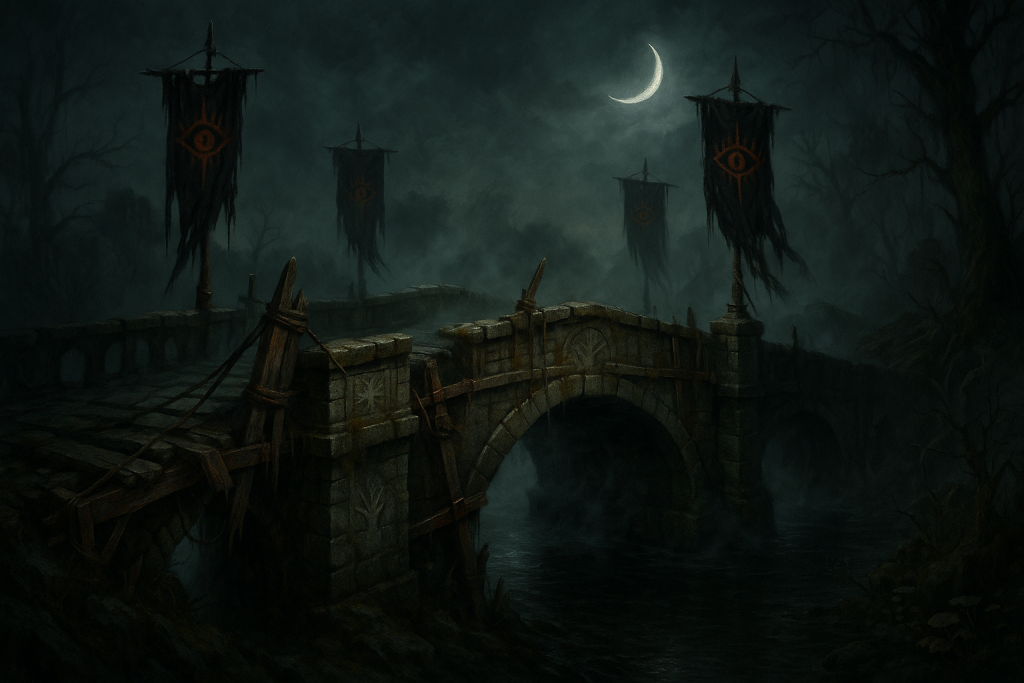
    The Morgulduin flowed black and sluggish beneath the ancient bridge, its waters gleaming with a faint, sickly light under the waning crescent moon. The air was sharp with the scent of decay and the metallic tang of blood carried on the morning breeze. What remained of the once-proud Gondorian crossing was a grim testament to the encroaching corruption—the original stonework now defiled by Mordor’s crude repairs. Gaps in the structure were patched with rough-hewn blocks and planks of splintered wood, lashed together with coarse ropes and reinforced with rusted iron supports. Blackened banners bearing the Eye of Sauron hung at intervals along the parapet, fluttering in the foul wind, while faint carvings of the White Tree could still be seen in the original stones, a ghostly reminder of what once was.

    At the western edge, where the dense woods of Ithilien offered their final cover, the squad gathered in silence. Their breaths ghosted in the chill air, each plume dissolving quickly as if the cold would not allow even that small defiance to linger for long. Behind them, the forest stood sentinel—oaks and beeches, their trunks wide and gnarled with age. Yet even here, the corruption from the east had begun its insidious work; the undergrowth grew tangled and wild, and at the edges nearest the Morgulduin, leaves had blackened at their tips, and strange fungi sprouted at the bases of the most ancient trees.

    The bridge stretched before them, a narrow spine of stone arcing across the haunted river. Its surface glistened faintly, slick with moss and age, as if time itself had conspired with the enemy to make the crossing treacherous. It was unassuming in appearance—just another relic in a land increasingly claimed by shadow—but it was everything. That thin stretch of stone held the supply line to Mordor’s forces in western Ithilien; cutting it would cripple their advance toward Osgiliath.

    Hadron crouched near the center of the group, a rough map spread out on the forest floor before him. His fingers, calloused and smeared with dirt, traced the jagged lines of the enemy’s anticipated approach from the eastern bank. His voice remained calm, but a coiled urgency belied his composure.

    “They’ll come in waves,” he said, his gaze sweeping across the squad. “And they’ll keep coming until one side breaks. We take this bridge, or Mordor’s supplies continue flowing west.”

    The words hung in the air, stark and uncompromising, pressing down on them with the weight of inevitability. Gamil grunted softly, adjusting the strap on his shield, the leather worn and patched from countless battles. His face was set in a grim mask, his jaw working as though chewing on thoughts too bitter to voice. Azrak, younger than the rest and much less experienced, fidgeted with the hilt of his sword. His knuckles were pale, the tendons in his hands taut as bowstrings. He looked down at the blade as if seeking reassurance from its cold, unyielding steel.

    Thordur, by contrast, leaned with deceptive ease against the trunk of an old oak. His bow rested loosely across his back, the curve of its wood smooth and polished from years of use. Yet even his relaxed posture couldn’t hide the way his jaw tightened or how his eyes flicked toward the bridge with measured calculation. He looked every inch the veteran—steady and deliberate—but those who knew him well could see the tension humming beneath the surface.

    Near the edge of their gathering, two newer additions to the squad maintained their own vigils. Elaran knelt at the forest’s boundary, his keen gray eyes fixed on the far side of the bridge, fingers absently adjusting the string of his longbow. He moved with minimal effort, each gesture precise and economical. Beside him, Durathon stood like a dark sentinel, the massive warhammer called Tarthorn resting on his shoulder. His broad frame cast a long shadow in the dim light, and he seemed to absorb the surrounding darkness rather than being diminished by it.

    Hadron’s gaze landed on Ungoránë, pinning him with a weight that wasn’t entirely the captain’s to give. “You’ll take the left flank with Gamil and Thordur,” he said. “Durathon, you’re the anchor. Elaran stays at the treeline with covering fire. Azrak, you’re with me on the right. We hold, no matter what.”

    The hilt of Ungoránë’s sword felt cool in his hand, the leather grip worn yet familiar. He gave a single nod, his voice steady as he spoke. “We’ll hold.”

    It wasn’t bravado; it was a promise, forged as much from duty as from necessity.

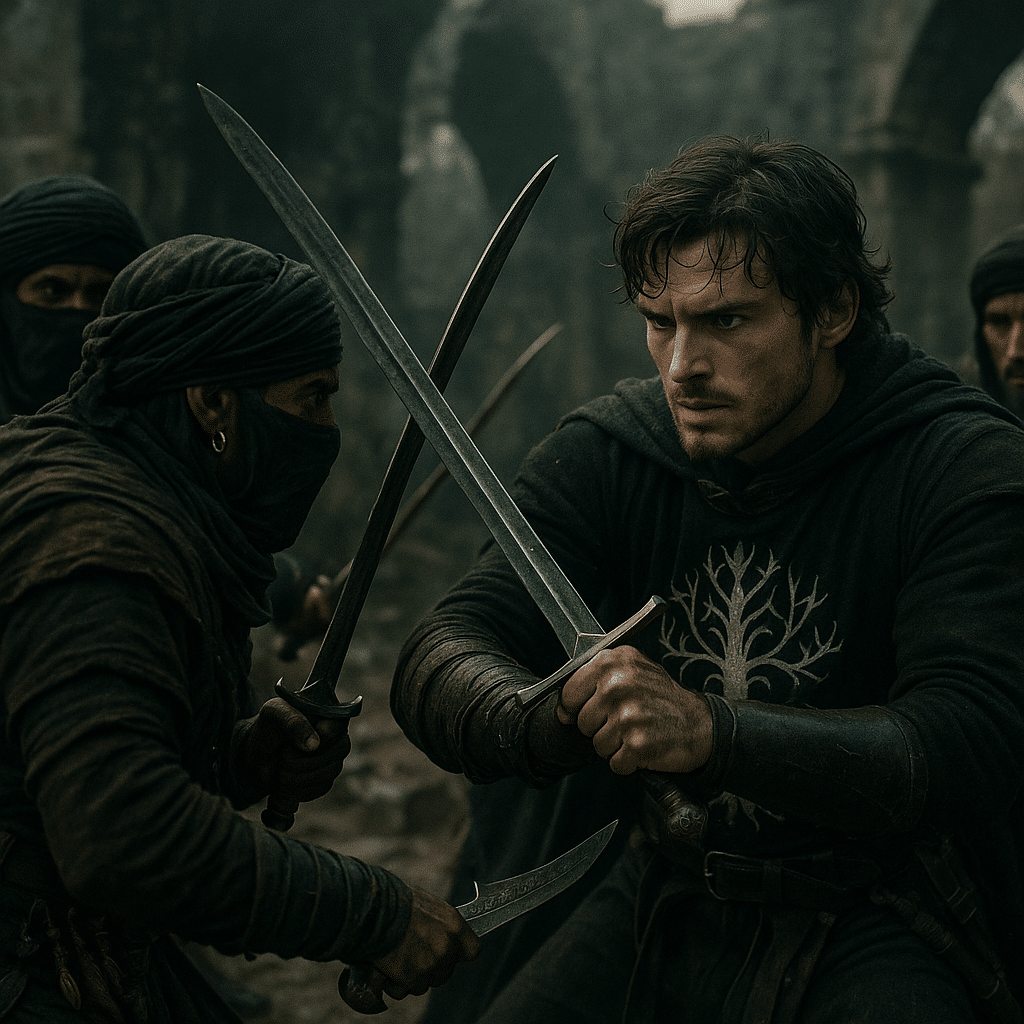
    The attack hit like the tide breaking against the cliffs—relentless, inevitable, and utterly unforgiving. What began as a low rumble from the eastern approach quickly erupted into a cacophony of boots pounding on stone, guttural war cries that tore through the still air, and the metallic hiss of blades unsheathed in unison. The Southrons surged forward from the Morgul Vale, their charge a living wave of fury and steel. Mist poured across the battlefield, rising from the black waters below, thick and choking as it rolled over the ancient bridge. It clung to every jagged corner and crude repair, blurring the line between friend and foe, flesh and shadow.

    Ungoránë stood at the head of the left flank, his grip firm on the hilt of his sword. The air buzzed with tension, a kind that pressed against the skin like an unseen weight. He could feel the battle coming- a storm rushing toward them- and every fiber of his being screamed to brace for the impact. His heart thundered, his breath visible in the chill morning air, but his focus was sharp, cutting through the haze of fear.

    Beside him, Gamil raised his shield just as the first Southron closed the distance. The man’s blade struck with a force that sent a resounding clang echoing across the bridge. Gamil grunted, shifting his weight to absorb the impact, his knees bending slightly under the strain. The shield held, its scarred surface a testament to past battles, but the Southron was relentless. He pressed forward, snarling, his scimitar flashing as he struck again.

    “Hold the line!” Ungoránë bellowed, his voice cutting through the chaos.

    Gamil barked a bitter laugh, deflecting another blow. “Easy for you to say!”

    Behind them, Thordur moved like a shadow, his bow already drawn. The twang of the string was quickly followed by the sickening thud of an arrow embedding itself in flesh. A Southron stumbled, clutching his throat as blood bubbled between his fingers. He fell to his knees, gasping, before collapsing face-first onto the ancient stones.

    “Don’t encourage him, Gamil,” Thordur called, his voice sharp with dark humor. “He’ll start thinking he’s in charge.”

    Ungoránë didn’t have time to respond. Another Southron lunged from the swirling mist, his curved blade telegraphing its path—a predictable diagonal slash aimed at the neck. Ungoránë shifted his weight to his back foot, and the attacker’s momentum carried him forward into empty space. Three distinct weaknesses emerged: exposed throat, unarmored armpit, and a gap between ribs. He selected the third. With mathematical precision, he drove his sword upward at a thirty-degree angle, feeling it slip between the fifth and sixth ribs, puncturing the lung before finding the heart. The man’s eyes widened—not in pain but in surprise—as Ungoránë withdrew the blade with an efficient twist to prevent suction. One less obstacle. He was already calculating his next move before the body crumpled.

    The Southrons pressed harder, their numbers a relentless tide. Each fought with a strange, single-minded fury, as if driven by a will beyond their own. Their strikes were wild, yet no less deadly for that. Steel met steel with deafening ferocity, sparks flying in the dim light. The air was thick with competing stenches: the metallic sweetness of arterial spray, the ammoniac undertones of voided bladders, and the distinctive rot emanating from the black waters below. Each breath coated the lungs in invisible filth.

    Ungoránë felt his body’s weariness with cold awareness: thighs trembling from exertion, a dull ache spreading through his sword arm, and breath coming shallow in the foul air that hung over the Morgul Vale. Yet his heart beat steady despite these burdens—a testament to years of battle and harsh training. Time seemed to slow and fragment around him. When another attacker lunged with a wild swing, Ungoránë saw it as clearly as if the man moved through water—the arc of the blade, the opening in his guard, the path of least resistance. His sword met the curved scimitar at its weakest point, steel grinding against steel with a terrible cry that echoed across the stone. The sound would shake the Southron’s resolve and warn Thordur of danger without the need for words.

    The ancient bridge became a deadly maze as the battle wore on. Blood from the fallen seeped into the cracks between weathered stones, leaving treacherous pools that gleamed black in the pale light. Ungoránë committed these perils to memory, choosing each step with care while watching the Southrons stumble and slip in their haste. The eastern span of the bridge, though solid underfoot, laid men bare to arrows from the shadowed vale beyond. At the center, a fallen barricade offered shelter but trapped defenders in a space too cramped for proper swordplay. The western approach, where stone had crumbled away over countless years, narrowed to a passage where scarcely two men could stand abreast—a throat of stone where Durathon’s great hammer denied the enemy their advantage of numbers.

    Durathon stood like a bulwark amid the chaos, reshaping the flow of battle through raw might alone. Where Ungoránë’s blade sought the spaces between armor and bone, Tarthorn fell like doom itself upon the enemy. A sweeping blow struck a charging Southron across the chest with a sound like thunder breaking over stone. Though the man’s skin remained unbroken, something vital shattered within—he crumpled without a cry, the light already fading from his eyes. When another foe raised his shield in desperate defense, Durathon’s hammer struck with terrible purpose. The wood held, but the arm beneath gave way with a sickening crack. The Southron howled, his shield now a useless weight hanging from a limb that would never again bear a blade, trapped by the very protection he had trusted.  

    Behind them all, from his position at the western edge, Elaran’s presence registered in Ungoránë’s awareness not through sight but through consequence: the precise rhythm of enemies falling to arrows that materialized without sound. The marksman’s efficiency was mathematical—each shot delivered exactly where vulnerability and opportunity intersected. A Southron rounding the barricade suddenly staggered, an arrow shaft protruding from the exact center of his exposed throat. The precision spoke of more than skill—it revealed an almost supernatural patience, a willingness to wait until circumstances aligned perfectly rather than firing at merely adequate targets.

    The battlefield was chaos, a swirling storm of mist and blood where no step was certain and no breath assured. Amid the din of clashing steel and desperate cries, a scream from the right flank ripped through the noise, sharp and primal. Ungoránë’s head snapped toward it, his chest tightening with dread. Through the haze, he saw Azrak crumpled to his knees, his shield reduced to jagged splinters dangling uselessly from his arm. His sword trembled in his grip, its edge gleaming faintly, but it hung slack as though the will to wield it had drained from him. Above him loomed a Southron warrior, his scimitar already rising in a gleaming arc for the killing blow.

    “Thordur!” Ungoránë’s voice sliced through the roar of battle, hoarse yet commanding. His legs moved instinctively, feet skidding over blood-slick stone as he sprinted toward the fray. “Cover me!”

    Behind him, the sound of a bowstring snapping taut echoed—a sharp, decisive note amidst the discord. Thordur’s arrow sliced through the misty air with a hiss, its fletching nearly invisible against the haze. It struck true, embedding itself deep in the Southron’s thigh. The warrior stumbled, his stance faltering as he growled in pain, his scimitar wavering mid-swing. Ungoránë closed the gap in an instant, his sword raised high.

    The blade came down with brutal efficiency, cleaving into the Southron’s side. It crunched through leather and bone, and a spray of dark blood fanned out, hot and metallic. The warrior’s guttural cry was choked off as he collapsed, his weapon clattering uselessly to the ground. Ungoránë didn’t watch him fall; his focus was already on Azrak.

    He seized the younger soldier by the arm, his grip firm yet urgent, and lifted him upright. “Get up!” he barked, his tone as sharp as the steel in his hand. “You’re not done yet.”

    Azrak’s face was pale, his expression caught between terror and disbelief. His breath came in shallow, ragged gasps, but there was something else in his wide eyes—a flicker of resolve struggling to reignite. He swallowed hard, his free hand tightening around the hilt of his sword as though grasping for an anchor in the chaos. “I’ve got it,” he said, his voice trembling but determined.

    “Good,” Ungoránë snapped, releasing him and shoving him back into the fray. “Stay with Hadron. Don’t let him down.”

    Azrak stumbled but regained his footing, his shoulders squared as he turned back toward the line where Hadron fought. He moved with shaky determination, each step becoming less hesitant than the last. Ungoránë watched him for a heartbeat longer, his chest heaving. The kid’s still green, he thought, the words bitter as bile. But he’s not broken. Not yet.

    A wave of movement caught Ungoránë’s attention, and his head whipped around just in time to see another Southron charging toward him, the man’s blade low and poised to gut him like a wild boar. The warrior’s face was twisted with fury, streaked with dirt and blood, his teeth bared in a feral snarl. Ungoránë raised his sword, confronting the attack head-on.

    The Southron’s scimitar swept horizontally—a weapon designed for slashing from horseback but ill-suited for the confines of the bridge. Ungoránë met it with the forte of his Gondorian longsword, the thickest part of the blade nearest the hilt. The curved edge slid harmlessly down his blade. He stepped inside the Southron’s guard, striking the man’s temple with calculated force using the pommel. As the enemy staggered, Ungoránë’s sword found the gap beneath the leather breastplate, sliding upward with minimal resistance until it grated against the sternum. He rotated the blade a quarter turn to the right, widening the wound channel, then extracted it at a downward angle to avoid binding in bone. Blood evacuated the puncture in rhythmic pulses—arterial damage. The Southron would bleed out in approximately thirty seconds. Ungoránë stepped away, conserving energy instead of delivering an unnecessary killing stroke.

    By the time the Southrons’ assault began to waver, Ungoránë had carved a brutal path back to the left flank, where Gamil and Thordur held their ground. Gamil’s shield was dented, its edges splintered, but he wielded it like an extension of himself, battering back enemies with an almost feral intensity. Thordur, his quiver depleted, fought with a long knife in one hand and the remains of his bow in the other, his grin sharp and wild.

    “Nice save,” Thordur called over the clash of steel, his voice filled with approval. “Azrak owes you one.”

    “He owes me more than one,” Ungoránë shot back, his tone grim yet steady. His mind flickered briefly to the younger soldier who fought alongside Hadron. Still alive, still standing- for now.

    Gamil let out a bark of laughter, slamming his shield into an attacker with enough force to send the man sprawling. “He’ll make it up to you in songs, I’m sure. The ballad of Ungoránë: savior of green recruits.”

    “Don’t give him ideas,” Ungoránë muttered, his sword flashing as he parried an incoming strike. He countered with a vicious upward thrust, the blade sinking into his opponent’s chest and emerging in a spray of crimson.

    But even as he fought, the weight of the moment lingered in his mind—the sight of Azrak on his knees, vulnerable and exposed, the scimitar poised to end him. Ungoránë had moved without thinking, driven by instinct and something deeper. He couldn’t shake the memory of his brother, Abrazân, his voice steady and unyielding in the quiet of another night: “You fight for the man next to you. That’s all.”

    The memory steadied him, grounding him amid the chaos. His grip on the sword tightened, and he pressed forward, each strike fueled by purpose. Not for glory. Not for songs. For them. Always for them.

    The air was thick with mist and the copper tang of blood; the battlefield was a chaotic tapestry of screams, steel, and desperation. The Southrons surged forward like a relentless tide, their war cries blending into a roar that seemed to shake the very stones of the bridge. The left flank buckled under their weight, and the men struggled to hold their ground as the enemy pressed harder with each wave.

    Gamil stumbled, his shield absorbing the brunt of a brutal blow that sent him skidding back toward the western end of the bridge. His face was set in a grimace, teeth bared as he braced himself for the next attack. Ungoránë noticed the gap widening, a fracture in their line that the Southrons would exploit in seconds. He moved without hesitation, his boots slipping on the blood-slick stone as he rushed to fill the breach.

    “Hold the line!” he bellowed, his voice raw, each word torn from his throat like a battle cry of its own. “We can’t let them through!”

    His sword came up in a sharp, precise arc, meeting the blade of an advancing Southron with a clash that reverberated through his bones. The impact jarred his arm, but he gritted his teeth and pushed back, twisting his wrist to deflect the enemy’s strike. His counter was brutal and efficient, the blade slicing across the man’s throat in a single, decisive motion. Blood sprayed in a dark arc, the warmth splattering across Ungoránë’s face as the Southron fell, his body crumpling like a marionette with its strings cut.

    But there was no time to linger. Another enemy was already closing in, his curved blade glinting in the dim light. Ungoránë stepped forward to confront him, moving fluidly despite the weight of exhaustion pressing on his limbs. His sword struck again, this time carving through the man’s chest with a sickening crunch. The Southron gasped, his eyes wide with shock as he dropped to his knees, clutching the gaping wound before collapsing face-first onto the stones.

    “Thought you could use some help,” came a voice over the din, sharp with amusement but tinged with iron resolve. Thordur appeared at Ungoránë’s side, his bow slung across his back and his dagger flashing in his hand. His face was streaked with blood, some of it his own, yet his grin was as unwavering as the stars above.

    Before Ungoránë could respond, Thordur surged forward, plunging his dagger into the neck of an advancing Southron. The man gurgled, his hands clawing weakly at the blade as Thordur yanked it free with a savage twist. Blood gushed from the wound, painting the ground with a vivid splash of crimson as the enemy collapsed.

    “Always a pleasure,” Ungoránë muttered, his tone dry despite the chaos. His sword lashed out in a sweeping arc, striking another Southron in the stomach. The blade bit deeply, tearing through flesh and muscle with brutal efficiency. The man let out a guttural scream, his insides spilled onto the ground as he crumpled into a twitching heap.

    Thordur let out a short laugh, wiping his blade on the tunic of a fallen enemy. “You know how to make a guy feel appreciated.”

    At the center of the bridge, Durathon stood as a bulwark against which the Southron advance broke like waves against rock. His massive warhammer swept in controlled arcs, each impact devastating. A Southron rushed at him with his shield raised; Durathon pivoted and brought Tarthorn down in a vertical strike that shattered not only the shield but also the arm beneath it, driving bone fragments into the warrior’s chest. The man didn’t even scream—he simply collapsed, his life extinguished in that single, brutal moment.

    “They’re faltering!” Durathon’s voice boomed across the battlefield, the first words he’d spoken since the battle began. His dark eyes scanned the eastern approach, where the next wave of enemies hesitated at the sight of their fallen comrades.

    The two of them moved together in a deadly rhythm of steel and instinct. Thordur’s dagger darted with quick, precise strikes, nimble and deliberate in its movements. Ungoránë’s sword was a heavier force, carving through the enemy with the grim finality of a headsman’s axe. They pushed forward step by step, their backs brushing against each other as they fought, each trusting the other to guard what they could not see.

    The Southrons faltered. It was subtle at first—a slight hesitation in their advance, and the lines no longer pressed forward with the same relentless determination. Ungoránë could see it in their eyes, the flicker of doubt that arose when men realized they were no longer the hunters but the hunted. He did not hesitate to take advantage.

    “Push them back!” he shouted, his voice rising above the chaos. His sword struck again, this time driving deep into an enemy’s side. The man cried out, his body jerking as Ungoránë wrenched the blade free, the motion sending a spray of blood across the stones.

    Behind him, Thordur dispatched another foe with a quick, brutal slice to the throat. “They’re breaking!” he called, his tone fierce with the thrill of battle. “Keep at it!”

    From the western treeline, a new volley of arrows arced overhead, finding their marks with unerring precision. Elaran had shifted positions, moving to higher ground that provided a clear line of sight over the entire bridge. His arrows rained down on the rear ranks of the Southrons, sowing confusion and panic. One by one, the enemy fell, their formations dissolving as they realized they were being picked off from a distance they couldn’t hope to close.

    And then it came, cutting through the clamor like a clarion call: the sound of a Gondorian horn. Its deep, commanding note echoed across the vale, a sound that spoke of reinforcements, of hope, of survival. The Southrons hesitated, their formation faltering as their gazes flicked toward the western woods.

    Over the rise, Gondorian rangers poured from the Ithilien forest, their green cloaks billowing behind them as they charged. They moved with the precision of those who knew this land intimately, their arrows finding gaps in armor and their blades striking with deadly efficiency. The Southrons broke, their once-disciplined lines dissolving into disarray as they fled, their shouts turning into cries of desperation as they retreated across the eastern half of the bridge.

    The Morgulduin bridge fell silent, and the battlefield transformed into a graveyard filled with shattered stones and lifeless bodies. The air was thick with the acrid tang of blood and the fetid stench rising from the black waters below, with the remnants of battle clinging to everything they touched. Near the edge of the western bank, the squad regrouped, their faces streaked with dirt and exhaustion, their movements slow and heavy as if the fight had drained the very life from their bones.

    Azrak sat slumped against a twisted oak, his breath coming in shallow, uneven bursts. His face was pale, streaked with blood that wasn’t his, and his hands trembled faintly as they gripped his battered sword. The shattered remnants of his shield lay discarded beside him, the wood splintered and rendered useless. Yet, he was alive, and that simple fact felt like a victory in itself.

    Nearby, Gamil leaned heavily on his shield, the deep cracks in its surface testifying to the battle’s ferocity. His broad shoulders heaved with effort, each breath a reminder of the weariness of a man who had borne the weight of the enemy’s assault and lived to tell the tale. His face was set in a grimace, the lines of his expression deepened by dirt and sweat, yet his eyes still held a glimmer of determination.

    Elaran stood slightly apart, methodically counting his remaining arrows, his movements economical and precise. Though his quiver was nearly empty, not a single shaft had been wasted—each one had found its mark with uncanny accuracy. His face betrayed no emotion, but the slight tremor in his fingers as he examined a bloodied arrowhead revealed the toll that the battle had taken even on his composed exterior.

    Durathon sat on a fallen log, his massive frame leaning forward as he inspected Tarthorn for damage. The warhammer’s head was slick with blood and fragments of bone, yet he handled it with surprising gentleness, wiping it clean with slow, deliberate strokes of a rag. Despite the brutality he unleashed on the bridge, his expression remained calm, almost meditative.

    Hadron approached them with measured steps, his expression unreadable. His armor bore fresh dents and scrapes, and a streak of blood ran down his cheek, dried to a dull rust. He halted in front of Ungoránë, his gaze steady yet heavy, as if weighing his next words.

    “You took a risk out there,” Hadron spoke softly, with each syllable articulated deliberately. “Leaving your flank to help Azrak.”

    Ungoránë met his eyes without flinching. His hand rested on the hilt of his sword, the blade still stained with the blood of those who had fallen. When he spoke, his voice was quiet yet resolute. “I couldn’t let him fall.”

    For a moment, Hadron said nothing, his sharp gaze searching Ungoránë’s face as if trying to find something hidden beneath the surface. Then, he nodded slowly, the movement carrying a weight of its own. “You made the right call,” he said. “It held the line.”

    Azrak looked up from where he sat, his voice hoarse but earnest. “You saved me, Ungoránë,” he said, his words unsteady but filled with conviction. “I… I won’t forget that.”

    Ungoránë’s eyes flicked to Azrak, noting the younger man’s pale face and the tremor in his voice. There was gratitude there, yes, but also something deeper—an understanding that life could be both fragile and precious. Ungoránë nodded, the gesture subtle yet sincere.

    Thordur broke the moment, his voice carrying a faint edge of humor as he clapped Ungoránë on the shoulder. His hand left a smear of blood, though whether it was his own or someone else’s was impossible to tell. “Seems like you’re making a habit of this, little brother,” he said, his smirk barely hiding the relief that they were all still standing.

    Ungoránë let out a faint laugh, the sound rough, tired, yet genuine. He shook his head. “Let’s hope it doesn’t catch on.”

    That night, as the squad rested and fresh Gondorian sentries secured the bridge, Ungorane sat by the fire with the sword resting across his knees. The battle replayed in his mind—the clash of steel, the cries of the wounded, and the moment Azrak’s life hung in the balance.

    The night had settled heavily over the camp, cloaking the western edge of the Morgulduin in a silence that felt almost unnatural after the chaos of the day. The fire burned low, its embers glowing like dying stars amidst the darkness. Around it, the squad rested, their bodies hunched in exhaustion, faces marked with streaks of ash, blood, and sweat. The air was thick with the metallic tang of iron, mingled with the acrid scent of charred wood and the faint sweetness of the Ithilien forest behind them.

    Ungoránë sat apart, as he often did, with the sword resting across his knees. Its blade was streaked with dried blood, and the nicks along its edge caught the faint light- tiny imperfections that told the story of the day’s violence. He slowly turned it in his hands, his fingers brushing the worn leather of the hilt, tracing grooves left by hands long dead. It felt heavier tonight—heavier than it had in the heat of battle. Or perhaps the weight came not from the steel but from what it had done.

    The battle replayed in his mind, vivid and relentless. He could hear the clash of steel ringing out over the ancient bridge, feel the jarring impact of every blow that connected. The cries of the wounded rose unbidden in his memory, sharp and raw, cutting through the haze like the jagged edge of a broken blade. Then there was Azrak, his shield shattered, his body crumpled to the ground as death loomed over him. Ungoránë had witnessed the moment—the way Azrak’s eyes widened, the way his fingers trembled against the hilt of his sword. He felt fear and resignation, the brief flicker of someone who knew the end had come.

    Ungoránë’s chest tightened at the memory. He could have stayed. He could have held the line, keeping his focus on the flank that threatened to buckle under the Southron onslaught. It would have been safer. Easier. The thought lingered, sharp and insistent, as if it were testing his resolve.

    But I didn’t, he thought, his grip tightening around the hilt of the sword. And because of that, we stood firm. Because of that, Azrak is still here.

    The memory of his brother surfaced, unbidden yet welcome. Abrazân’s voice echoed in his mind, steady and unyielding, as it had been on that distant night. “You fight for the man next to you. That’s all.”

    Those words, once simple and clear, now carried a weight that settled deep in his chest. They were neither a command nor a principle; instead, they represented a truth—a truth that had guided him across the blood-soaked bridge to stand between Azrak and death.

    The ache that accompanied the memory was faint, but it lingered- a quiet reminder of loss. Yet with it came clarity. Ungoránë’s gaze drifted to the sword again. It was no longer a stranger’s weapon; it was his now, its weight a part of him.

    Across the camp, Durathon sat with Tarthorn resting on his lap, the warhammer’s head now clean but marked with new scars from the day’s combat. His large hands moved surprisingly gently over the weapon, applying oil to prevent rust. The big man’s presence was still new to the squad, yet there was no denying the impact he had on today’s battle. His eyes briefly met Ungoránë’s across the flames—a silent acknowledgment passed between them before both returned to their tasks.

    Near the edge of the firelight, Elaran knelt on one knee, carefully straightening the fletching on his few remaining arrows. His methodical focus seemed to isolate him from the rest of the group, yet Ungoránë noticed how the archer’s gaze occasionally flicked toward each member of the squad, watchful and attentive despite his apparent detachment.

    Thordur’s voice broke through the silence, low and calm. “You did well today.”

    Ungoránë glanced up to find Thordur sitting nearby, his knife carving slow, deliberate arcs into a piece of wood. The firelight danced across his face, highlighting the streaks of grime and blood that marred it. For a long moment, Thordur didn’t look up, focused on the task at hand. He didn’t need to; the words hung between them, heavy with meaning.

    Ungoránë furrowed his brow, his voice tinged with uncertainty. “Did I?”

    Thordur finally looked up, his grin faint but genuine, a small, steady light in the darkness. “You kept us alive,” he said simply. “That’s more than most can say.”

    Pale morning light reluctantly broke over the Morgulduin, casting long shadows across the ancient bridge and the corrupted eastern shore beyond. The squad moved sluggishly, their movements weighed down by the exhaustion of the previous day. Dirt and blood streaked their faces, and their armor was dented and scuffed, but they were alive—and for now, that was enough.

    Azrak fumbled with his sword belt, his hands trembling slightly. Gamil leaned heavily on his splintered shield, muttering curses under his breath as he adjusted the straps. Thordur, always a step removed, stood with his back against a weathered oak, carving something indiscernible into a piece of wood. He appeared calm, as he often did, but there was an edge to him, a tautness that belied the ease of his posture.

    Elaran was already at his post, scanning the eastern shore with focused intensity, his longbow ready at his side. Durathon moved among them, his massive frame seemingly absorbing the morning mist as he meticulously checked the bindings on his warhammer.

    Ungoránë stood at the edge of the camp, the wind stirring his unkempt hair as he gazed toward the eastern shore of the Morgulduin. His sword hung at his side, its weight a constant reminder; the hilt worn smooth beneath his grip. Each scratch and dent in the blade told the story of the brutal fight for the bridge, and each felt heavier now in the aftermath.

    “Ungoránë,” Hadron’s voice broke through the morning stillness, low and steady. Ungoránë turned, his brow furrowing as he saw the captain standing a few paces away, arms crossed over his chest. “Walk with me.”

    They moved away from the others toward a part of the camp where a stand of ancient oaks provided a measure of privacy. Hadron leaned against one of the trunks, his expression unreadable. The man’s armor bore fresh scrapes, and a streak of dried blood ran across his jaw; yet his presence was as steady as the stones beneath his boots.

    “You’ve come a long way,” Hadron began, his voice calm but carrying an undercurrent of something more—approval, perhaps, or expectation. “You’re not just fighting for yourself anymore. They see it. I see it. You’re leading them, whether you realize it or not.”

    Ungoránë tensed, the weight of those words landing like a blow. He shook his head slightly, his hand tightening around the hilt of his sword. “I don’t think I’m the right man for that,” he admitted, his voice quieter than he intended. “I’m still figuring out how to carry my own weight, let alone theirs.”

    Hadron tilted his head, studying him with the piercing gaze of someone who had spent years judging men’s worth on the battlefield. “That’s exactly why you’re the right man,” he said, his tone cutting through Ungoránë’s hesitation like a blade. “The ones who think they’re ready, who believe they have all the answers—they’re the ones who get men killed. You question yourself. You care. That’s what makes the difference.”

    Ungoránë’s jaw tightened. He opened his mouth to argue, but Hadron raised a hand, silencing him. “You’ll lead your own squad one day,” he continued, his voice softening but losing none of its resolve. “But for now, you will stand beside me. I’m making you sergeant. My second.”

    The words struck like a hammer blow, solid and inescapable. Ungoránë blinked, his mind scrambling to process their weight. ” Sergeant. Second in command. ” It felt surreal, as if Hadron were speaking to someone else entirely.

    “I—” he began, but Hadron cut him off with a sharp look.

    “You’re ready, whether you believe it or not,” Hadron said, his tone leaving no room for argument. “And I don’t have time to convince you of something I already know. You’ve earned this, Ungoránë. Now carry it.”

    For a moment, the younger man remained silent, his thoughts churning. Doubt wrestled with something quieter yet no less potent—a flicker of pride, a faint glimmer of hope. He met Hadron’s gaze, searching for any sign of uncertainty, but the captain’s expression was unwavering, hewn from stone.

    Finally, Ungoránë nodded, the motion slow yet resolute. “I’ll do my best,” he said, the words feeling inadequate but honest.

    Hadron’s expression softened, and he placed a firm hand on Ungoránë’s shoulder. “That’s all I ask,” he said simply. “Keep them alive. That’s what matters.”

    As the squad prepared to move out, Ungoránë found himself watching them with new eyes. Azrak struggled to fasten his sword belt, his hands still trembling slightly from the previous day’s fight. Gamil leaned heavily on his battered shield, muttering curses as he adjusted the straps. Thordur stood apart, carving something indiscernible into a piece of wood, his movements unhurried yet precise.

    Elaran signaled from his vantage point—all clear to the east, at least for now. His quiet competence would be an asset in the days to come. Durathon hefted Tarthorn onto his shoulder, his dark eyes scanning the bridge they had fought so hard to claim. The big man’s strength and unflinching resolve had already proven invaluable.

    They were no longer just comrades; they were his responsibility. That truth settled over Ungoránë like a weight, yet it didn’t crush him. Instead, it anchored him, giving shape to a role he hadn’t asked for but could no longer deny.

    Hadron’s words echoed in his mind: ” You’ll lead your own squad one day. ” The thought was daunting, yet it also carried a strange sense of inevitability. He adjusted the strap of his pack, his fingers brushing the hilt of his sword. The weapon no longer felt foreign—it was his now, a part of him.

    As the squad began their march deeper into Ithilien, the Morgulduin bridge remained behind them, secured but never truly conquered—a lonely outpost of resistance against the growing shadow from the east. The path ahead was uncertain, fraught with danger and hardship, yet Ungoránë felt a flicker of resolve stir within him. He glanced at Azrak, Gamil, Thordur, and the newcomers Elaran and Durathon. They were battered but unbroken, and they trusted him—even if he didn’t fully trust himself yet.

    “This isn’t the life I imagined,” Ungoránë thought, gripping the hilt of his sword firmly. “It’s harder. Darker. Filled with choices I never wanted to make. But it’s mine. And I’ll carry it. For them. Always for them.”

    With that thought, he pressed forward, the weight of command resting on his shoulders—not as a burden, but as a sense of purpose.

  • Like Wind and Whisper

    The dream seized Ungoránë without warning or transition—the sudden immersion of being thrust into a moment already unfolding. He was a child again, his feet bare against earth that yielded beneath each step, cool and damp with the morning’s lingering dew. The clearing around him pulsed with a vitality that reality could never quite capture, colors saturated beyond truth, scents sharpened to an almost painful clarity. Pine resin hung thick in the air, mingling with the earthy perfume of soil and rotting leaves. Birdsong cascaded from the branches above, each trill distinct and deliberate, as if the forest itself were trying to speak some ancient, forgotten language.

    A breeze whispered through the clearing, stirring his hair and raising gooseflesh along his arms—not the chill of fear, but the primal alertness of a creature suddenly aware it is not alone. The forest felt sentient around him, breathing and watching with the patient vigilance of something that had existed long before him and would continue long after he was gone.

    Abrazân stood several paces away, arms folded with casual authority, his posture relaxed yet somehow commanding the very air around him. His grin held layers, like a weapon with multiple edges—teasing at the surface but underneath lay something more knowing, more deliberate. Golden light spilled through gaps in the canopy overhead, dappling his figure and seeming to frame him by design, as though the trees themselves conspired to cast him as something more than merely human. The sunlight caught his hair, transforming the dark waves into burnished bronze and lending him an almost mythic quality that transcended the mundane.

    In that moment, with light pooling around him like liquid gold, Abrazân didn’t resemble the boy Ungoránë had grown up with. He appeared as though he had emerged from one of their father’s fireside tales—the kind of warrior whose name would outlive his bones, whose deeds would be etched onto shields and woven into songs long after his body had returned to dust. His presence filled the clearing, not just physically but with something deeper, something that made the dream world itself bend around him like light around a star.

    “Catch a rabbit, little brother,” Abrazân said, his voice rich with the particular blend of playfulness and command that only elder siblings could master. The words cut through the forest sounds with perfect clarity, carrying both challenge and affection in equal measure. His grin widened slightly, eyes sparkling with a confidence that suggested he had already seen this story play out to its conclusion. The challenge hung between them, weighted with expectation, something far heavier than the simple task itself implied.

    “No traps. No help. Just your hands.”

    Abrazân’s voice softened almost imperceptibly with the last words, yet the firmness remained, unyielding as iron beneath velvet. He leaned against a nearby pine, his body at ease while his gaze never wavered from Ungoránë’s face. There was no mockery in his expression, only the steady weight of expectation—the kind that tested and probed for weakness not to exploit it but to strengthen it. This wasn’t merely play; this was ritual, a moment of passage wrapped in the guise of a childish dare. His expectation carried an implicit promise: disappointment if Ungoránë faltered, but pride—quiet and understated—if he succeeded.

    Ungoránë’s heart hammered within his chest, a desperate rhythm that oscillated between excitement and dread. Abrazân had always possessed that maddening certainty, that unshakeable belief which made others doubt themselves while simultaneously inspiring them to prove themselves worthy of such faith. His confidence was absolute, a towering wall of expectation casting a long shadow. It was a belief so solid, so unwavering, that Ungoránë sometimes felt crushed beneath its weight.

    That steady gaze seemed to see straight through him, peeling back layers to reveal some hidden core of strength that Ungoránë himself couldn’t quite grasp. But doubt twisted beneath his ribs nonetheless, an uninvited serpent coiling around his courage. Why was Abrazân so certain? That quiet, unyielding confidence, so reminiscent of their father’s, weighed on Ungoránë’s shoulders like a mantle he hadn’t earned and wasn’t sure he could bear. Yet he would never show this uncertainty—not to Abrazân, whose belief was both a burden and a blessing.

    It wasn’t merely pride that kept Ungoránë’s doubts hidden, though pride certainly played a role. It was something more fundamental and painful: the terror of watching that unshakeable belief shatter against the hard edge of his inadequacy. To fail was one thing; to witness Abrazân’s faith in him crumble was unthinkable. And so he stood, gripping his resolve as he would a blade—his knuckles white with effort, determination borrowed yet no less fierce for being so.

    “Fine,” Ungoránë said, though the word caught in his throat, betraying the uncertainty that simmered beneath. He swallowed hard, straightening his spine as if good posture might somehow grant him courage. “I’ll catch one,” he added, the declaration firmer this time, weighted with a conviction he didn’t truly feel but desperately wanted to. He searched his brother’s face for even the slightest flicker of doubt and found none, which somehow made his own misgivings burn all the more fiercely.

    Abrazân laughed, a sound that seemed to fill the clearing like water filling a basin—rich and expansive, almost tangible in its warmth. It wasn’t cruel laughter; it carried genuine amusement wrapped around a core of affection. With a theatrical flourish, he gestured toward the dense tangle of underbrush at the edge of the clearing, fingers splayed like a showman unveiling his greatest wonder.

    “Show me, little brother,” he said, the words carrying both challenge and implicit faith. “Let’s see if those quiet feet of yours are good for something other than sneaking extra portions after supper.”

    The words ignited something in Ungoránë’s chest—not anger, exactly, but a fierce, burning need to prove himself worthy of that confidence. His cheeks flushed with a defiance peculiar to younger siblings everywhere, a heat that spurred him forward even as doubt gnawed at his resolve. Yet beneath that defiance flickered something warmer, more profound: the quiet glow of pride that Abrazân thought him capable of this feat, that his brother believed in him so completely when he could barely believe in himself.

    For all his teasing, Abrazân possessed an uncanny ability to transform ordinary moments into legends in the making, imbuing simple challenges with the gravity of ancient quests. Standing there in the filtered sunlight, his presence remained as immovable and steadfast as the ancient oaks surrounding them, and he watched with that infuriating certainty that both inspired and intimidated.

    The underbrush before Ungoránë loomed dense and secretive, a world unto itself filled with rustlings and whispers that seemed to mock his determination. He squared his shoulders, his mind already cataloging everything Abrazân had taught him during countless hours exploring these woods together—the subtle art of placing each foot just so, of reading broken stems and faint impressions in soft earth, of becoming not an intruder but a part of the forest’s quiet conversation.

    He glanced once more at his brother, who still stood with that unshakeable posture, arms crossed and expression expectant. The weight of Abrazân’s gaze pressed against him like a physical thing, neither crushing nor overwhelming, reminding him with every heartbeat that this challenge was more than just the simple task at hand. This was about proving something—to his brother, to himself, and perhaps to something larger than either of them.

    Ungoránë’s fists clenched briefly at his sides before relaxing, his breathing steadying as he took the first step forward into what now felt less like a game and more like a test of worth that only siblings could truly understand.

    Ungoránë sank into a low crouch, his fingertips brushing the cool dampness of the earth as he eased himself forward. The tall grass whispered against his tunic, a sound so faint it was barely distinguishable from the forest’s gentle breathing. Each movement was calculated and painfully deliberate, his weight transferred with the methodical care of someone testing thin ice. He remembered his father’s movements during their rare shared hunts—each step placed with the deliberate reverence of a sacred ritual, not merely walking but communing with the land itself, becoming an extension of forest and shadow.

    Rabbits, however, were creatures of wind and whisper, their presence marked not by obvious tracks but by the ghost of passage—indentations so slight they might be imagined, broken grass blades that could have been bent by the morning breeze. The signs led him in maddening circles, tracks appearing and vanishing with frustrating inconsistency, leading nowhere and everywhere at once. What had seemed like hours passed in the strange, elastic time of dreams, each empty trail stoking the ember of frustration that grew steadily hotter behind his eyes.

    This wasn’t like Abrazân’s tales, where determination alone guaranteed triumph, where the hero’s heart proved truer than the obstacle’s difficulty. The forest seemed to conspire against him, the earth keeping its secrets close, the undergrowth dense with shadows that concealed all he sought. His frustration simmered beneath his skin, but he pressed onward nonetheless. Each careful placement of his feet was a silent refusal to admit defeat; each controlled breath was a promise to himself—and to Abrazân—that he would not surrender to failure.

    Then—movement. A flicker in the tangled brush so brief that he nearly dismissed it as imagination. But Ungoránë’s breath caught in his throat; his entire being suddenly focused to a knife’s point on that single spot. There it was: a rabbit, small and gray, its form almost indistinguishable from the dappled forest floor. Only its movement betrayed its presence—the subtle twitch of long ears, the rhythmic bob of its head as it nibbled delicately at a tuft of clover. Ungoránë’s heart thundered so violently in his chest that he feared the rabbit might hear it; the sound deafening in his own ears.

    He inched forward with excruciating slowness, his body coiled with tension, every muscle trembling with the effort of controlled stillness. Each shift of weight was a calculated risk, bare feet pressing against the earth with a delicacy that left no trace and made no sound. His hands stretched before him, fingers splayed and trembling slightly with the intensity of his focus. The rabbit continued its meal, unaware or unconcerned by his presence, lost in the simple act of survival. The air felt thick and heavy with the scent of damp soil and resin, every detail of the moment hyper-real in the strange, sharp clarity that only dreams and mortal danger can bring. Every inch gained felt like a mile conquered, his breathing shallow and controlled, his entire consciousness narrowed to this singular purpose: close enough, just a little closer, almost there.

    He lunged—a desperate, explosive movement that broke the forest’s reverent silence. His fingers grasped at empty air where the rabbit had been only heartbeats before, closing instead around a fistful of damp grass and soil. The world seemed suspended for one crystalline moment, perfect in its stillness, before reality rushed back in with the sound of rustling underbrush as the rabbit vanished—a ghost dissolving back into the forest that had birthed it, leaving no trace but the thundering of Ungoránë’s heart and the dirt beneath his fingernails.

    The realization of failure seeped into him slowly, like cold water soaking through cloth. His fingers unclenched, releasing the crumpled vegetation, and his gaze was fixed on the empty space where success had been so tantalizingly close. He could almost feel the phantom warmth of the creature still hovering in the air between his hands, a promise unfulfilled.

    Then came laughter—rich and unrestrained, rolling through the forest like summer thunder. Ungoránë turned, heat rising to his face as he saw Abrazân leaning casually against an ancient oak, his shoulders shaking with barely contained mirth. The laughter wasn’t cruel; though in that moment of raw disappointment, it stung like salt in an open wound. It carried genuine amusement tinged with affection, the kind of good-natured ribbing that only someone who truly cared could deliver without cruelty.

    “Almost!” Abrazân called, his voice carrying easily through the still air, that familiar teasing lilt evident even from a distance. “You’re too eager, too hungry for it. You have to wait, let it come to trust the stillness. Patience, little brother.”

    Ungoránë clenched his jaw until he felt the muscles bunch beneath his skin, teeth grinding as he swallowed the urge to snap back. Patience. Always patience with Abrazân, as if the word itself were a magical incantation that solved all problems. But patience didn’t fill empty hands or satisfy the gnawing need to succeed. It didn’t earn that gleam of approval in his brother’s eye that Ungoránë craved more than he cared to admit. No, only success would do that—and success meant trying again.

    And so he did.

    Again and again, he stalked through the undergrowth, each attempt more careful than the last, each failure more bitter than its predecessor. The air grew heavy with his mounting frustration, the world narrowing until there was nothing but the hunt and the elusive prize that continued to slip through his fingers. His palms became raw from contact with the ground, and his knees ached from hours spent in a crouch, but the thought of surrender was more painful than any physical discomfort. Giving up meant hearing that quiet sigh he could already imagine Abrazân making—not angry, not even disappointed, just faintly resigned, as if he had expected better but wasn’t truly surprised by the failure.

    The prospect of that sound was unbearable. Thus, Ungoránë persisted, driven equally by stubborn pride and desperate need.

    Finally, after what might have been minutes or hours in the strange fluidity of dream-time, fortune favored his persistence. A rustle in the brush caught his attention, and there—smaller than the last, nearly motionless beneath the shadow of a fallen log—sat another rabbit. It remained perfectly still, save for the occasional twitch of its whiskers, its tiny nose working ceaselessly to read the air around it.

    Ungoránë froze completely, his lungs barely moving as he drew in air through slightly parted lips. He calmed his racing heart with sheer force of will, each breath measured and controlled as he lowered himself incrementally closer to the ground. His heartbeat sounded impossibly loud in his own ears, but the rabbit showed no signs of alarm. Whether it hadn’t noticed him or simply judged him no immediate threat, he couldn’t say—and didn’t dare question his extraordinary luck.

    Closer. One more breath. Closer still.

    This time when he lunged, his hands found purchase—fingers closing around warm, living fur, the rabbit’s body solid and surprisingly heavy in his grasp. For one perfect moment, disbelief and triumph surged through him in equal measure, a lightning strike of pure, undiluted joy. Laughter erupted from him unbidden, bright and unrestrained; the sound of victory so sweet it nearly brought tears to his eyes.

    He held the rabbit aloft, its body squirming against his grip, and turned toward where Abrazân stood watching. His grin stretched wide enough to make his cheeks ache, pride radiating from him in palpable waves. For that singular, perfect moment, nothing else in all the world mattered. He had done it. He had proven himself worthy.

    But triumph, like all things, is ephemeral.

    The rabbit transformed in his hands, becoming not prey but predator—a whirlwind of fur, muscle, and desperate survival instinct. Its hind legs kicked with shocking strength, claws raking against his forearms and leaving stinging welts in their wake. Its body twisted with frenetic energy that seemed impossible for something so small, every fiber of its being committed to escape. Panic radiated from the creature, its frantic struggle igniting a confused tangle of emotions in Ungoránë’s chest—determination mixing with guilt, triumph souring into uncertainty.

    “Easy,” he hissed, the word meant as much for himself as for the creature thrashing in his grip. He tightened his hold, but it felt like trying to contain quicksilver, the rabbit’s movements growing more desperate with each passing heartbeat. Then came the bite—sharp and sudden, a flash of pain that tore a startled yelp from his throat. Instinct overrode intention, his fingers springing open before conscious thought could intervene. In that instant of reflexive release, the rabbit was gone—a blur of movement vanishing into the underbrush as though it had never been there at all.

    Ungoránë stared at his hand, the bite already reddening, and his breath came in quick, shallow gasps. The marks of the rabbit’s desperate bid for freedom throbbed against his skin, serving as a physical reminder that even victory could slip through fingers that didn’t know how to hold it properly.

    Ungoránë sank back on his heels, cradling his injured hand against his chest as the sharp sting of the bite pulsed in rhythm with his heartbeat. The pain was clean and honest, unlike the murky swell of emotions churning beneath his ribs—frustration and shame and the bitter taste of almost-victory turned to ash. He blinked hard against the threatening heat behind his eyes, his jaw clenched tight against the possibility of tears. Then came the soft crunch of approaching footsteps, and Abrazân appeared beside him, crouching with fluid grace that made the movement seem effortless.

    His brother’s grin was wide and warm, carrying more understanding than mockery, though amusement still danced in his eyes. “You almost had it,” Abrazân said, his voice pitched low enough to feel like a shared secret between them. “But almost isn’t enough when it comes to wild things.”

    “I did catch it,” Ungoránë muttered, the words sharp with wounded pride. He glared down at his injured hand, the red marks standing out starkly against his skin. “It just didn’t stay caught.” The bitterness in his voice was palpable- a child’s frustration at a world that refused to bend to his will.

    Abrazân laughed softly, the sound rumbling deep in his chest, and reached out to take Ungoránë’s hands in his own. His touch was firm yet gentle, with weathered fingers dwarfing Ungoránë’s smaller, dirt-smudged ones. “That’s because you didn’t know how to hold it properly,” he said, his tone shifting from teasing to teaching with seamless ease. He repositioned Ungoránë’s hands, shaping them into a specific configuration. “Like this—see? Behind the legs, under the belly. This way it can’t kick you, and it can’t twist around to bite. You’ve got to be firm enough that it feels secure, but not so tight that you crush it. Just steady. Understand?”

    Ungoránë nodded, the tension gradually easing from his shoulders as he focused on his brother’s instruction. Abrazân had always possessed that uncanny ability to make even failure feel like a step forward, transforming disappointment into opportunity with nothing more than a shift in perspective. The sharp edges of frustration began to dull under the steady warmth of his brother’s attention, giving way to renewed determination.

    “I’ll try again,” he said, the words steady now, imbued with quiet resolve rather than desperate need.

    Abrazân laughed, reaching out to ruffle Ungoránë’s hair with casual affection that somehow conveyed more than any formal praise ever could. “I know you will,” he said, his grin widening to reveal white teeth against sun-darkened skin. “You always do, little brother. It’s what makes you who you are.”

    When Ungoránë woke, the dream clung to him like morning mist, its details crisp and vivid despite the veil of years that should have dulled them. He lay still for a moment, the chill night air seeping through his clothes and raising gooseflesh along his arms as another memory surfaced unbidden—a companion piece to the dream that carried its own weight of significance.

    The first time he successfully brought a rabbit home was shortly after Abrazân had taught him the proper way to hold them. He remembered the swell of pride in his chest as he entered their father’s house, the squirming creature held carefully in his grip, exactly as his brother had shown him. His father looked up from his work at the table, a rare flicker of interest crossing his weathered features as he took in the sight of his youngest son’s triumph.

    “Well then,” his father had said, his voice gruff yet not unkind, “is that for eating?”

    “Yes!” Ungoránë had answered with all the certainty of youth, though in truth, he hadn’t considered the question until it was asked.

    His father’s gaze shifted to the rabbit, still very much alive and trembling in Ungoránë’s hands, one eyebrow rising slightly in silent question. “Then why’s it still breathing?”

    The question had struck Ungoránë dumb, reality crashing against expectation with jarring force. He’d stared at the rabbit as if seeing it for the first time, suddenly unsure of how to proceed. His hesitation had drawn a low chuckle from his father, who set aside his work and rose from his seat. “Come here, boy,” he’d said, beckoning Ungoránë closer. Taking the rabbit from his son’s hands with practiced ease, he demonstrated with quick, efficient movements. “Like this—one quick twist. Clean and quick. That’s how you break their neck. Next one, you do it yourself.”

    The frigid night air pressed against Ungoránë’s skin as he sat up fully, the memory fading back into the recesses of his mind, though its weight remained. The fire beside him had burned down to embers, casting just enough light to outline his solitary figure against the darkness. Despite the chill, something warm and steady had kindled in his chest- a quiet comfort that existed independent of his physical discomfort.

    Ungoránë could still recall the complexity of emotions that washed through him at his father’s instruction—awe mingled with unease, pride tangled with a child’s natural reluctance to cause harm. The responsibility felt enormous, a burden too heavy for his small shoulders. Yet he carried it, just as he now carried so many others, because there was no alternative—because that was what it meant to grow from boy to man in a world that offered no soft transitions.

    As the last memory faded into the crackling whisper of the dying fire, Ungoránë’s hand found the hilt of his sword, fingers curling around the leather grip with familiar ease. The weapon’s weight against his side was constant and grounding, an anchor that kept him tethered to the present even as his mind wandered down pathways of remembrance. His father’s voice, like Abrazân’s, echoed in the quiet corners of his consciousness, not haunting but guiding—a steady presence that remained long after both men had returned to dust.

    “Thank you, Abrazân,” Ungoránë whispered into the darkness, the words barely audible above the soft pop and hiss of the fading embers. “Thank you, Dad,” he added, equally soft but no less fervent. The simple phrases carried more than gratitude—they held acknowledgment, respect, a recognition of debts that could never truly be repaid. His fingers tightened briefly around the sword’s hilt, the leather rough and worn beneath his calloused skin, forming a tangible connection to lessons learned and promises kept.

    The weight of the blade felt different somehow—not heavier, but more significant and purposeful. It was more than mere metal and leather; it represented continuity, a physical manifestation of knowledge passed from hand to hand, generation to generation. Abrazân might be gone from this world, but what he had given Ungoránë remained, carved into memory as surely as runes were carved into stone.

    “I won’t forget,” he murmured, the quiet vow dissolving into the night air. The words were for himself as much as for the ghosts of his memory—a promise to carry forward not just survival but the essence of what they had taught him: to honor their memory not through grief but by living as they had shown him to live.

    The night stretched vast around him, the stars cold and distant in the immeasurable void above. Yet for the first time in longer than he could remember, Ungoránë didn’t feel entirely alone. The memory of his brother’s laughter, his steady hands, and unwavering belief lingered like a presence just beyond sight. It wasn’t enough to fill the hollow spaces carved by loss, but it was enough to make the darkness seem less absolute and the cold less biting.

    It was sufficient to remind him that even in a world that had taken everything, something remained that could not be taken—something carried in blood, bone, and memory, something as fundamental as the beating of his heart.

    A loud crack from the fire jolted Ungoránë from his reverie, the sound sharp as a breaking branch underfoot. The dream’s images receded like the tide, yet their impression remained, heavy and tangible as the sword across his lap. It was then that other sounds began to register—the faint clink of metal against metal, the soft murmur of voices, and even the occasional ripple of subdued laughter. The noises had likely been present all along, but he hadn’t been ready to hear them, too wrapped in memory to acknowledge the present. The fire that had seemed so solitary was, in fact, one of several, and beyond the immediate circle of his light, the camp continued its nighttime rhythm.

    He stood, muscles stiff from prolonged stillness, and took a moment to orient himself in the real world. His hand still rested on the hilt of his sword, thumb pressed against the familiar curve of the guard. Not drawn, not threatening—simply present, an extension of himself. The dream clung to him like woodsmoke, fading but not gone, as he stepped quietly to the edge of the firelight.

    From this vantage point, he could see them clearly: Thordur’s solid form, head thrown back in quiet laughter at something someone had said, accompanied by two unfamiliar figures. Their armor marked them as Gondorian, like him, though the specific wear patterns and modifications suggested men who had seen their share of combat. They were not fresh recruits, then, but possibly transfers.

    For a long moment, Ungoránë simply observed, hesitant to pierce the bubble of easy camaraderie that had formed in his absence. There was something almost sacred about such moments—men finding brief respite in each other’s company, a temporary shelter against the weight of what they had seen and what they would likely see again. Interrupting felt somehow intrusive.

    Yet he couldn’t remain forever at the periphery, a shadow watching shadows. With deliberate steps, he moved into the circle of firelight, making no particular effort to announce himself but avoiding being unnoticed. He crouched near the edge of the group, close enough to be counted among them but far enough that his presence wouldn’t disturb the established rhythm of their conversation. No one questioned his arrival or his previous absence. No one broke the quiet flow of the moment to acknowledge him directly. He appreciated that more than he could have expressed.

    “Well, look who wandered out of the shadows,” Thordur finally said, his voice carrying the easy, affectionate teasing of someone who knew exactly how far such ribbing could go before crossing into unwelcome territory. He shifted slightly to make room beside him and patted the ground in wordless invitation.

    Ungoránë settled in silence, placing his sword across his knees where its worn blade caught the firelight. He gave a single nod in Thordur’s direction—acknowledgment, gratitude, and a greeting all conveyed in one simple gesture. Between them, it was enough.

    Across the fire sat two strangers, both wearing the gear of Gondor’s forces but bearing the unmistakable marks of hard travel and harder fighting. One stared into the flames with the unfocused gaze of a man seeing something beyond the present moment, while the other’s eyes seemed fixed on an invisible middle distance, perceiving nothing at all. They carried themselves with the quiet intensity of men who had witnessed the worst the world could offer and somehow returned to tell of it. Not recruits, no. These were men who had already paid the price of admission to this particular brotherhood.

    “Elaran,” Thordur said, gesturing to the quieter of the two, who acknowledged his introduction with nothing more than a slight inclination of his head. “And Durathon,” he continued, nodding toward the second man, who responded with a noncommittal grunt that wasn’t unfriendly so much as measured—a man who saw no reason to waste words when a sound would suffice.

    No hands were extended in greeting. No platitudes were exchanged. Just the simple, stark acknowledgment of each other’s existence, which was all any of them really required. Elaran’s gaze met Ungoránë’s once—steady, calm, unreadable—before drifting back to the fire, while Durathon busied himself checking the head of his warhammer, fingers moving with the practiced precision of ritual rather than necessity before setting the weapon down at his side.

    “Not here to talk,” Durathon said after a moment, the words flat but not confrontational. It was simply a statement of fact- one that Ungoránë understood perfectly. They hadn’t come seeking friendship or conversation; they had come because this was where they were told to be, and they would do what was required of them. Everything beyond that was a luxury, not a necessity.

    No one pushed for further conversation. The silence that settled around them was not uncomfortable, but rather companionable- a quiet shared by men who understood that, at times, words were overrated. The crackle of the fire and the occasional sigh of the wind through the trees provided all the soundtrack they needed.

    Then came an unexpected sound: the creak of leather and the soft whisper of cloth being unwrapped. Thordur reached into his pack and produced something Ungoránë had never seen him carry before—a worn lute, its wood darkened by age and use yet clearly well-maintained. Ungoránë couldn’t hide his surprise; throughout their time together, he had never known Thordur to play any instrument, much less carry one with him through the hardships of their travels.

    Thordur caught his glance and offered the faintest hint of a smile but said nothing as he began to tune the instrument, his thick fingers moving with unexpected delicacy across the strings. There was something in the way he handled it, something in the careful precision of his movements, that spoke of personal significance—this was not merely an object but a piece of himself, something that carried history and meaning beyond its immediate function.

    When the first notes drifted into the night air, they arrived without fanfare or introduction. There were no words, no attempts at showmanship or entertainment—just a quiet melody that wove around them like a thread, binding the moment together. It wasn’t particularly cheerful, nor was it melancholic; it simply existed, steady and unwavering, like a heartbeat in the darkness. It served as a shield against the unknown that awaited beyond their circle of light.

    No one spoke. Even Durathon, who had seemed restless before, grew still; his eyes half-closed as the music washed over them. The fire flickered and danced, casting shifting shadows across faces that revealed nothing and everything all at once. Ungoránë’s sword lay across his knees, no longer merely a weapon but a connection—to his past, to his purpose, to the men who sat with him now in this moment of unexpected peace.

    He didn’t smile. Such expressions had become foreign to him, unnecessary in a world that rarely warranted them. Yet, he stayed, and that was its own kind of acceptance. The warmth surrounding him now came not just from the fire but from something more elemental: the simple, profound understanding that they were all facing the same darkness and, for tonight at least, they were doing so together.

    It wasn’t brotherhood, not yet. It wasn’t even friendship. But it was something—a beginning, perhaps. An acknowledgment that while the path ahead remained shrouded and treacherous, they need not walk it entirely alone.

    The lute’s melody continued, filling the spaces between them; for now, it feels just right.

  • The Weight of Shadows

    The camp clung to life as tenuously as a flame battered by the wind, its existence fragile amid the jagged ruins of Osgiliath. Once a city of silver spires and proud stonework, it now lay in fragmented ruins, broken by time and the relentless hand of war. The fire at the camp’s center burned weakly, its dancing flame flickering erratically. It cast uneven shadows over the shattered landscape, illuminating fractured stone and weary faces in hues of molten gold and bloodstained red. The warmth it offered was an illusion, too thin and fleeting to push back the cold that seeped into every corner of the night. Ungoránë leaned forward, poking at the blackened wood with a stick. Sparks leapt upward, fading into the cold air like fleeting memories. The flames sputtered and regained a weak hold, their fragile light casting uneven shadows once more.

    Shadows shifted across the ground like restless spirits, born from smoke and memory. They flickered and danced, stretching and curling with the fire’s faltering rhythm. To anyone watching, it might have seemed as though the ruins themselves were alive, their jagged edges clawing at the dark as if trying to reclaim something long lost.

    Most of the squad had succumbed to exhaustion, their bodies draped in a haphazard patchwork of cloaks and torn blankets. The occasional murmur of restless sleep or the soft rustle of fabric broke the silence. Ungoránë’s gaze wandered over them, lingering on the faint rise and fall of their breathing—an odd solace amidst the weight of his thoughts. Others huddled close to the fire, their faces slack and pale, the weariness of survival etched into their features. Occasionally, the quiet was broken by the groan of a wounded man, the sound raw and unguarded, or by the soft rustle of cloth as someone shifted in restless sleep. Beyond the camp, the Anduin murmured softly, its steady rhythm threading through the silence like a whispered lullaby. Ungoránë tilted his head, catching the faint ripple of water. It was a sound both soothing and distant, a reminder of something steady and unbroken amidst the ruins. Yet it was detached—a comfort too far removed to reach those who needed it most.

    Ungoránë sat apart, as he always did. Distance had become his habit, a self-imposed exile that felt more natural with each passing day. The fire’s weak glow outlined his silhouette, carving sharp lines of shadow and light against the fractured column he leaned against. His fingers brushed over the cold, rough surface of the stone, tracing the grooves where time and war had left their marks. The column felt ancient, its jagged edges whispering of a history that seemed impossibly far removed from the bleak present. Once a proud marker of a city built to endure, the column now lay in ruins, jagged and raw, mirroring the man who rested against it.

    The sword lay beside him, its presence heavy and accusing. Its blade, streaked with dried blood that gleamed black in the cold light, seemed to absorb the fire’s glow rather than reflect it. Ungoránë turned it over in his hands, his fingers brushing the grooves in the hilt. The leather wrapping was smooth in places, worn down by years of use, its surface bearing the imprints of another’s grip. He traced those marks absentmindedly, as though trying to map the life of the man who had held it before him.

    It wasn’t mine, he thought. Not really.

    The blade had belonged to someone else—a soldier whose name he didn’t know, whose face had already begun to blur in his mind. He hadn’t seen the man fall, but he had found the sword lying beside his broken body, its edge still wet with the blood of enemies. It felt like a stranger’s legacy, thrust into his hands by the uncaring hand of fate. A burden he hadn’t asked for but couldn’t put down.

    The faces always came first.

    They drifted out of the smoke and shadows, pale and stark against the dark backdrop of his thoughts. Men he barely knew. Men who had marched beside him into battle with hope, fear, or duty written on their faces. Their names were slippery things, half-forgotten or never known, but their deaths lingered like fresh scars. Some had screamed as they fell, their voices sharp and jagged, filled with disbelief at how quickly everything could be taken from them. Others had died silently, surprise frozen on their features as the light dimmed in their eyes.

    Ungoránë closed his eyes as though the simple act of shutting them might drive the images away. It didn’t. If anything, the faces burned brighter, etched into the darkness behind his lids. He saw them more vividly now than he ever had in life—their fear, their pain, and the fleeting moments of acceptance. There was no escaping them.

    I didn’t know their names. Not all of them, he thought. The words in his mind were heavy, sharp-edged things, cutting into him with their truth. But they followed me. They trusted me. And now they’re gone.

    The thought lodged itself in his chest, cold and unyielding. It wasn’t the first time he’d felt this weight, and it wouldn’t be the last. His jaw tightened as he fought against it, but the faces remained, relentless in their clarity.

    The Southrons came next, unbidden. Their faces rose like shadows from the corners of his mind, mingling with those of his comrades until he could no longer separate them. He remembered their cries and the terror in their eyes as they fell. He remembered the way their blood mingled with that of his men, pooling in the mud until he couldn’t tell one life from another.

    They hadn’t been so different. That thought lingered, sharper than any blade. How many lives have I taken? he wondered, his hand tightening on the hilt of the sword until his knuckles turned white. How many fathers? How many brothers and sons? Was their cause less worthy than ours? Did they deserve it? Did we?

    The questions turned over in his mind, slow and heavy, like stones shifting in a riverbed. They had no answers. Or perhaps the answers were too terrible to face.

    The weight of it pressed down on him, a suffocating thing that felt as real as the cold air filling his lungs. He looked down at the sword in his hand, its edge catching the faint glow of the firelight. The blade wasn’t lighter tonight. If anything, it felt heavier, as though it had soaked up the lives it had claimed and now carried them in its steel.

    The soft crunch of footsteps broke through the haze of Ungoránë’s thoughts. Deliberate, unhurried. He didn’t need to look up to know who it was—Thordur always moved like that, as if he carried not just himself but a small measure of calm through the chaos surrounding them. There was no urgency in his stride, no sharpness to his approach. It was the sound of someone who knew when to push forward and when to simply be.

    Without a word, Thordur settled down beside him. The faint creak of the wood in his bow was the only announcement of his arrival, the weapon laid carefully across his lap. They didn’t exchange greetings. They didn’t need to. The silence stretched between them, but it wasn’t uncomfortable. It was the kind of silence that could only exist between those who had bled, fought, and endured together. The fire crackled softly, its warmth barely reaching through the cold air.

    “You’re thinking too loudly again,” Thordur said at last. His voice was low, laced with the kind of dry humor that seemed to come so naturally to him. It wasn’t a question—it never was with Thordur. He had a way of knowing things without needing to be told, as if he could see the burden a man carried just by looking at him.

    Ungoránë let out a sharp huff of air, the sound hovering somewhere between a laugh and a sigh. “Hard not to,” he said, his voice rough from exhaustion. He kept his eyes on the fire, watching the flames curl and twist around the blackened wood. The movement was hypnotic, distracting him from the thoughts that churned like storm clouds in his mind.

    Thordur tilted his head slightly, studying him. The firelight danced across his face, casting sharp shadows that softened the hard angles of his features. His gaze wasn’t piercing—it was quiet and thoughtful, as if he were trying to piece together a puzzle without all the edges yet in place. “You’re carrying it, aren’t you?” he asked, his tone quieter now, the humor giving way to something gentler. “The debt of it all.”

    Ungoránë’s jaw tightened. He didn’t respond immediately. Instead, he reached down, his fingers brushing the hilt of the sword that rested beside him. The leather felt rough beneath his touch, its edges worn smooth in places where another man’s grip had claimed it. The weapon felt heavy, not just physically but also in its meaning. He stared into the flames, their dancing glow reflecting in his dark eyes.

    “I made the call,” he said finally. His voice was steady, but there was a raw edge to it, a vulnerability he didn’t bother to hide. “They followed me. Some of them didn’t come back. That’s on me.”

    Thordur shifted, leaning forward until his elbows rested on his knees. For once, the smirk that so often played at the corners of his mouth was absent. Instead, his expression was somber, and his gaze remained steady. “It’s on them too,” he said, his words measured yet firm. “They knew the risks, just like we all do. They followed because they believed in you. Don’t take that away from them.”

    He hesitated for a moment, then added, “There was this one lad I fought beside back in Lossarnach. We were clearing out a ruined farmhouse—quiet place, or so we thought. I’d barely stepped inside when he grabbed my arm and shoved me back. I didn’t even have time to ask why before an arrow buried itself in the wood right where I’d been standing. I never saw it coming.”

    Thordur’s expression softened, his voice quiet but steady. “He didn’t make it out of that skirmish. But that moment? That choice? It saved me. I carried his face for a long time, wondering if I could’ve done more to save him. But the truth is, he made his choice, same as all of us. Same as your men. They stood for you because they believed it was worth it.”

    He leaned back slightly, his gaze returning to Ungoránë. “You can’t carry it all, little brother. You carry your part, and you honor theirs. That’s how you do it.”

    The words hit harder than Ungoránë had expected, cutting through his guilt with the precision of a blade. He turned his head to look at Thordur, his brow furrowed. The firelight caught the faint lines of his face, the weariness etched into his features. “How do you do it?” he asked. The question came quietly, almost as a whisper. “Carry it, I mean.”

    Thordur’s smile returned, faint but warm, the kind of smile that felt less like an expression and more like a small, steady light in the dark. “You don’t carry it alone,” he said simply. “You share it—with us, with the ones who stand beside you. That’s what we do, little brother. We carry each other.”

    For a moment, Ungoránë said nothing. He turned the words over in his mind, testing their weight and truth. He looked away, his throat tightening as the tension in his chest pressed harder. He nodded once, the motion stiff and reluctant, yet genuine.

    Thordur didn’t push further. He didn’t need to. He just sat there, his presence a quiet reassurance, solid and unyielding. The fire crackled softly between them, its warmth doing little to chase away the chill in the air, but something about the moment felt less cold. Less heavy.

    They sat together like that, the silence stretching out again, but this time it didn’t feel so oppressive. Thordur leaned back, his hand idly brushing the smooth wood of his bow, while Ungoránë turned the sword over in his hands, his fingers tracing the grooves in the hilt as though trying to understand its obligation.

    For the first time that night, the faces in his mind began to fade—not completely, but enough to give him room to breathe. Thordur didn’t speak again, and Ungoránë didn’t feel the need to. There was nothing more to say.

    The fire had burned low by the time Thordur left, its once-bright flames reduced to faint embers, glowing like dying stars against the dark. Shadows stretched long and thin, flickering over the uneven stones of the ruins. The camp had quieted further; the restless shifts and soft murmurs of the sleeping men faded into the background hum of the Anduin’s distant flow.

    Ungoránë sat alone, the weight of the sword pressing down on his lap like a silent accusation. His fingers brushed the hilt absently, tracing the grooves worn smooth by another man’s grip. The leather was cold under his touch, rough but familiar, as though the weapon carried a faint memory of its own—a ghost of the hands that had held it before.

    The fire crackled softly, its fluttering flame against the jagged stones. Ungoránë’s gaze dropped to the weak flames, their golden glow catching on the faint grooves of the sword’s blade. For a moment, the glint reminded him of something familiar—chainmail shimmering in the firelight, each link alive with the same molten hue. The memory stirred, vivid and unbidden, sweeping over him like a tide. 

    Abrazân, sitting by the fire, had his chainmail catching the flickering light. The glow turned the steel into something almost alive, with every link gleaming like a constellation against the dark fabric beneath.

    Abrazân’s voice had been steady that night, low and calm, the way it always was when he spoke of things that mattered. “You fight for the man next to you,” he said, his gaze fixed on the flames. “That’s all.”

    At the time, those words had seemed simple. Obvious, even. Ungoránë had been so young then, so eager to prove himself. He’d nodded along, his heart swelling with pride at the thought of standing beside his brother, living up to the legacy of the men who had come before them. But now—now those words felt like something else entirely. They were heavy, laden with a responsibility he hadn’t understood until it was too late to ask what Abrazân had really meant.

    He could see his brother clearly in his mind’s eye, the way he had looked that night. Calm, resolute, as though the air he carried was something he had long since made peace with. But had he? Had Abrazân questioned his choices, the way Ungoránë did now? Had he carried their faces with him—those who had fallen, those he couldn’t save? Or had he simply kept going because he had no other choice?

    The questions twisted in his chest, sharp and unrelenting. He had no answers—only the memory of his brother’s voice, low and steady, cutting through the haze of uncertainty like firelight cuts through the darkness.

    Ungoránë’s hand tightened around the hilt of the sword, his knuckles turning white. The leather bit into his palm, grounding him in the present even as his thoughts lingered in the past. The fire crackled softly, a faint, uneven sound that filled the silence but offered no comfort.

    Was this how you felt, brother? he wondered. Did you doubt yourself? Did you wonder if it was worth it? Or did you already know what I’ve only just begun to understand?

    He turned the sword slowly in his hands, the blade catching the dim light. It wasn’t his—not truly. But it was here, solid and unyielding; in its own way, it had chosen him. He ran his thumb over the worn leather of the hilt, feeling every ridge and imperfection as though they might hold the answers he sought.

    “I understand now,” he thought, the words forming slowly and deliberately in the quiet corners of his mind. “I think I finally understand.”

    It wasn’t about glory. It wasn’t about songs or the White Tree or the pride of Gondor. It wasn’t even about survival. It was about standing when others couldn’t. It was about carrying the responsibility, even when it felt like it might crush you. It was about giving the men beside you one more day, one more chance, because you could.

    The fire flickered weakly, its warmth fading as the night stretched on. Ungoránë stared at the sword a moment longer before lifting his gaze to the stars above. They shone cold and distant, scattered like shards of broken glass across the night sky. For a moment, he watched their steady light, feeling the sharp chill of the air bite at his skin. Their indifference was strangely comforting—a reminder that the world continued, indifferent to the chaos below. But they were steady and unwavering, and something about that steadiness settled inside him.

    He let out a slow breath, his grip on the sword loosening just slightly. The weight of it hadn’t changed—it was still heavy, still foreign in his hand. But it felt different now. Not lighter. Just… steadier. Familiar in a way it hadn’t been before.

    The memory of Abrazân lingered, his voice echoing faintly in the quiet: “You fight for the man next to you. That’s all.”

    When Thordur left, the camp grew still again, the fire burning low. Ungoránë remained where he was, the sword resting in his lap. The memory of Abrazân rose unbidden, his voice clear and steady: “You fight for the man next to you. That’s all.”

    This isn’t the life I imagined, Ungoránë thought as he stood, the sword hanging at his side. The ruins of Osgiliath stretched out before him like a jagged wound. It’s harder. Darker. But it’s mine now. And I’ll carry it. For Abrazân. For Thordur. For the ones who can’t stand alone.

    The fire flickered behind him, its faint warmth brushing against his back. The sword no longer felt foreign. It wasn’t lighter, but it felt familiar now—a part of him.

    I’ll keep going. Not for glory. Not for songs. For them. Always for them.

    With that thought, he turned back toward the camp, the faint echo of his brother’s voice guiding his steps: “You fight for the man next to you. That’s all.”

  • The Cliffside Gambit

    The camp held its breath. The crumbling watchtower’s shadow stretched long across the ground, its jagged edges stark against the faint glow of the lantern hanging from the broken arch. The light wavered, throwing distorted patterns over Hadron’s face as he crouched over the map, his finger tracing a dark line along the Anduin.

    “This is where we hit them,” Hadron said, his voice steady and deliberate. Each word fell like a hammer striking stone. “Their supply line runs through this pass. If we take it out, their position will collapse.”

    The squad leaned in closer, faces drawn with fatigue but etched with focus. Gamil adjusted his shield with a faint scrape, his eyes narrowing as he studied the map. Azrak shifted uneasily, his hand twitching toward his sword as if the movement might steady him. Even Thordur, usually quick with a quip, remained silent, his sharp gaze fixed on the parchment.

    Hadron’s finger moved again, tapping the edge of the pass where a jagged mark indicated the cliffs. “The Southrons have fortified the cliffs overlooking the pass: archers and a barricade. Scouts report heavy resistance.”

    Thordur’s eyes flicked up, his brow furrowing. “How are we supposed to take that without getting ourselves killed?”

    Hadron didn’t flinch at the challenge in Thordur’s tone; his response was measured, his voice low yet firm. “We don’t fight head-on. We move under the cover of darkness. A small group will take the cliffs first and neutralize the archers. Once the high ground is ours, the rest of us will move to secure the pass.”

    The lantern swayed slightly in the breeze, its light catching on the charcoal marks. Ungoránë’s eyes followed the narrow ascent drawn on the map, his stomach twisting. The path was steep, exposed, and treacherous. Even in the dark, the risk was glaring. The cliffs loomed in his mind, sharp and unyielding.

    “How long do we hold the cliffs once they’re ours?” Ungoránë asked, his voice calm despite the weight settling in his chest.

    Hadron’s gaze met his, steady and unrelenting. “As long as it takes for us to break their lines.”

    Simple words. Brutal clarity. The silence that followed was thick and heavy with unspoken thoughts. Azrak glanced at Gamil, who tightened his grip on his shield but said nothing. Thordur finally broke the quiet, leaning back slightly as a faint, dry chuckle escaped his lips.

    “Well, little brother,” Thordur said, his voice light but edged with tension. “Looks like this one’s yours.”

    The faint humor in his tone grated on Ungoránë’s nerves, but he let it pass. He felt Hadron’s gaze settle on him again, heavy with expectation and weighing him down like a stone strapped to his back.

    “You lead the advance,” Hadron said. There was no room for doubt in his voice. It wasn’t a suggestion or a question—it was a command. “Your group is smaller, faster. You’ll need to sneak. If they spot you before you reach the cliffs, it’s over.”

    Ungoránë nodded, the movement short and stiff. “Understood.”

    The words felt hollow in his mouth but hung in the air. The weight of the mission pressed harder now, sinking into his bones. He could see the unspoken doubts in the faces around him—the silent calculations, the grim acceptance. They would follow him because they had no other choice.

    Hadron straightened, folding the map with precise, deliberate movements. “Get some rest,” he said, his voice softer now but no less firm. “We move when the moon is high.”

    The squad dispersed slowly, their movements heavy with exhaustion and anticipation. Ungoránë lingered by the watchtower, his back pressed against the cold stone as he stared at the cliffs in the distance. The faint outlines were barely visible against the night sky but loomed sharp and clear.

    The sword at his side felt heavier now, as if it already bore the weight of the task ahead. His fingers brushed against the worn leather of the hilt, the rough texture grounding him for a moment. It wasn’t just a weapon—it was something more, something laden with a history he didn’t know and a purpose he hadn’t chosen but couldn’t turn away from.

    Behind him, the camp murmured in restless tones. The fire crackled faintly, its warmth a small comfort against the chill creeping in from the river. Ungoránë let out a slow breath, his gaze fixed on the dark horizon.

    “They’ll follow you,” he thought, the faces of his squad flashing through his mind: Azrak’s uncertain grip, Gamil’s quiet determination, and Thordur’s sharp, knowing grin. “Because they have to. Because they trust you to bring them back.”

    He clenched his jaw, the memory of Abrazân’s voice surfacing unbidden. “Just keep going, little brother.”

    The sword felt steadier in his hand as he gripped it tighter. The waiting was the most challenging part: the endless moments before the storm broke. But it wouldn’t last much longer.

    The path to the cliffs was unforgiving, the kind that seemed purpose-built to test resolve. Rocks shifted beneath Ungoránë’s boots, slick with dew, each step a minor betrayal of sound against the brittle silence of the night. The cold gnawed at exposed skin, sharpening every breath into a reminder of the life clinging to the edge of this world. The sword strapped to his side felt heavier with each step, as though it understood the stakes better than he did.

    Behind him, Thordur moved like a shadow, holding his bow loosely but ready, the string taut as if it shared his nerves. Gamil followed, his shield strapped firmly to his back, the weight making his movements deliberate. Azrak brought up the rear, breathing quickly, plumes visible in the pale wash of moonlight spilling over the jagged rocks.

    The darkness warped the landscape, turning the cliffs into a jagged maw that loomed over them. Shadows stretched and twisted, each one a possible threat, and each crack in the stone a hiding place for death. The wind carried faint sounds from above—Southron voices, low and guttural, their words unintelligible yet unmistakably confident. They believed they were safe.

    Ungoránë kept his pace steady, his focus locked on the path ahead. He felt the weight of responsibility pressing against his chest as surely as the cold bit into his skin. It wasn’t just about reaching the cliffs; it was about ensuring that every man behind him remained safe.

    “Feeling confident?” Thordur’s voice was a whisper, barely more than a breath, yet it quickly carried through the silence.

    Ungoránë didn’t look back. “I’m confident enough.”

    Thordur’s chuckle was soft and dry, like leaves crunching underfoot.

    “That’s more than usual; it must be the sword.”

    Azrak’s muttering broke through the moment, nervous and quick. “I’d feel better if we were anywhere else.”

    “Then climb faster,” Thordur hissed back, his tone edged with a faint humor that didn’t quite reach his eyes.

    Ungoránë felt the faintest tug of a smirk but didn’t let it settle. The path ahead narrowed, with the rocks growing sharper and less forgiving. He raised a hand, a simple motion that immediately silenced the others. They froze, breaths held, pressing themselves against the uneven stone as a shadow moved above them.

    An archer, his silhouette distinct against the pale light of the crescent moon, scanned the area lazily. His bow rested at his side, the posture of a man who felt safe, who had completed this same patrol a hundred times before without incident. His boots crunched softly against the rocks as he moved past, oblivious to the threat crouched below.

    Ungoránë let out a slow, controlled breath, his fingers curling briefly around the hilt. It wasn’t the time to draw yet, but the feeling of it steadied him, grounding him in the moment.

    The group remained still, pressed against the rock, their breaths shallow and synchronized. They waited for the patrol’s footsteps to fade, the faint clink of the archer’s gear swallowed by the wind.

    Thordur leaned in close, his voice barely audible. “I’ll take the first shot. Just give me the signal.”

    Ungoránë nodded, his mind already calculating the next steps. The cliffs were close now, but every movement from here on must be precise. There is no margin for error. One sound, one misstep, and the mission would collapse before it had truly begun.

    His gaze drifted upward, tracing the path leading them into the heart of danger. The sword at his side shifted slightly with his movement, its weight a reminder of the lives depending on him. This wasn’t about heroics or glory. It was about getting his men to the top and ensuring they came back alive.

    Ungoránë raised a clenched fist at the cliff’s edge, halting the squad. The rocks beneath them were slick with dew, and the wind carried faint traces of salt and smoke, the air sharp enough to cut. He turned to Thordur, his expression taut with expectation. Thordur nodded once, a sharp, precise motion, and stepped forward without hesitation. His bow rose smoothly; the motion was practiced, fluid, and almost artful.

    The arrow left the string with a faint whisper, its flight slicing through the still night air. The Southron archer toppled soundlessly, his body folding into the shadows of the rocky outcrop. Ungoránë watched for a breathless moment, his ears straining for any sign that the others had noticed. When no alarm came, he gestured forward, and the squad moved as one, their footsteps muffled by years of instinct and discipline.

    They spread out across the cliffs like ink spilled over paper, each man sliding into position with a hunter’s precision. The Southrons had been careless; their confidence had made them lax. Their torches sputtered against the breeze, casting flickering light over their crude barricades. Shapes moved in and out of the glow—figures slouched, weapons held lazily and unaware of the shadow creeping toward them.

    The first clash came with the subtlety of a thunderclap. Gamil’s shield struck like a battering ram, throwing a Southron archer off balance. The man’s cry of alarm was cut short by the whistle of Thordur’s second arrow, finding its mark with brutal efficiency. Azrak followed with a yell, his blade shimmering in the campfires as he charged at another archer.

    The fight that followed was brutal and intimate, the kind of combat that leaves no room for hesitation. Ungoránë’s sword swung in tight arcs, its edge meeting flesh and steel with equal resolve. The unfamiliar weight of it had become, if not natural, at least a familiar companion. He moved through the fray like a shadow, each strike deliberate and each movement calculated.

    A Southron turned toward him, his scimitar gleaming in the torchlight. The man’s eyes widened as Ungoránë’s blade found the soft gap between his shoulder and neck. The Southron crumpled without a sound, and his weapon clattered against the rocks.

    The squad fought with the precision of a whetted blade, their motions deliberate, and their silence a weapon unto itself. Thordur’s arrows sang in a deadly symphony with Gamil’s shield strikes, while Azrak’s sword cut quickly and cleanly. The Southrons were overwhelmed before they could muster a defense; their cries were swallowed by the night and the relentless hiss of steel.

    When the last of the archers fell, silence reclaimed the cliffs. Ungoránë stood at the edge, his breath coming in sharp bursts, his chest rising and falling in rhythm with his heart’s pounding. Below, the Southron forces stirred in the ravine, their torch-lit barricades flickering like tiny, defiant beacons against the dark expanse of the valley.

    He tightened his grip on the hilt of his sword, his knuckles whitening as he stared at the scene. The barricade was a fortress in miniature, and its defenders moved like ants as they prepared for the inevitable assault.

    “We don’t have much time,” Ungoránë said, his voice low but steady, each word laced with quiet urgency. “Hadron will be here soon.”

    Thordur moved to his side, his bow resting lightly in his hand, though his expression was anything but casual. His eyes traced the barricades below with keen intensity. “We’ve done our part,” he said quietly, his tone not satisfied but resolute.

    Ungoránë nodded, though the weight in his chest remained. The cliffs were theirs, but the battle below would be entirely different. His gaze lingered on the Southrons, their movements sharp and purposeful even amid the chaos. Victory felt close yet fragile, like a flame struggling against the wind.

    The cliffs were silent for now, their claim staked with blood and steel.

    The words hit the air like a hammer strike on steel—final and undeniable. Gamil’s deep voice lingered, steady as the foundation beneath them. But the weight of the decision hung heavier than the cold night, heavier than the sword in Ungoránë’s hand.

    Gamil’s warning had been clear; his tone cut through the restless murmurs of their breaths. Below, the Southrons were no longer a shifting sea of aimless figures. They were focused now, their torches clustered, their shapes tightening into units. One group began to break off, its formation flowing like a river toward the narrow, treacherous paths leading to the cliffs—the paths Ungoránë and his men had just taken.

    Azrak’s voice was tight with barely contained panic, his wide eyes locked on the climbing figures. “We can’t hold this. Not against that.” His hand tightened around the hilt of his sword, the leather creaking faintly in protest.

    Ungoránë didn’t answer immediately. His eyes followed the Southrons below, each step they took pressing down on the certainty of the decision he hadn’t yet voiced. The torches looked like will-o’-the-wisps against the dark rock, leading death straight to their position. He shifted his grip on his blade, the unfamiliar weight grounding him. When he finally turned his head, it wasn’t Azrak he looked to—it was Thordur.

    Thordur stood with his bow in hand, a silent figure carved from the darkness. The flickering light of the torches played across his face, casting shadows that sharpened his features. His expression gave nothing away, but his eyes told a different story. They met Ungoránë’s and lingered, a thousand unsaid words passing between them in the silence.

    You know what we have to do, they seemed to say.

    Ungoránë nodded, the motion small and almost unnoticeable. He had already made the choice; now he only needed to say it aloud. He turned to face the squad, his voice breaking through the brittle quiet like a drawn blade. “We hold.”

    Azrak’s head snapped toward him, disbelief etched across his features. “What? They’ll overrun us!”

    “Maybe,” Ungoránë said, his tone steady and deliberate. “But if we fall back now, they’ll reinforce the pass. Mission fails. Hadron and the others won’t stand a chance. We hold. We buy him time.”

    Azrak stared at him, his lips parted as if to argue, but the words didn’t come. His breathing was shallow, his shoulders tense, yet he didn’t move. He didn’t look away, as if searching Ungoránë’s face for any sign of doubt. He wouldn’t find any.

    Gamil stepped forward, his broad figure solid as the rock beneath their feet. His hand came down heavily on Azrak’s shoulder, the gesture both a comfort and a command. “You heard him,” Gamil said, his voice calm but carrying an edge of finality. “We hold.”

    For a moment, no one spoke. The only sound was the distant murmur of Southron voices, growing louder with every passing second. Then Thordur’s voice broke the silence, low and steady. “We hold,” he echoed, his bow already nocked and ready.

    Azrak looked at each of them in turn, his chest rising and falling like a man standing on the edge of a cliff, staring into the abyss. Finally, he exhaled a shaky, resigned breath. “We hold,” he whispered.

    Ungoránë turned his gaze back to the path, the Southrons’ torches drawing closer. The cliffs felt smaller now, and the space between them and the enemy tightened like a noose. He adjusted his grip on the sword, the rough leather wrapping grounding him for what was to come. His heart beat steadily, loud in his chest, but his voice remained calm as he spoke.

    “Positions,” he said, and they moved.

    Thordur took his place first, his bow raised, the arrow resting lightly against the string. He stood with the quiet confidence of someone who had done this a hundred times and expected to do it a hundred more. Gamil crouched low, his shield raised like a fortress wall. Azrak stood near him, his hands trembling, but his stance solidified with each passing second. Ungoránë moved to the center, the sword feeling heavier now, though his grip remained firm.

    He glanced at each of them, their faces illuminated by the faint, flickering light. For a moment, he thought of the man whose sword he carried. Had he stood like this, facing impossible odds with only faith in those beside him to carry him through? Had he felt the same tightening in his chest and the same desperate resolve?

    “Not much time left,” Ungoránë thought. “But time enough to make it count.”

    The Southrons were close now, their voices sharper, their movements swift and deliberate. The first figures emerged from the darkness, their weapons gleaming.

    Ungoránë raised his sword, the blade catching the faint light of the torches below. “For Gondor,” he said, his words steady and clear.

    And they held.

    The Southrons hit them like a swift, merciless, and unrelenting storm. First, their arrows rained down, slicing through the air like venomous snakes; their sharp hiss was the only warning before impact. Shafts struck rock and dirt, the brittle crack of splintering wood mingling with the metallic ring of arrows glancing off shields. Some found their marks with sickening precision, burying themselves in exposed flesh or slipping through gaps in armor, drawing gasps and cries of pain that were quickly swallowed by the chaos.

    The relentless whistle of fletching filled the air, a ceaseless, maddening rhythm that drove them lower against the rocks. Shields raised and backs hunched, the men formed a huddled line, bracing as the storm of arrows churned overhead. Each heartbeat dragged as if stretched thin by the tension, the world narrowing to the crash of steel, the thud of arrows, and the grim realization that this was only the prelude.

    Then came the firelight, flickering against the jagged cliffs, painting the world in restless shadows. The Southrons emerged from the dark like wraiths, their blades catching the light with a predatory gleam, sharp and cold as death itself. Their war cries rose in unison, a guttural roar that ricocheted off the stone, filling the narrow paths with a sound like rolling thunder.

    The weight of their charge pressed upon the defenders long before the clash, an invisible force that bore down on their resolve, turning breath into stone and time into a taut string about to snap. The narrow paths became a funnel of fury as the Southrons surged forward, their ranks relentless and their intent unmistakable: to break them, body and spirit alike.

    When the first Southron crested the ridge, Ungoránë was there to meet him. The man’s scimitar cut through the air in a vast, sweeping arc, a strike meant to crush and dominate. But Ungoránë stepped into the blow, his blade rising accurately to intercept. Steel collided with a sharp clang; the impact rang like a struck bell, its tremor jolting up his arm.

    The blades locked for a fleeting moment, the weight of the scimitar pressing hard, but Ungoránë twisted his grip, the sword slipping free with a screech of metal. Without hesitation, he drove the blade forward, aiming for the vulnerable gap between the breastplate and neck. The blade bit deep, its edge finding its mark. The Southron’s eyes widened in a fleeting moment of shock, his expression frozen in startled recognition before his body gave way, crumpling lifelessly to the blood-streaked ground.

    There was no time to think. Another Southron surged forward, and then another, their weapons gleaming in the flicker. Ungoránë’s blade moved in swift, deliberate arcs, each strike sharp and precise. His movements displayed practiced efficiency, honed by desperation and necessity.

    The unfamiliar weight of the sword, once a burden in his grip, seemed to vanish with every swing. It became an extension of his will, its purpose aligning seamlessly with his own. Each parry and thrust felt almost instinctive, as if the blade understood what was needed and guided him toward it. It moved not as a borrowed weapon but as though it had been forged for this moment, alive with a quiet, deadly certainty.

    Beside Ungoránë, Gamil was an unyielding wall of iron and grit. His shield moved like a fortress gate, rising and falling with a defiant rhythm that reverberated through the air. Blow after blow crashed against it, each impact met with unwavering strength.

    A Southron lunged, his scimitar flashing in a desperate arc, but Gamil stepped into the attack, his shield driving forward with the force of a battering ram. The edge slammed into the man’s chest with a sickening crack, the sound cutting through the chaos like a thunderclap. The Southron staggered, his weapon falling uselessly to his side. Gamil’s blade was already there, swift and merciless, slicing across the man’s throat with brutal precision. The Southron collapsed, blood pooling at his feet, but Gamil didn’t pause; his shield rose again to meet the next challenge.

    Azrak fought like a cornered animal, his movements wild and fierce; each swing driven more by desperation than by precision. His sword flashed erratically in the shifting light, a blur of steel that seemed as likely to miss as to strike. Yet, by sheer will or luck, it found its mark.

    A Southron broke through the line; his curved blade raised high, the strike’s intent clear in his dark eyes. Azrak turned with a desperate cry, his swing clumsy but infused with raw fear and determination. The edge of his blade connected, slicing into the man’s neck with terrible finality. A spray of blood arced through the air, hot and metallic; the smell was sharp amid the chaos.

    The Southron crumpled, his body twisting as it struck the ground with a hollow thud. Azrak stumbled back, his breath coming in ragged, uneven bursts. His eyes were wide, pupils dilated with shock, and his chest heaved as though he had sprinted for miles. Still, his grip on the sword tightened, his knuckles white against the hilt. Whatever uncertainty lingered in his gaze was tempered by the flicker of resolve that had not yet abandoned him.

    “Steady!” Ungoránë barked, his voice cutting through the chaos like a blade. “We hold!”

    The words rang out above the clash of steel and the guttural cries of the Southrons, a command sharp enough to carve through fear. For a fleeting moment, the line steadied, shoulders squared and shields locked as his voice anchored them. The weight of his authority pressed into the fray, not loud but firm, carrying a resolve that refused to falter, even in the storm of battle.

    Thordur’s arrows flew past like whispers of death, their deadly precision slicing through the chaos. Each shot was deliberate; his movements remained calm despite the rampage surrounding him. Nothing went to waste; Thordur’s every draw of the bowstring was calculated, and every release was unerring. Southrons fell before they could crest the ridge, their cries silenced by the dull, final thud of fletching meeting flesh.

    Thordur worked in grim silence, his expression carved from stone. He seemed untouched by the chaos, focused only on his task. His quiver emptied with a steady, unyielding rhythm; each arrow found its mark as if guided by fate.

    The night dragged on; the firelight painted the battlefield in jagged, shifting shadows that danced like specters over the chaos. Ungoránë’s breaths came in hard, ragged bursts, mingling with the thick, metallic tang of blood and the acrid sting of sweat clinging to the air. The ground beneath him was a treacherous mire of churned mud and gore, slick and unyielding, threatening to pull him down with every step.

    Still, they held. Teeth clenched, muscles burning, the line stood against the unrelenting tide. It wavered, bending beneath the weight of the Southrons’ assault, but it never broke—a fragile thread of defiance stretched taut against the storm.

    Then, it came—a sound that sliced through the chaos like a blade through fog. A single, sharp, triumphant note rose above the clamor of steel and screams: the warhorns of Gondor.

    The call was unmistakable, a clarion cry that stirred something profound in Ungoránë’s chest—something that cut through exhaustion and fear alike. It wasn’t just a signal; it was a promise. The line around him seemed to stiffen, backs straightened, and hands gripped weapons tighter. Hope rippled through their ranks like a spark catching dry tinder.

    Help was coming.

    The sound carried an almost tangible force, lifting heads and steadying wavering resolve. Ungoránë felt it, too, an unexpected surge of strength filling his aching limbs. For the first time that night, his blade was guided by determination rather than desperation. The tide began to turn.

    The call split the night, clear and commanding, slicing through the suffocating weight of exhaustion and filling the air with a pulse of renewed strength. Ungoránë turned, his gaze snapping toward the pass below, and there they were: Hadron’s forces.

    They surged forward like an unrelenting tidal wave, their torches blazing through the oppressive darkness, transforming the battlefield into a chaotic interplay of shadow and flame. The golden glow danced wildly across armor and weapons, casting fleeting silhouettes of the charging soldiers. Their war cries rose to meet the thunder of their march, a rallying chorus that struck the Southron lines like a hammer blow.

    The clash of steel rang out anew, sharper and more decisive, each strike ringing with the resolve of Gondor’s resurgence. This time, it was the Southrons who faltered. Their once-cohesive ranks wavered; the momentum of their relentless assault crumbled under the weight of Hadron’s counterattack. A ripple of panic spread through their lines, shattering their discipline as Gondor’s soldiers pressed forward with unyielding force.

    From the cliffs, Ungorane watched as the tide of battle turned. Gondor’s charge shattered the Southron formation, dissolving their disciplined ranks into chaos. The precision of their earlier assault unraveled like a frayed rope worn thin under the relentless strain. Soldiers broke apart, scattering in every direction; their cries were no longer those of battle but of desperation.

    Some fled toward the shadowed embrace of the forest, where the tangled trees promised safety that would never come. Others made a frantic dash for the Anduin, their shouts of terror swallowed by the crashing roar of the waters below. The battle was no longer a fight for victory; for the Southrons, it had become a desperate struggle for survival.

    The last Southron on the cliffs fell to Thordur’s arrow, the feathered shaft striking true with a precision born of grim necessity. His body collapsed to the ground with a dull finality, the sound carrying a weight that seemed to reverberate through the sudden stillness. The battle’s fury ebbed away like a receding tide, leaving behind only the whisper of the wind, which carried the faint, retreating echoes of the enemy’s flight.

    Ungorane stood at the edge of the ridge, the borrowed sword heavy in his grip. Its blade, stained and chipped from the relentless clash, bore the marks of survival. It felt like an extension of the weight pressing against his chest, the burden of those who had fought and fallen. Yet, like the men who stood alongside him, the sword remained unbroken.

    Below, the pass stretched out in shadowed silence. Fires still flickered among the wreckage, their light casting jagged reflections on scattered steel and broken bodies. It was a grim tableau of victory, but the pass was theirs now—hard-fought and hard-won.

    “We did it,” Azrak murmured, his voice trembling with relief and disbelief. His legs gave out, and he sank to his knees, the weight of the moment pressing him down. His sword slipped from his grasp, clattering against the bloodied stone, forgotten. He stared out over the battlefield, his wide eyes tracing the smoldering remnants of the fight as though he couldn’t quite believe it was over.

    Gamil clapped a heavy hand on Azrak’s shoulder, the gesture rough but steady. His breathing was labored, each word dragged out between gulps of air. “Not bad for a bunch of half-starved soldiers,” he said with a wry grin, though the exhaustion etched into his face softened the humor. His shield dangled loosely at his side, its once-pristine surface battered and streaked with blood, a testament to their hard-won fight.

    Thordur approached, his steps deliberate, his quiver empty and his bow slung across his back. The flame light played across his drawn features, his expression unreadable. When his gaze met mine, the faintest hint of a smirk tugged at the corner of his mouth. “You kept your word, little brother,” he said quietly, his voice carrying a weight of quiet pride. “We held.”

    Ungoránë didn’t answer immediately. His arms hung heavily at his sides, every muscle trembling with exhaustion. The sword in his hand, once alive with purpose in the chaos, now felt like a lifeless burden—a responsibility he had taken on without question. Slowly, he turned it over, the firelight glinting off its notched edge. It wasn’t the axe that had been an extension of his strength, nor the spear he had wielded out of sheer necessity. This sword was something else entirely—a weapon he hadn’t sought; yet one that, in its own way, had chosen him.

    “We held,” Ungoránë echoed softly, his voice unwavering despite its weariness. The words carried the weight of the battle; the scars and stains on his blade spoke for every strike and every moment of defiance that had brought them to this fragile victory.

    The squad regrouped slowly, moving like men aged years in hours. Behind them, the battlefield stretched like a grim tapestry of blood and ruin. The air was thick with the acrid tang of smoke and the lingering coppery scent of spilled life. Each step felt heavy, as if their feet were made of lead, and their breaths were shallow and labored.

    Gamil sank against a jagged rock, his shield propped at his side. The wood splintered, and the metal rim dented, but somehow it had held. His chest heaved with every breath, and his hand rested limply on his knee. Across from him, Azrak sat with his back against a crumbling wall, his sword resting across his lap. His hands trembled as he stared at the bloodied blade, his expression blank as though he were trying—and failing—to make sense of what had just happened.

    Thordur dropped beside Ungoránë without ceremony, his bow resting across his knees. His face was streaked with dirt, and his tunic bore the telltale rents of close calls, but his expression was calm. Not serene—there was a sharpness in his eyes, an alertness that hadn’t dulled even in the aftermath—but steady. Reliable.

    “Well, little brother,” Thordur said, his voice edged with exhaustion but carrying the faintest trace of humor. “You held.”

    Ungoránë didn’t answer immediately. His hand tightened around the sword hilt, the leather rough against his palm. He exhaled slowly, the sound heavy in the air. “Barely,” he murmured.

    The fire cast long, flickering shadows across the ruins, dancing over the faces of the squad. They looked at Ungoránë differently now—not just as a comrade but as something more. It was a weight he hadn’t asked for, did not want, but it had settled on his shoulders all the same.

    Hadron approached deliberately, his broad frame cutting a silhouette against the dim glow. His armor was scuffed, streaked with grime and blood, but he still carried himself with the unyielding presence of a commander. He halted a pace away, his eyes scanning the squad before settling on Ungoránë.

    “You made the right call,” Hadron said, his voice low and steady. “You held when it mattered. That saved us.”

    The words landed heavily, not like a compliment, but like a responsibility. Ungoránë nodded, his chest tight. The sword rested in his lap, its edge dulled and its purpose fulfilled. But his mind was elsewhere, with the faces of the men who had fallen—the ones who hadn’t made it. He could still see them—their final moments etched into his memory like scars on a blade.

    “At what cost?” he asked, his voice barely above a whisper.

    Hadron’s gaze softened; the edges of his stern expression smoothed into something almost compassionate. “The cost of leadership,” he said. “You’ll carry it now. But you’ll also carry them—the ones who survived because of you.”

    Ungoránë looked up at him, his throat tight. He knew the words were meant as reassurance, but they didn’t lighten the weight in his chest. If anything, they added to it. He turned his eyes to the sword, his fingers brushing over the nicks and notches on the blade. It wasn’t just a weapon anymore—it was a promise, a reminder of what was won and lost that night.

    Thordur leaned back against the rubble, his gaze fixed on the night sky. “You know,” he said lightly, though his voice carried an undertone of weariness, “it’s not every day you hear Hadron give a speech like that. Take it as a win, little brother.”

    Ungoránë let out a faint huff, somewhere between a laugh and a sigh. “Doesn’t feel like a win.”

    “It rarely does,” Hadron said, his tone grave but not unkind. “But you’ll learn to see it for what it is. Every breath your men take, every step they take back to camp—that’s the victory.”

    Gamil spoke up, his voice rough but steady. “He’s right. We wouldn’t be here if you hadn’t made that call. So don’t start thinking this was luck.”

    Azrak glanced over, his eyes wide and uncertain. He hesitated before speaking, his voice soft. “You saved us, Ungoránë. That’s what matters.”

    The words hung in the air, fragile but sincere. Ungoránë shifted, his grip tightening on the sword. He didn’t feel like a savior; he felt like a man who had stumbled into the right choice, who had fought, bled, and somehow emerged alive. The weight in his chest remained, but it shifted slightly—not lighter, but steadier.

    He looked around at the squad—at Gamil’s unwavering stare, Thordur’s quiet smirk, Azrak’s hesitant gaze, and Hadron’s firm nod. They were battered, bruised, and bloodied, but they were alive. And they were looking at him now, not as brothers-in-arms but as something more.

    Ungoránë exhaled slowly, his jaw setting with quiet determination. He didn’t know if he was ready for what that meant, but he would carry it all the same.

    “For as long as I can,” he thought. “For them. For the ones who can’t any longer.”

    The fire crackled softly, its glow casting faint warmth against the cold night. The ruins around them stood silent, their jagged edges softened by shadow. Though the weight of the sword in his lap hadn’t lessened, Ungoránë found he could bear it just a little more easily.

    That night, Ungoránë sat apart from the others, his back pressed against a crumbling wall that had once held Osgiliath’s glory. The fire before him crackled softly, its glow licking at the jagged edges of the stones and casting long, uncertain shadows across the camp. Around him, the squad moved like ghosts—quiet, their laughter subdued, their voices no more than murmurs that barely touched the heavy silence. The air was thick with the lingering scents of smoke and blood, an unshakable reminder of what they had endured.

    Across his knees rested the sword. Its blade, dulled and nicked, still bore streaks of grime and dried blood, evidence of its work that day. The hilt was warm against his palm, and the leather was worn smooth by hands that weren’t his. He traced its surface absently, his fingers seeking comfort in its imperfections. But the comfort didn’t come.

    The faces of the fallen haunted him. He hadn’t known most of them—not their names, homes, or lives before the war claimed them. But in the chaos of battle, he had seen their final moments: the wide-eyed desperation of a man who knew he wouldn’t make it, the vacant, unnatural stillness of someone who had already slipped beyond the reach of life. Those images were etched into his mind, sharp as the sword’s edge should have been.

    His gaze drifted to the fire, its light flickering weakly against the night. This isn’t what I wanted. The thought came unbidden, bitter, and unrelenting. As a boy, he had imagined war differently. He had dreamed of glory—of songs sung in his name, of victories carved into the history of Gondor; dreams built on naivety, stories that didn’t show the blood, fear, or weight of it all.

    Not glory. Not songs. Not this.

    He clenched the sword tighter, his knuckles whitening as the leather bit into his skin.

    Across the camp, Gamil sat by another fire, his broad shoulders slumped and his shield resting beside him, battered yet intact. Azrak was nearby, his head bowed over his sword, his hands still trembling. Thordur leaned against a rock, his bow across his lap, his face unreadable, but his posture felt heavy. Hadron paced the edges of the camp, his silhouette stark against the faint glow of the flames. Each of them bore the same exhaustion and unspoken grief for those they had lost.

    Ungoránë’s chest tightened. If I have to bear this load, I’ll carry it. The thought settled over him, grim and resolute. For Gamil. For Azrak. For Thordur and Hadron. For those who fall and those who stand, I’ll keep going.

    The fire cracked sharply, sending a spray of sparks into the cool night air. He stared into its glow, watching the embers twist and rise before disappearing into the dark. The sword rested heavily across his knees, but something about it felt different now. It wasn’t that the burden had lessened—it hadn’t. The faces of the dead still lingered, and the weight of their loss still pressed against his chest. But it no longer felt like a weight he carried alone.

    He looked up, his eyes catching Thordur’s across the camp. The man offered a faint nod, his expression as steady and grounded as ever. Gamil, noticing the exchange, grunted softly and turned back to his shield, his movements deliberate. Azrak, still trembling, glanced over and offered a tentative, almost apologetic smile. Even Hadron, still pacing, cast a quick, appraising glance in his direction before resuming his vigil.

    For them, Ungoránë thought. For those who trust me to lead. For those who keep fighting. For those who can’t.

    Heavy with its history, the sword rested more easily against his knees now. He wasn’t sure if he would ever feel worthy of it or of the men who had followed him up those cliffs. But as the firelight danced across the steel, Ungoránë made a quiet promise—to himself, the squad, and the fallen.

    I’ll keep going.

  • In the Shadow of Sacrifice

    The battle unfolded like a nightmare, chaotic and unrelenting. The Southrons poured over the river under a shroud of early morning mist, their cries sharp as knives cutting through the chill of dawn. The mist hung heavy and thick, clinging to the earth like a suffocating veil, swallowing shapes and shadows until the battlefield was little more than flashes of movement and the raw, brutal sounds of war. The ground churned beneath boots and hooves, a treacherous mire of mud and blood; each step dragged soldiers deeper into the earth’s greedy grasp.

    The air was thick with the discordant symphony of battle: the clash of steel on steel, the sharp hiss of arrows slicing through the air, and the guttural screams of the wounded and dying. Smoke from unseen fires coiled through the fog, acrid and biting, stinging eyes and searing lungs. The noise was relentless, a tide that ebbed and surged, drowning thought and leaving only the instinct to survive.

    Ungoránë moved through the chaos like a shadow, his axe a constant in his grip. The haft was rough and familiar beneath his fingers, the leather worn smooth by use. It anchored him, a steady weight in a world gone mad. The blade rose and fell with cold precision; each strike was deliberate, and each motion was honed by necessity. He didn’t fight with rage; it was too wild and reckless. Instead, he fought with focus and purpose: every swing of his axe aimed not just to kill but also to protect.

    His eyes darted through the haze, searching, always searching. Gamil came into view first, shield raised high, his broad frame braced against the onslaught of two Southron spearmen. The cracks in his shield ran deep, spidering with every blow, the wood groaning under the strain. Sweat streaked through the grime on his face, and his teeth were bared in a grimace of effort. He held fast, but Ungoránë could see the toll it was taking.

    Further back, Azrak stumbled, his sword heavy in hands that shook with exhaustion. His movements were slower now, his footing unsteady in the slick, clinging mud. Desperation was etched into his features, a mask of determination stretched thin over the raw terror that threatened to spill through.

    And Thordur—Thordur was barely more than a shadow in the distance, his bowstring a faint flicker of motion. The soft twang of arrows being loosed cut through the cacophony like a whisper of death, precise and unerring. He moved with purpose; each step was calculated, and every arrow served as a lifeline.

    They aren’t just comrades, Ungoránë thought as his axe cleaved into the shoulder of a charging Southron, the blade biting deep before wrenching free. They’re my brothers. My responsibility. My burden to bear.

    The thought was a weight he carried as surely as his weapon, pressing down with a familiar, aching heaviness. He couldn’t lose another—not after the last time, not again. The faces of the fallen haunted the edges of his vision, ghosting through the mist with eyes that blamed and mouths that screamed. He clenched his jaw, forcing the memories down and burying them beneath the raw, immediate need to keep moving.

    But nothing was steady for long.

    It happened fast. Too fast.

    The Southron surged from the melee like a storm given flesh, his scimitar raised high, its edge catching a fleeting glimmer of pale morning light. For an instant, Ungoránë’s world narrowed to that single arc of steel, the way it whistled through the air with intent, slicing through the clamor of the battlefield. His body moved on instinct, twisting to the side, and his boots skidded in the mud. The blade passed close enough to graze the edge of his cloak, but he was already bringing his axe around, the motion sharp and brutal.

    The blade bit deep, carving through the Southron’s ribs with a sickening crunch that reverberated up Ungoránë’s arms. The man let out a guttural cry, wet and raw, before collapsing into the muck, his scimitar falling limply from lifeless fingers. Ungoránë planted his foot against the body, ready to wrench his weapon free, but the slickness of blood and the pull of flesh held it firm.

    No time.

    The next Southron barreled toward him, his curved blade a flash of motion, quick and deadly. Ungoránë’s grip tightened on the haft of his axe, and he raised it just in time to block the strike. Steel clashed with a jarring impact, the sound sharp and brutal against the symphony of war around them. The blow ripped through his arms, the sheer force driving the weapon from his hands. Ungoránë’s axe spun through the air, glinting once before disappearing into the mud, half-buried and utterly out of reach.

    The Southron pressed forward, his advantage clear, his movements relentless. The spear in his hands darted toward Ungoránë’s chest, a flash of iron aimed with deadly precision. Time slowed in the way it often did in moments like this—clarity sharpening the edges of panic. Ungoránë twisted again, the motion raw and desperate, his boots digging into the treacherous ground. The spear’s blade grazed past him, close enough to slice through the edge of his mail and nick the flesh beneath.

    He lunged before the Southron could recover, his hand darting forward to catch the spear just below the blade. The wood was rough against his palm, the grain biting into his skin as he yanked hard. The Southron stumbled, his grip faltering as Ungoránë wrenched the weapon free with a savage snarl. Without hesitation, he spun the spear around in a single, fluid motion, the shaft cutting through the air with a faint whistle.

    The point drove into the Southron’s chest with brutal efficiency, the weight of the strike slamming him backward. His eyes widened in shock, his mouth working soundlessly as he crumpled into the mud, the spear still buried in his chest.

    Ungoránë stood over the body, his breath coming in hard, uneven bursts. His chest heaved with exertion, every inhalation carrying the acrid sting of blood and smoke. His arms ached, the lingering tremor of the fight vibrating through his muscles, and his heart thundered in his chest like a war drum.

    The spear felt wrong in his hands—too light, too foreign. The balance was all wrong; the weight was unfamiliar, lacking the heft and solidity of his axe. It was a tool made for precision and reach, not the raw, crushing power he had wielded earlier. It felt like wearing someone else’s boots: serviceable yet alien. However, there was no time for preference or comfort. It would have to suffice.

    Ungoránë adjusted his grip on the shaft, his fingers tightening as he scanned the battlefield. Shapes moved in and out of the mist, vague and indistinct, while the cacophony of war surged around him like a living thing. Somewhere nearby, another Southron screamed in challenge, the sound tearing through the fog like a hunter calling its prey.

    Ungoránë exhaled slowly, forcing his breathing to steady. The weight of survival pressed against his shoulders, heavy and relentless. The spear might not feel like his, but it was enough. It had to be enough.

    For now.

    The spear darted and thrust through the melee, its lighter weight lending itself to quicker, more fluid motions than Ungoránë was accustomed to. It lacked the satisfying heft of his axe, the way that weapon could cleave through armor and bone alike with brutal finality. Yet, in its own way, the spear became an extension of him. He moved with it, weaving through the chaos, each thrust deliberate and sharp. For a time, it felt almost natural, a new rhythm taking shape amid the cacophony of war.

    But nothing in battle ever lasts.

    The spear struck the unyielding steel of a Southron’s shield. The impact rang out, sharp and jarring, sending a shock up Ungoránë’s arms. A heartbeat later, the shaft splintered with a sickening crack, fragments of wood falling away like shattered bone. He stumbled back, clutching the broken remnants, now little more than a jagged stick.

    Before he could react, another Southron surged toward him, a curved blade glinting in the dim light as it arced through the air. There was no time for strategy, no space for second-guessing.

    Ungoránë hurled the broken shaft with every ounce of strength he had, his arm snapping forward like a bow releasing its string. The jagged end struck the charging man in the chest—not deeply, but with enough force to stagger him. The Southron stumbled, momentarily losing his balance and delaying his attack.

    Ungoránë’s eyes darted across the battlefield, his breath coming in sharp, shallow bursts. The air was thick with the iron tang of blood and the acrid scent of charred stone and ash. Shapes moved in and out of the mist, indistinct and chaotic, their cries distant and distorted—like echoes in a dream. He needed a weapon. Something. Anything.

    Time seemed to stretch. The clash of steel and the thrum of arrows faded to a dull hum at the edge of his senses. His vision narrowed, and he scanned the ground as if the earth itself might surrender what he sought. And then, he saw it.

    A Gondorian soldier lay crumpled a few feet away, his armor darkened with mud and blood. One arm jutted at an unnatural angle, his body half-submerged in the churned muck of the battlefield. His face was obscured by grime and the angle of his fall, but the outline of his form spoke of stillness. Finality. Beside him, barely visible beneath a coating of dirt, a sword caught the faintest glint of light. Its blade was nicked and battered but still whole. Serviceable.

    The world around Ungoránë dissolved. Everything—shouts, movement, the oppressive weight of danger—faded into a singular, sharp focus. His chest tightened, his breath catching as he stared at the fallen soldier. He didn’t know the man’s name. He wasn’t from their squad; his face was unfamiliar. Yet, he was a brother nonetheless: a Gondorian, one of their own.

    Something in Ungoránë hesitated, a small crack in the armor of instinct and urgency. It felt wrong, this act of taking. The sword was not his; it had belonged to someone who wielded it with purpose, someone who had fought and fallen—a life extinguished too soon. For a heartbeat, Ungoránë felt rooted to the ground, as if tethered by the weight of an unspoken promise.

    “Forgive me,” he murmured, the words a breath lost to the storm of battle. His voice was raw, heavy with guilt that had no place here but lingered nonetheless, as persistent as the ache in his chest.

    He dropped to one knee in the muck, his fingers curling around the hilt of the sword. The leather was slick with grime, its texture worn smooth by hands that had gripped it before him. It felt heavier than the spear had been; the balance was unfamiliar but not unwelcome. A tool of survival, yes, but more than that—a relic of someone’s life. Ungoránë’s grip tightened, testing the weight, and in that moment, something inside him settled. This wasn’t his weapon. It never would be. But for now, it was his to carry.

    Rising, Ungoránë turned toward the fray, the sword held firmly in his grasp. The borrowed blade gleamed faintly, battered but unyielding. He thought of the soldier lying still in the mud, his life spent, his purpose unfulfilled. A single thought anchored Ungoránë amidst the chaos: I’ll make it count. For you. For all of us.

    The battlefield surged around him again, the roar of war swallowing his thoughts as he tightened his grip and stepped forward. Ungoránë surged ahead, the sword moving in sharp, deliberate arcs. It was not a part of him—not yet—but it didn’t need to be. For now, it was enough.

    The Southron came at him again, his blade slicing through the air in a wild, arcing strike. The motion was reckless, raw with desperation, but no less deadly for that. Ungoránë stepped into the attack, his boots sinking into the mud with a sickening squelch. He raised the borrowed sword just in time; the impact of steel meeting steel reverberated up his arm like a lightning strike. His grip tightened against the jarring blow, and every muscle in his body tensed to absorb the force.

    The Southron pushed harder, his strength bearing down on Ungoránë like a wave. But Ungoránë held firm. With a sharp twist of his wrist, he broke the pressure and turned the blade aside, creating a fleeting opening. He moved without hesitation; the tip of his sword found the man’s gut with a swift, brutal thrust. The Southron let out a guttural cry, his body collapsing into the muck as Ungoránë wrenched the blade free; the motion was quick and efficient.

    The borrowed sword felt strange in his hands, its balance foreign, almost alien. But a sword was anything but foreign to him. It still lacked the satisfying heft of his axe, the crushing finality of its cleave. This weapon was lighter and faster, but with that speed came a subtlety he needed to readjust to. At first, his movements were halting and awkward, as though the sword resisted his attempts to command it. But Ungoránë adapted quickly. He had to. The battlefield offered no hesitation and no time for trial and error. Each swing gained confidence, and each parry was a little sharper as he found the rhythm of this unfamiliar sword.

    His eyes swept the battlefield, scanning through the chaos for his squad. Shapes moved in the mist, indistinct and blurred by the haze of smoke and blood. Then, he saw Gamil.

    The broad-shouldered man was pinned against a crumbling wall, his shield raised high but barely holding. Two Southron attackers bore down on him with relentless ferocity, their curved blades hammering against the splintering wood. Gamil’s teeth were bared in a snarl of effort, his knees buckling under the force of each blow. His shield wouldn’t hold much longer, and his sword arm hung low, too slow to counter.

    Ungoránë didn’t think; he moved.

    Mud sucked at his boots as he charged, the borrowed sword trailing slightly behind him, its edge gleaming faintly in the dim light. The first Southron didn’t see him coming. Ungoránë’s blade sank deep into the man’s back, the force of the strike driving the Southron forward before he crumpled against the wall. The second attacker turned, his face twisting in shock, but it was too late. Ungoránë stepped in close, his movements swift and deliberate. He batted the man’s weapon aside with a sharp twist of the sword, the clatter of steel falling to the ground, punctuating the moment.

    “Get up!” Ungoránë barked, his voice cutting through the noise like the snap of a whip.

    He grabbed Gamil’s arm, hauling him to his feet with a strength that belied his exhaustion. For a moment, their eyes met. Gamil’s were bloodshot, rimmed with sweat and desperation, but they carried something else, too: gratitude.

    Gamil nodded, his breath coming in ragged bursts. “I thought that was it,” he managed, his voice hoarse.

    “Not yet,” Ungoránë said, his tone hard but steady. He released Gamil’s arm and turned back toward the fray, his sword already poised. “Stay close.”

    The two men moved forward together, their steps quick but purposeful, cutting through the chaos side by side. Gamil’s shield still hung in pieces on his arm, but he held it high, using it to block the wild swings of the remaining attackers. Ungoránë’s blade flashed in the dull light, sharp and efficient; each strike was a precise response to the storm of violence around them.

    The rhythm of the sword came easier now, its foreign weight no longer a hindrance but a tool. It wasn’t his axe, and it never would be, but in this moment, it didn’t need to be. It was enough. Together, they carved a path through the melee, the battlefield narrowing to the space they claimed with each step, each strike.

    For a moment, Ungoránë allowed himself the faintest glimmer of hope. Not for victory, but for survival. For his brothers.

    The battlefield grew quiet, though the silence was not peace but an aftermath, heavy and oppressive. The Southrons had retreated into the shadowed trees, their war cries fading into the distance like a storm moving on. What they left behind was grim—a twisted tapestry of mud and blood, littered with the bodies of the fallen. Some lay crumpled where they had fallen mid-charge, their weapons still clutched in death’s grip. Others sprawled awkwardly, their faces turned to the sky in frozen expressions of surprise or terror. The air hung thick with the coppery tang of blood and the acrid bite of smoke, the stench clinging to everything like a second skin.

    The squad gathered near the shattered remains of a statue, its once-proud figure now little more than a pile of rubble rising from the muck. Their faces were pale, streaked with dirt and exhaustion, and their movements were sluggish as though the weight of the battle clung to them as much as the mud on their boots. No one spoke at first; the silence was broken only by the rasp of labored breathing and the distant cries of the wounded.

    Ungoránë stood apart, his shoulders hunched against the fading light. In his hand, the borrowed sword hung loosely. Its blade was dull and chipped, streaked with the remnants of its brutal work. He turned it over slowly, his fingers brushing against the nicked edges. The hilt felt worn smooth where another man’s hands had held it. Its weight felt strange, neither unwelcome nor familiar; it was a tool that had done what it needed to do, but nothing more.

    The sound of approaching boots drew his attention, and he looked up to see Thordur making his way over, his bow slung casually over one shoulder. The man’s steps were deliberate yet unhurried, and his sharp eyes flicked over Ungoránë before settling on the sword. A faint grin tugged at his lips—the kind that always seemed to hold a trace of mischief, even in moments like this.

    “That’s new,” Thordur said, his tone light but carrying an undercurrent of something unspoken.

    “The axe is gone,” Ungoránë replied simply, his voice low and rough. He didn’t meet Thordur’s gaze; his attention dropped back to the sword.

    “And the spear?”

    “Broken,” Ungoránë said, his tone flat and unembellished.

    Thordur chuckled softly, shaking his head as though Ungoránë’s plight were somehow both predictable and endlessly amusing. “So now you’re a swordsman. Again.”

    Ungoránë didn’t respond immediately. His fingers tightened on the hilt of the sword, his eyes lingering on its blade. It still felt foreign in his hands, the balance off and the weight different from the tools he knew. And yet, it had worked. It had served. That, at least, was something.

    “You fought well today,” Thordur said after a moment, his voice quieter and carrying none of the teasing edge it had before. “The squad noticed.”

    “They did?” Ungoránë’s voice was skeptical, but the faint lift of his brow betrayed a flicker of surprise.

    Thordur nodded. “Gamil said you saved his life. Azrak, too. Even Hadron looked impressed—and you know how rare that is.”

    A faint huff escaped Ungoránë, caught somewhere between a laugh and a sigh. “It’s not about that,” he said, shaking his head.

    Thordur tilted his head slightly, his gaze steady. “Then what’s it about?” he asked, his voice softer now, his usual levity replaced by something closer to curiosity—or perhaps understanding.

    Ungoránë hesitated; the question cut deeper than he’d expected. His thoughts turned unbidden to the boy’s face, the fear etched there, and to the soldier whose sword he now held—the lifeless weight of his sacrifice hanging over the battlefield. He glanced toward the squad, their weary forms silhouetted against the pale remnants of the day’s light. His brothers were still alive. Still here.

    “It’s about keeping them alive,” he said finally, his words low, almost a whisper, yet steady. “For as long as I can.”

    Thordur’s grin softened into something genuine, free of his usual playfulness. There was warmth in it and a flicker of something close to pride. “You’ve come a long way, little brother,” he said, his tone carrying an easy familiarity that felt like an anchor in the shifting tide of the moment.

    Ungoránë met his gaze; his own expression was unreadable, except for the faint furrow of his brow. The borrowed sword hung heavily at his side, a reminder of the weight still to carry. The faint glow of the firelight caught in both their eyes, providing a fragile warmth against the encroaching cold.

    “Not far enough,” Ungoránë said at last, his voice quiet but firm. “Not yet.”

  • A Fragile Warmth

    The fire crackled softly, a fragile ember of warmth against the chill that wrapped around Osgiliath’s ruins like a shroud. Its faint glow painted the broken stones with jagged shadows, twisting them into shapes that seemed almost alive, as if the city itself were trying to draw breath. Around the fire, the squad sat in loose formation, their faces flickering between light and dark with the rhythm of the flames. Smoke from damp wood curled lazily upward, mingling with the ever-present metallic tang of blood and the earthy scent of damp stone.

    Azrak crouched closest to the fire, his shoulders hunched as he wrestled with flint and steel. The sharp scraping broke the rhythm of the night, each futile strike sending a brief burst of sparks that flared brightly before winking out in defeat. His muttered curses rose with every failure, each word tinged with frustration and self-directed annoyance.

    Across from him, Thordur lounged like a man who had never known discomfort. He sat with one leg stretched out, the other bent just enough to prop up his ever-present knife and a small block of wood. The blade moved with lazy precision, carving away thin curls that drifted into his lap, light as feathers. A smirk, infuriatingly relaxed, curved his lips as he watched Azrak’s struggle.

    “You’d think by now you’d have mastered basic fire-making, Azrak,” Thordur said, his voice light and teasing, carrying that insufferable air of casual superiority he wore like a second skin.

    Azrak’s head snapped up, his glare sharp enough to cut through the smoke. “Not all of us grew up sneaking into the kitchen to light lamps after curfew,” he shot back, his frustration bleeding into every word.

    Thordur leaned further back, his grin widening as he settled more comfortably against a piece of fallen stone. His posture was deliberate, the kind of easy confidence that could only come from years of practice—or from someone who enjoyed stoking irritation. 

    “Sneaking?” he said, his tone feigning disbelief. “That wasn’t sneaking; it was survival. Try finding your way through a yard full of goats in the dark when your brothers have nicked your boots for a prank.”

    Gamil, seated with his back against a broken column, let out a deep chuckle that rumbled through the stillness like distant thunder. His weathered face split into a rare grin, with lines deepening around his eyes. “Did the goats teach you sleight of hand too, or was that just a natural talent?” he asked, his voice dry and edged with quiet amusement.

    Thordur’s grin widened, mischief lighting up his face like the flicker of firelight. With a smooth, practiced motion, he reached toward Azrak. His hand moved with such casual precision that it seemed almost lazy—until he straightened, holding a coin aloft between his fingers, the polished surface gleaming in the firelight. “Goats taught me to work for my supper,” Thordur said, the words carrying a theatrical lilt as if he were delivering a punchline to an unseen audience. “The sleight of hand came when I realized the goats didn’t have pockets.”

    Azrak’s reaction was immediate. His hand shot to his belt, his eyes wide with a mix of irritation and panic. “Wait, that’s—”

    “Relax,” Thordur interrupted smoothly, tossing the coin back with a flick of his wrist. It spun once, catching the light before landing at Azrak’s feet with a soft clink. “It’s for the firewood fund.”

    The camp erupted into laughter, the sound breaking through the night’s solemnity like sunlight piercing storm clouds. Even Gamil joined in, his deep, rumbling voice shaking his shoulders as he shook his head, his shield leaning forgotten at his side.

    Ungoránë, sitting just outside the circle of firelight, allowed himself a faint smile, a subtle curve of his lips that softened the usual sharpness of his features. He poked the fire with a stick, watching the embers stir and rise in a brief, fiery dance before fading into the night. The warmth of the flames brushed against his skin, but it was the sound of their laughter that reached deeper, touching something quiet and guarded within him.

    “You’re a menace,” Ungoránë said dryly, though his tone held no real edge—more a reflection of his weariness than any true disapproval.

    Thordur turned toward him, his eyes gleaming with unrepentant mischief. “A lovable menace,” he corrected, his grin widening, and the firelight catching on his teeth.

    “Only because Hadron hasn’t caught you yet,” Azrak grumbled, his fingers still clutching his reclaimed coin as if he expected it to vanish again.

    From a few paces away, Hadron glanced up without pausing in his meticulous task of cleaning his blade. His hands moved with the steady, practiced precision of a man who had done this a thousand times before. “Caught him?” he echoed, his gruff voice laced with a faint thread of humor. “I let him think he’s getting away with it. Keeps him sharp.”

    That brought another wave of laughter, lighter this time; the edges softened by warmth and camaraderie. The sound wove into the crackle of the fire, filling the space between the men with something that felt, for a moment, like normalcy. The ruins of Osgiliath seemed to recede into the background; the weight of war and survival was momentarily forgotten in the glow of shared mirth.

    Ungoránë leaned back, his gaze drifting over the group as the firelight played across their faces. Thordur, with his relentless humor and effortless charm; Azrak, with his stubborn pride barely masking the vulnerability beneath; Gamil, quiet and grounded, with his rare but perfectly timed wit; and even Hadron, the stoic backbone of the squad, whose dry remarks carried more wisdom than they seemed to convey.

    They make it easier, Ungoránë thought, his fingers brushing idly against the haft of his axe. Thordur, with his humor; Azrak, with his stubbornness; Gamil, with that rare, dry wit; even Hadron, for all his gruffness. Maybe this is what I’ve been missing: the fire, the stories, the reason to keep going.

    The flames flared briefly, throwing a plume of sparks into the air, and Ungoránë watched them rise and vanish into the dark. For the first time in longer than he cared to admit, the cold, hollow ache inside him eased just a little. It wasn’t gone—he doubted it ever would be—but tonight, it was quiet. And tonight, that was enough.

    Dawn crept over the ruins of Osgiliath, its pale light slicing through the haze of smoke that hung like a veil over the city. The morning was quiet, save for the faint murmur of the Anduin in the distance, its voice steady and unyielding as it wound past the shattered remnants of stone and steel. The squad stirred slowly, their movements mechanical and weary. Armor clinked softly as buckles were fastened, swords checked, and shields adjusted by hands that moved instinctively. There was no chatter, only the low rustle of readiness as the men prepared for the day’s patrol.

    Hadron’s voice broke the silence, sharp and direct.

    “Ungoránë. A word.”

    The name hung in the air like the snap of a taut bowstring. A few glances flicked toward Ungoránë, subtle but heavy with curiosity; though no one spoke. Thordur, crouched by the fire, raised his eyebrows briefly, but even he remained silent. Ungoránë pushed himself to his feet, his movements deliberate, the tension in his shoulders betraying the unease he wouldn’t allow to touch his face.

    Hadron’s gait was measured as he led Ungoránë to the edge of the camp, his boots crunching against the rubble-strewn ground. His posture was rigid, and his steps were precise, each one carrying a sense of purpose that was impossible to ignore. When they reached a stretch of broken wall that half-heartedly shielded them from view, Hadron turned abruptly. His expression was as sharp as the edge of the blade he carried, and his eyes narrowed as they fixed on Ungoránë with unyielding scrutiny.

    “You’ve been stepping out of line,” Hadron began, his voice low but cutting. It was the kind of tone that didn’t need to be raised to carry weight. “Charging ahead. Taking risks. That kind of behavior puts everyone in danger.”

    Ungoránë crossed his arms, his jaw tightening as he straightened to meet Hadron’s gaze. The words hit like a challenge, and Ungoránë refused to flinch. “I’ve saved lives doing it,” he said, his tone even, though the edge of defensiveness was unmistakable.

    Hadron’s eyes narrowed further, his expression hardening into something colder and more unrelenting. “And how many more will you cost?” he said, each word deliberate and weighted. “This isn’t just about you, Ungoránë. You’re part of a squad. If you can’t keep that in mind, you’re no use to me.”

    “I’m not trying to—” Ungoránë began, his voice rising slightly, but Hadron cut him off with the precision of a blade slicing through the air.

    “It doesn’t matter what you’re trying to do,” Hadron growled, his voice quiet but forceful enough to feel louder than it was. “What matters is what you’re doing. And right now, you’re playing with lives that aren’t yours to risk.”

    The words struck harder than Ungoránë expected, hitting with a force that made his fingers twitch where they rested against his arm. For a moment, the memory of blood-soaked fields flickered at the edge of his thoughts, voices shouting his name and reaching too late. He pushed the image down, burying it beneath the simmering heat of frustration.

    Before Ungoránë could formulate a response, another voice cut through the tension.

    “He’s trying, Hadron,” Thordur said, stepping into the space as if he belonged there. His tone was calm but carried a quiet conviction that demanded attention. He kept his bow slung over his shoulder, his posture relaxed yet deliberate, like a man who had chosen his moment carefully. “We’ve all seen it. Give him time.”

    Hadron turned to Thordur, his gaze shifting, the hardness in his features softening by the smallest fraction. He studied Thordur for a moment, his expression unreadable, before his lips pressed into a thin line. “Time won’t matter if he gets himself or someone else killed,” he said, his voice quieter now, but no less firm.

    Hadron’s eyes flicked back to Ungoránë, his gaze steady and unrelenting. “Prove me wrong,” he said, his tone dropping to a low growl. “Or I’ll find someone who will.”

    With that, Hadron turned and walked away, his steps as deliberate as when he had arrived. The tension he left behind hung in the air like smoke, heavy and stifling.

    Thordur lingered, his hands resting lightly at his sides, one brushing the edge of his bow. He tilted his head toward Ungoránë, his expression somewhere between exasperation and understanding. “Don’t let him get to you,” he said, his voice quieter now, almost conversational. “He’s harder on you because he sees what you can do.”

    Ungoránë let out a bitter laugh, the sound rough and low. He shook his head, his arms falling to his sides. “Doesn’t feel that way.”

    Thordur’s lips twitched into a faint grin, the kind that was more reassuring than mocking. “If he didn’t think you were worth the effort,” he said, his tone light but carrying weight, “he wouldn’t bother.”

    Ungoránë didn’t respond immediately; his eyes were fixed on the horizon where the pale light of dawn met the jagged silhouette of Osgiliath’s ruins. The warmth of the fire had faded from his skin, replaced by the cold reality of Hadron’s words. But Thordur’s voice lingered, steady and grounding, like an anchor in the storm.

    “I’ll prove him wrong,” Ungoránë said finally, his voice low yet firm.

    Thordur’s grin widened slightly, his eyes glinting with approval. “Good,” he said simply before turning back toward the fire, leaving Ungoránë alone with the rising sun and the weight of what lay ahead.

    The next day, the battle came quickly, with a savage precision that left no room for thought, only instinct. The Southrons’ assault began with a sharp, keening whistle in the air, followed by the deadly hiss of arrows slicing through the sky. The arrows rained down relentlessly, splintering against the scattered rubble that served as makeshift cover. Each impact sent shards of stone and wood flying, a brutal reminder of how fragile their defenses truly were.

    Ungoránë crouched low behind a crumbled wall, the worn haft of his axe firm in his grip.  

    Beside him, Gamil knelt with his shield raised high; the wood was already showing signs of strain. Cracks spidered across its surface, each one growing wider with every impact. Sweat streaked Gamil’s face, cutting clean paths through the grime that clung to his skin, and his breathing was ragged and heavy from exertion.

    “We’re pinned,” Gamil said, his voice tight, his eyes darting toward the line of archers in the distance. Their ranks were steady and disciplined; each volley was precise. “We have to fall back.”

    Ungoránë didn’t answer immediately. His gaze swept over the battlefield, calculating. The rubble-strewn expanse between them and the Southron archers felt impossibly wide, like an open maw waiting to swallow them. Falling back would only delay the inevitable; the arrows would follow, relentless. They wouldn’t make it far.

    “Stay here,” Ungoránë said finally, his voice calm and resolute.

    Gamil turned sharply, his brows drawing together in a mix of confusion and alarm. “What are you doing?” he demanded, his tone low yet urgent.

    Ungoránë shifted his grip on the axe, his knuckles whitening against the leather-wrapped handle. “Drawing their fire,” he replied simply; his tone was so steady that it might have been mistaken for indifference.

    “Are you out of your mind?” Gamil snapped, his voice rising despite the danger. But before he could say more, Ungoránë was already moving.

    He darted out from cover, his body a blur of motion against the broken landscape. The archers noticed him immediately. Their focus shifted, and the next volley came for him, arrows hissing through the air like angry serpents. Ungoránë didn’t stop. He moved with reckless grace, weaving through the chaos, his boots finding precarious purchase on the uneven ground. The sharp crack of arrows striking stone echoed around him, but he kept his focus ahead, narrowing the distance with terrifying speed.

    The first archer didn’t have time to react. Ungoránë’s axe arced upward, its blade catching the light before sinking into flesh with a sickening crunch. Blood sprayed hot and immediate, staining his hands as the man crumpled. The movement was instinctive now; every swing of the axe was a calculated strike, and every step forward was a deliberate choice. The remaining archers hesitated, their bows wavering as confusion rippled through their line. It was enough. The squad seized the moment, regrouping and surging forward with renewed strength.

    When the skirmish finally ended, the battlefield fell into an uneasy quiet. The Southrons were routed, their disciplined ranks shattered, and the acrid stench of blood and sweat hung heavily in the air. Ungoránë stood amidst the wreckage, his chest heaving and his axe slick with blood. His ribs ached with every breath, but he ignored the pain; his focus shifted as Gamil approached.

    The older man’s shield dragged at his side, its cracks now deep gashes. His face was streaked with sweat and grime, but his eyes held something different—not anger or frustration, but something sharper and heavier: respect.

    “You’re insane,” Gamil said flatly, his voice cutting through the settling quiet.

    “Maybe,” Ungoránë replied, shrugging. His tone was light, but there was an undercurrent of exhaustion that even he couldn’t hide.

    Gamil’s mouth twitched, the faintest hint of a reluctant smile. “But that was a damn fine move,” he said, his voice quieter now, almost grudgingly. The words carried weight, as if they had been pulled from some deep, guarded place.

    Ungoránë blinked, caught off guard by the sincerity. “Thanks,” he said simply; the word felt strange on his tongue.

    “Don’t get used to it,” Gamil muttered, though the faint smile remained, lingering like an afterthought as he turned away.

    That night, the camp was quiet—the kind of quiet that comes after hard-won survival.  

    The fire burned low, its light casting long, flickering shadows over the jagged ruins.  

    The squad sat scattered around it, their movements slow and their voices hushed.  

    For once, there was no need for jokes or stories; the silence spoke volumes.

    Ungoránë sat apart, his back against a cold stretch of stone, his axe resting beside him. His thoughts were heavy, pressing against his mind like the weight of the day’s battle. But as he looked around the camp, his gaze settled on each face in turn; that weight began to shift. There was Thordur, already carving another figure, his brow furrowed in concentration. Azrak tended to his sword with his usual blend of determination and frustration. Gamil, his shield resting by his side, wore an unreadable expression but was no longer distant. Even Hadron, stoic and silent, sharpened his blade with the same methodical precision as always.

    It’s not about glory, Ungoránë thought, the realization settling over him like the warmth of the fire. It’s not even about redemption. It’s about the man next to you. The one who would do the same for you if the time came.

    He let his head rest back against the stone, his eyes fixed on the fire. Its warmth reached him, softer than the flames but no less real. For the first time in years, it didn’t feel like a shield against the cold. It felt like something else entirely—something he hadn’t dared to let himself feel for too long.

    It felt like home.

  • Embers in the Dark

    The fire burned low, a fragile ember fighting against the vast press of night. Its light stretched thin and flickered, a heartbeat of gold against the ruin-black shadows of Osgiliath. The men huddled close, their shapes half-formed in the firelight, phantoms of flesh and steel that wavered and blurred like smoke. The air was heavy, thick with the twin ghosts of smoke and blood, clinging to skin and armor, seeping into memory. It was the kind of night that felt eternal, the kind where silence held its breath, waiting for something to break.

    The soldiers sat in scattered clusters, their movements slow, heavy, and deliberate—like men carrying unseen burdens. Their faces were pale and drawn, exhaustion carved into every hollow and line. A faint murmur threaded through the camp, rising and falling with the fire’s soft crackle, like a song remembered in fragments. The voices held no laughter, no brightness—only the quiet, colorless cadence of men who were too worn to think of their sorrows and too haunted to find sleep.

    Ungoránë sat apart, the firelight touching him lightly, like a thing unsure of its welcome. It brushed his shoulders and fell away, leaving the rest of him cloaked in shadow. Across his knees lay an axe, its blade chipped and dark, its leather-wrapped haft slick with sweat and blood. It was a weary thing, as scarred and battered as the hands that held it. His fingers curled tightly around it, white-knuckled and unyielding, as though it were not just an axe but an anchor—something solid in a world that threatened to slip away if he let go.

    The firelight played across his face, casting it half in shadow, as if it couldn’t decide whether to bare him to the world or let him vanish into darkness. It caught the sharp lines of his jaw and the deep hollows beneath his eyes, carving him into something harder than flesh—something weathered and worn thin. He stared into the flames, his gaze glassy and distant, like a man looking through a window into another world. The day’s battle flickered in his mind, disjointed and cruel: the clash of steel, voices turned to raw screams, and the sound—gods, the sound—of hooves like thunder crashing through the ruins. Even now, the echo lingered, relentless as an unpaid debt.
    Across the fire, Thordur’s voice cut through the low murmur, as clean and sudden as a blade sliding free of its sheath. There was an edge to it, sharp and bitter, like a man spitting out something that tasted foul. “Bastards hit hard and fast,” he said, the words clipped and deliberate, each one falling like a stone into a still pond. “We held them. Barely. Next time, they’ll hit harder. Heavier.” He left the thought hanging there, unspoken but understood. That’s how it always was. War didn’t come in gentle waves—it crashed like the tide, each return heavier than the last.

    Thordur’s words hung in the air, heavy and brittle as old iron. A few men nodded, their motions slow and perfunctory, as though agreement was all they could muster. Across the fire, Gamil shifted, his back settling against the cold, pitted stone of a ruined pillar. His shield leaned beside him like an old friend, its surface marred by fresh scars. Gamil’s face was pale in the firelight, his hair plastered to his brow in damp, uneven strands. Still, his gaze turned to Ungoránë, shadowed yet steady, like a man staring down at something larger than himself and refusing to blink.

    “You moved quickly today, Ungoránë,” Gamil rasped, his voice rough as a blade dragged over stone. He slumped against the crumbling pillar like a man who’d forgotten how to hold himself upright. His shield leaned beside him, battered and crooked, the metal scarred by a jagged crack that told its own story of the day’s fight. Sweat dripped from his hair, dark and plastered against his brow, and the deep hollows beneath his eyes looked carved from something harder than flesh—exhaustion that sleep would never touch.

    “That bastard had me dead to rights,” Gamil went on, his voice quieter now, raw with something between fatigue and truth. He rubbed a trembling hand over the back of his neck, his fingers uncertain, like he wasn’t used to gratitude sitting in his mouth. “You didn’t have to, but you did. I wouldn’t be here otherwise, I reckon.”

    The words lingered in the air like smoke, curling softly and slowly before settling where they pleased. The fire’s glow wavered, throwing uneven shadows that seemed to breathe on their faces. One by one, the conversation sputtered out until the quiet grew thick enough to hold a man down. Ungoránë felt their gazes like hands on his shoulders—heavy, unspoken, pressing.

    The firelight touched them in pieces: hollow cheeks turned to gold, pale eyes ringed with shadows, mouths that opened but found no words. Their expressions were strange, caught somewhere between curiosity and something quieter—relief, maybe, or gratitude still too raw to trust with a voice.

    Ungoránë shifted subtly, like a man trying not to disturb the stillness of deep water. His shoulders curled in under the weight of their eyes, though he never once looked up. His focus remained on the axe across his knees, its edge dull and notched, blood drying to brittle rust where it clung stubbornly.

    Slowly, his fingers traced the leather grip, worn smooth by sweat and time. There was comfort in it—a simple, solid truth he could hold onto. It had weight, real and familiar, in a world that so often felt as if it might slip through his hands.

    “You would’ve done the same,” Ungoránë said at last. His voice was quiet and steady, as if the words weighed nothing at all. A lie, of course. Words always weighed something, even the smallest ones.

    “Maybe.” Gamil’s mouth pulled into the ghost of a smile, thin and weary. He scrubbed at the back of his neck, his hand trembling faintly; though whether from bone-deep fatigue or something less obvious was hard to say. “Still, thanks.”

    The word landed with a soft finality, like a stone dropped into still water. Small, but it sent ripples all the same.

    There was a moment of silence before Azrak spoke; the silence around him pulled tight, trembling.
    He sat cross-legged, his shoulders stiff as if the weight of the day clung to him like damp clothes.
    Across his lap lay his sword, its blade dulled and streaked with grime—a tarnished thing of violence.
    Yet his fingers held the hilt as if it were the last true thing in a world that kept shifting beneath him.
    His knuckles had gone pale, his grip fierce and unyielding, though there was no enemy left to fight.
    When he finally spoke, his voice came low and fragile, as if he feared it might crack under the strain of being heard.

    “You saved me too,” Azrak said, his voice small and unsteady, trembling like a thin string plucked in the quiet. It barely rose above the fire’s faint crackle, almost lost in the restless dance of the flames. His eyes stayed fixed on the firelight, locked there as if looking away might undo the moment. “That Southron…” The words faltered, soft and broken, like an arrow that had lost its flight. “I thought I was finished.”

    His words dropped into the silence like a stone into still water, sending ripples that spread slowly and surely. Around the fire, the soldiers fell quiet, their murmured voices fading mid-word, like a breath held too long. The weight of Azrak’s confession hung there, heavy and raw, settling over the group like a shared burden no one dared to name.

    Thordur leaned back against a splintered column, his movements as unhurried as a man at ease with the world. The firelight caught his face in playful fits and starts, as though it, too, paused to consider him. He tilted his head, the shadow of a smirk curling at the edge of his mouth. “Told you he had it in him,” he said, his voice light as falling ash. The tone was casual, well-worn like an old boot, but there was something beneath it—something quieter, warmer. Pride, low and steady, like the coals that keep a fire alive long into the night. “You guys just needed to see what happens around you while fighting.”

    Ungoránë’s head came up sharply, his glare like the first spark struck against flint—brief and bright but lacking the fire to catch. Weariness dulled its edges, leaving it more bark than bite. Thordur, for his part, was undisturbed. He met the look with the easy arrogance of a man who had seen this dance before, one brow lifting, his smirk widening just enough to let you know it wasn’t going anywhere.

    The fire cracked like a breaking bone, sending sparks leaping into the air—brief and brilliant. They scattered upward, tiny stars born of flame, only to wink out and vanish into the greedy dark. The sound lingered, sharp and abrupt, holding the silence tense and expectant, a pause that never broke.

    The thought came like a knife’s edge, sharp and unkind, slicing clean through the fog of his weariness. It was wrong. The words stirred within him, cold and certain, a truth he couldn’t say aloud. This wasn’t heroism, nor was it redemption. It was the raw, desperate refusal to stand still and watch someone die—again. Because he knew, deep down to the core of his bones, what it meant to be late. What it cost. How it feels, and to this day still gnaws.

    The leather-wrapped haft of the axe bit into his palm, its roughness a small, solid thing to hold onto—a tether to here, to now. It grounded him, but it didn’t calm the tight knot of tension coiled deep in his chest. The firelight played along the blade’s chipped edge, the flickering glow turning it into something ancient and grim, a relic that had borne witness to every hard choice, every bloody line he’d crossed. It was his record, etched in nicks and rust stains, and it carried the weight of what he’d done—choices that could never be unmade.

    The memory pressed close, a presence as persistent as the crackle of the fire—always there, even when the flames burned low. He could still hear it, faint but sharp, like the distant whisper of a wind carrying words from another time. Abrazân’s voice, rough and familiar, wrapped in that steady warmth that never faltered, not even when the world turned cruel. “Keep going, little brother.”

    The words sliced through him as clean as a razor. He had kept going, hadn’t he? Step by step, fight by fight, day after day. But going wasn’t the same as moving forward. Moving forward was purpose. This was something else: survival, yes, but laced with penance. Every swing of his axe or sword, every life snuffed out, and every comrade dragged back from death’s edge—it all felt like another stone, laid carefully atop the burden he carried. A weight that grew heavier, quieter, and harder to bear with each step.

    I saved them today because I had to, he thought, his jaw clenched tight as the fire muttered and cracked like a riddle. If I hadn’t—if I’d faltered for even a breath—there’d be another soul to haunt me. Another voice in that grim chorus. The thought was sharp, cold, and familiar, like the edge of a blade he’d gripped too long.

    He let out a breath, sharp and sudden, like steam escaping from a kettle that had been on the boil too long.
    The air was thick with smoke and sweat, clinging to him like a second skin—so familiar it almost felt like home.

    His gaze wandered, restless and searching, to the others around the fire. Gamil leaned against his battered shield, his face pale and hollowed by the day’s weight. Azrak still held his sword as though it might slip from his grip and vanish into the dark. And then there was Thordur, all easy slouch and crooked grin, though his eyes carried a heaviness that no smile could lift.

    They were here. They were breathing. For now, that would be enough. It had to be.

    But the thought lingered, stubborn as smoke in his hair, as the shadows of the past coiled around his heart, always tightening their grip. It’s never enough. The words curled through him, soft and cruel, like a whispered secret. It hadn’t been enough then, and it wouldn’t be enough now. The fire sputtered, flinging embers skyward—brief, bright things that rose and vanished into the vast, unfeeling dark.

    He flexed his fingers around the axe handle, slow and deliberate, as though the motion might pry loose the knot of tension coiled tight in his chest. It didn’t. The weight of it all sat heavy on him, a relentless thing, like a hand on his shoulder that refused to let go—reminding him of promises made in quiet moments and the ones he had shattered, or worse, left unfulfilled.

    And still, in the quiet corners of his mind, Abrazân’s voice lingered. “Keep going, little brother.”

    Later, when the camp sank into an uneasy hush, Ungoránë lingered by the fire. The heat brushed his face, gentle as a hand, yet it failed to touch the cold that had settled somewhere deep inside him. The night pressed close, vast and unrelenting, with the ruins of Osgiliath towering like blackened ribs against the pale scatter of stars. Beside him, his axe lay within reach, its weight familiar, its presence reassuring—a companion as quiet as it was unyielding. The blade caught the light, a dull gold glimmer as the whetstone whispered along its edge in slow, practiced strokes. The rhythm was steady and calming. It was a small thing, but small things had their worth.

    The whetstone whispered against the blade, a steady rhythm that cut through the silence like a lullaby sung to steel. It was a sound Ungoránë knew well, one that belonged to nights like this—nights spent mending what battles had broken. There was comfort in the ritual: the soft rasp of stone, the scrape and glide, the edge slowly regaining its sharpness. Some scars it smoothed away; others it could not. Those stayed, etched deep into the blade, a record of where it had been and what it had endured. Ungoránë let the thought linger, fleeting but insistent. Perhaps he carried his scars the same way—some shallow, others carved deep enough to remain, no matter how many times he tried to smooth them over.

    The fire murmured to itself, sending up thin sparks that swirled and vanished into the dark. Ungoránë let out a slow breath, watching it bloom white in the cool night air before fading, like a secret spoken and forgotten. Around him, the camp lay quiet and uneasy, men scattered like cast dice, their bodies twisted into the jagged embrace of stone and earth. Their breathing had settled into something rough and restless, their murmurs spent, leaving only the faint rustle of cloth and the soft sigh of the wind weaving through the ruins. It sounded almost like a voice, low and lonely, whispering to the bones of the city that had once been.

    The soft crunch of boots on dirt tugged at Ungoránë’s focus. He knew the sound, familiar as a favorite tune hummed in passing—Thordur, moving with the kind of deliberate ease that suggested he didn’t care who heard him coming. Ungoránë didn’t look up. He didn’t need to. Thordur stepped into the fire’s warm glow, his face calm, his movements unhurried, as though the world couldn’t touch him. He sank onto a stone opposite Ungoránë, slow and smooth, the same careful grace he brought to all things. In his hands was a small block of wood and his ever-present knife, the blade winking briefly in the firelight as if it, too, had something to say.

    Thordur said nothing at first. He eased into the silence like slipping into a warm bath, one leg stretched lazily in front of him, shoulders settled with a kind of practiced ease. The quiet that settled wasn’t awkward or strained; it was thick and full, like the pause before a story begins—the space where words wait to be born. Ungoránë didn’t lift his eyes from the axe across his knees, the whetstone whispering its steady rhythm against the blade. If Thordur’s arrival caught him off guard, he gave no sign of it. Ungoránë sat still as a stone, and the axe sang softly in his hands.

    “ You’re thinking too loudly again,” Thordur said, his voice carrying the faint lilt of amusement, like the teasing pluck of a lute string. The firelight caught the corner of his mouth, where a smirk tugged lazily, warm and knowing. His words broke the silence with the same ease as a fire’s crackle: light enough to seem careless, but with a weight that settled into the space between them all the same.

    Ungoránë said nothing. His eyes stayed on the blade stretched across his knees, the whetstone gliding its edge with the patience of a pendulum. There was something soothing in it: the scrape of stone against steel, a sound steady enough to hold him in place, as if it were the only thing keeping him from unraveling entirely. But his hand betrayed him. His grip on the axe haft grew iron-hard, his knuckles pale and bloodless, the tension winding tight as wire beneath his skin.

    Thordur didn’t press, not right away. Instead, his knife found its rhythm again, a slow and deliberate whisper of steel against wood. Shavings curled from the blade, tumbling to the ground like secrets too soft to hear. The firelight flickered, catching the faint smirk that played on his lips—a quiet thing, half amusement, half something deeper, as if he understood the weight of silence and was content to let it sit.

    “They’re talking about you, you know,” Thordur said at length, the scrape of his knife underscoring the words like the beat of a slow, steady drum. “Azrak. Gamil. Even old Hadron. They’re saying you fought differently today. Smarter.” His tone was light, but the words held weight, like stones tossed just far enough to ripple the surface without breaking it.

    The whetstone stilled for the barest moment, a beat missed in an otherwise steady rhythm. Then it resumed, slow and deliberate, as if nothing had happened. Ungoránë’s jaw tightened, the muscles working as if he were grinding his teeth against words that wanted to escape. “They’re reading too much into it,” he said at last, his voice low and flat, each word clipped and careful, as if they might cut him if he wasn’t cautious.

    “Are they?” Thordur’s voice softened, the edge still there but wrapped in something quieter, sharper. He leaned back with the easy grace of a man at peace with himself, though his eyes betrayed him—keen and cutting, fixed unrelentingly on Ungoránë. “Because from where I was standing, you fought as if it mattered. Like we mattered.”

    The words hit harder than Ungoránë cared to admit, slipping through cracks he thought he’d sealed long ago. The whetstone stilled in his hand, its rhythm broken. The blade in his lap caught the firelight, a faint glimmer that turned its edge to liquid gold. He stared at it, at the warped reflection staring back—a face bent and twisted by the curve of the steel. It looked nothing like him. It looked like a ghost, thin and restless, caught somewhere between being and nothing at all.

    “It wasn’t that,” Ungoránë said at last, his voice low and weighted, each word pulled like a stone from the deep places he didn’t dare to explore.

    “Then what was it about?” Thordur asked, leaning forward just enough to bridge the space between them, elbows resting on his knees. His eyes held no bite, only a quiet sharpness dulled at the edges by something warmer—curiosity, tempered by understanding. “Was it the boy?”

    The question struck like a stone dropped into still water, its ripples spreading into places Ungoránë had carefully walled away. The memory surged, unbidden and merciless, snuffing out the firelight like a gust of wind. He could see the boy’s face—those hollow eyes, wide and empty, staring at him as though through a veil of smoke. The image clung to him, sharp as an unsheathed blade left forgotten. And then the voice came, small and splintered, trembling on the edges of memory. “He said he’d come back.”

    Ungoránë’s fingers closed around the axe haft, tightening until the leather bit into his palms, leaving grooves he’d feel long after. The fire crackled softly, its warmth a hollow thing, unable to touch the cold that crept steadily through his chest. He let his gaze fall to the axe, where firelight shimmered along the edge, twisting and warping in its reflection like something alive. It was somehow easier to watch the blade’s flickering glow than to meet Thordur’s eyes. It was easier to pretend that the weight pressing down on him came from the axe and nothing else.

    “You wouldn’t understand,” he said, his voice low and careful, as though the words were made of glass and might shatter if spoken too loudly.

    “Try me,” Thordur said, his voice steady as still water, carrying no edge of impatience—only the weight of quiet resolve. The knife in his hands paused, its blade resting against the unfinished wood, forgotten for the moment. He didn’t press; didn’t prod. He simply waited, his attention fixed on Ungoránë with a patience that felt as solid and immovable as stone.

    The silence stretched, thick and heavy, like something alive and watching. It pressed against Ungoránë, close as the ruins looming in the dark, vast and unyielding. The fire crackled, a log shifting as embers flared bright—defiant for a heartbeat—then fell back into the quiet gloom. At last, Ungoránë spoke, his voice slow and measured, each word dragging its heels as though it had to be pulled, kicking and screaming, from somewhere deep and dark inside him.

    “It’s about not being too late,” he said, his voice rough, scraped raw against the edges of something unspoken.

    He didn’t look up. His gaze stayed on the axe across his lap, the blade catching the firelight like a whisper of something sharp and fleeting. He turned it slowly in his hands, the motion unthinking, the steel glinting faintly.

    “It’s about reaching out,” he said, quieter now. “Pulling someone back while you still can.” His fingers curled tighter around the haft, the words settling heavy in the space between them. “That’s all.”

    The words lingered in the air, rough and jagged, like a stone skimming water before it sinks. Ungoránë let out a slow, uneven breath—the kind you give when there’s nothing left to hold onto. His shoulders slumped, the weight of the words settling over him like an old, familiar cloak. He hadn’t planned to say it. He hadn’t wanted to.

    But memories are unruly things.
    They don’t knock politely or wait for an invitation.
    They rise up from the deep, sharp as splinters, insistent as a knife at your ribs.
    The boy’s face.
    The way his hands shook.
    That shattered whisper of a promise from a brother.
    It waited in the dark, patient as a hunter, refusing to let him look away.

    Thordur nodded slowly and deliberately, as if he were turning the words over in his hands, testing their weight. He let the silence stretch, giving the thought its due before finally speaking. “Not a bad reason to fight,” he said, his voice low, steady, and threaded with something softer—an understanding that didn’t need to be spoken aloud.

    Ungoránë shot him a glance, his eyes narrowing, a flicker of irritation like a spark in dry grass. “Don’t make it more than it is,” he muttered, his voice edged and tight. He spoke like a man trying to shove words back into his mouth, as if saying them smaller might shrink their weight.

    Thordur’s grin was subtle, a ghost of a smile tugging at the corner of his mouth—soft and knowing. It wasn’t much, but it held the kind of warmth you only find near dying fires on cold nights. “I wouldn’t dream of it,” he said, his voice light and easy, though something deeper hid beneath it—steady and quiet as a promise.

    The fire cracked, spitting a spray of sparks that scattered upward like a handful of stars flung into the dark. Neither of them spoke. Thordur’s knife found its rhythm again, whispering its sharp, deliberate song against the wood, a quiet sound that somehow filled the space between them. Ungoránë bent his head to his axe, the whetstone rasping along the blade in slow, practiced strokes. The two sounds wove together—stone on steel, steel on wood—simple, steady, and unspoken, like the kind of language only firelit silence can teach.

    The silence had changed. It wasn’t heavy, not anymore. It lingered like a well-worn cloak: not entirely comfortable, but familiar enough to settle into. The fire’s warmth played between them, flickering steadily like a heartbeat, soft as an old promise. And for the first time that night, Ungoránë felt the knot in his chest loosen just a little. It wasn’t much, but it was enough to let him breathe.

    Two days later, the Southrons came again, and this time they brought the storm with them. The sound hit first—a low, relentless drumming, like the heartbeat of something vast and hungry. Hooves pounded the earth, growing louder and closer until the ground itself began to tremble. Dust rose in choking clouds, and stones shook loose from their ancient perches; then the cavalry poured through the ruins of Osgiliath like a breaking wave. They smashed into the front lines, armor gleaming and spears lowered, scattering squads like dry leaves caught in a sudden wind.

    Ungoránë was already moving, a step ahead of the chaos as it swallowed the world whole. The air was a cacophony—shouts and screams, the shrill clash of steel meeting steel, and the hollow, panicked wail of horses. He moved through it all like a shadow given shape, his axe an extension of his will, fluid and final. The blade sang through the air, biting deep, cleaving flesh and rending armor with grim, practiced precision. Blood followed each strike in dark, elegant arcs, misting the air with its iron scent—a sharp tang that clung to the back of his throat and settled heavily in his lungs.

    But this time, Ungoránë’s attention wasn’t trapped in the rhythm of blade and blood. His eyes cut through the chaos, sharp and searching, like a hawk skimming the wind. The battlefield unraveled in fleeting glimpses: Gamil braced behind his battered shield, holding the line with shoulders bowed but unbroken. Azrak, pale and shaking, his sword a trembling promise barely keeping the enemy at bay. And Thordur—steady as a stone—further out, his bowstring taut, releasing arrows with a calm precision that made the madness around him seem laughable.

    They were more than soldiers in the storm. They were faces he knew, names he carried, lives that had bled into his own. They weren’t just comrades; they were his—his to protect, his to carry through fire and shadow.

    Azrak stood rooted to the ground, his back pressed against a crumbling pillar as if hoping the stone might swallow him whole. His face was pale, almost ghostly against the grime streaked across his cheeks, and his sword quivered in his hands like a leaf caught on the edge of winter.

    Across the distance, the Southron rider bore down on him, a black shape wreathed in dust and thunder. The spear glinted cruelly in the sunlight, its sharp point unwavering and aimed squarely at Azrak’s chest. In that instant, the world seemed to narrow to a single line: the spear’s path and the boy frozen at the end of it.

    Ungoránë moved before the thought could take shape, his body a sharp and sudden force. The axe swung, a weight and a whisper, cleaving through flesh and bone with a sound that struck deep—like a branch snapping underfoot in a quiet wood. The rider tumbled from the saddle, lifeless before he hit the ground, armor clattering like a broken promise.

    Ungoránë didn’t pause, didn’t breathe. He couldn’t. Not now. Not when the line between saving and losing was so thin that it could be cut with a blade.

    “Move!” Ungoránë’s voice cracked like a whip, sharp enough to cut through the chaos. He grabbed Azrak, shoving him hard enough to force his feet into motion. There was no softness in the gesture, no room for doubt or hesitation. Azrak stumbled, his eyes wide and wild, flicking back just once—like a man looking for a promise that wasn’t there—before he turned and ran, his steps uneven yet swift.

    Azrak staggered but obeyed, his face a tangle of relief and raw fear, like a man who’d just felt the edge of a blade kiss his throat. Ungoránë didn’t watch him flee—he couldn’t. The battle snarled and crashed around him, a storm of hooves and steel, blood, and screams. There was no room for looking back, no room for anything but the next blow, the next breath.

    Another rider came, a black shape with a glinting spear, swift as a shadow and twice as cruel. The blow struck hard—iron biting deep into Ungoránë’s side, a savage, breath-stealing thing that slammed him to the ground. The world narrowed to a single, blinding flare: a searing burst of agony, intense and fiery white. For an instant, everything stilled. The roar of the battle faded. The earth itself seemed to hold its breath, waiting to see if he would rise.

    But even as agony flared through him, Ungoránë moved. He rolled to his feet, the motion ragged and sharp, like a blade drawn too quickly from its sheath. His breath came in short, searing gasps, his ribs alight with fire; yet his hands did not falter. The axe was still in his grip, steady and certain as his heartbeat.

    The rider turned his horse, the spear tip gleaming like a shard of sunlight, lowered once more. The charge began again, hooves pounding a rhythm that rattled the earth and rang in Ungoránë’s bones like a distant, ominous drum.

    An arrow whispered past Ungoránë’s ear, close enough to stir the sweat-damp strands of his hair. It flew true, silent and sure as a promise, and buried itself in the rider’s neck. The Southron tumbled from the saddle, his body hitting the ground with the heavy, muffled finality of a stone dropped into deep water.

    Thordur stepped into view, bow in hand, his movements unhurried, as though he had all the time in the world. He nocked another arrow with the easy grace of a man born to it, the string taut, the bow already half-drawn, his sharp gaze scanning for the next target.

    Thordur strode to Ungoránë’s side, his bow still drawn, his gaze sharp enough to cut glass. Sweat and dirt streaked his face, but his breathing was measured, as steady as a clockmaker’s hand. He nocked another arrow with a flicker of practiced ease, his eyes skimming the chaos like a man choosing which storm cloud to tame next.

    “You’ve got to stop throwing yourself at death,” he said, his voice low and rough, carrying just enough edge to bite. Beneath the exasperation, though, there was something else—an undercurrent of concern that softened the words, making them land like a warning instead of a rebuke.

    Ungoránë winced, his hand finding the wound at his side. Blood slicked his fingers, warm and slippery, though he couldn’t say whose it was—his or another’s. The pain radiated in jagged waves, fierce and unrelenting, not enough to bring him down.

    “You sound like Captain Hadron,” he said, his voice rough and thin, like a blade’s edge dulled from too much use. His teeth clenched around the words as if speaking them cost him more than the wound ever could.

    Thordur’s grin was faint, a small thing, but it softened the hard edges of his face like sunlight breaking through cracks in stone.

    “Guess you’ve started to grow on me, little brother,” he said, his voice light and his smile steady as a heartbeat.

    And somehow, in the chaos, those words settled around Ungoránë like a cloak against the cold. The world was still blood, dust, and screaming steel, but it was enough. Enough to keep him upright when the fire in his chest flickered low.

    Ungoránë let out a breathless chuckle, the sound unraveling into a sharp hiss as pain lanced through his ribs. He straightened, slow and deliberate, like a man testing the weight of his own bones. His fingers curled tighter around the axe, finding strength in its familiar heft.

    His gaze swept the battlefield—keen, practiced, unrelenting. Chaos surged around him, wild as a storm-tossed sea, but he stood in the calm at its center. For a fleeting moment, with Thordur steady at his side, it was enough. A tether against the storm. A promise, quiet but sure, that he wouldn’t face it alone.

    That night, the squad gathered by the fire. Their soft and frayed laughter was a threadbare echo of something brighter. It wound through the quiet like the last notes of a half-remembered song—familiar, fragile, and bittersweet.

    The flames burned low, their light catching on the jagged edges of Osgiliath’s ruins, turning broken stone into gold and shadow. The men sat in uneven circles, voices low and movements slower than they had been that morning. Exhaustion weighed on them like damp wool, but it couldn’t smother the faint sparks of relief that flickered to life among them.

    The day had been cruel, as days often are. But they were here. They were alive. And somehow, that was enough to stir the embers of laughter, faint and thin though it was, still glowing at the edges with something worn but true.

    Ungoránë sat apart, his figure carved from shadow and firelight, familiar yet distant. His shoulders curled inward, a man drawn tight around something heavy and unseen. The fire’s glow played across his face, teasing at its lines while offering nothing to read.

    One hand rested on the bandage at his side, his fingers tracing slow circles across the rough fabric, as though testing where ache ended and relief began. The pain had dulled to a low, steady throb—no longer sharp, but persistent as a distant drumbeat. It was a quiet thing now, but it lingered, a reminder of how close the blade had come, how near he’d skirted the edge. Far too close, he thought. Closer than any man had a right to.

    The boy’s face surfaced again, not as a weight dragging him down but as a spark catching in dry tinder. Ungoránë closed his eyes and let it wash over him, sharp and stinging.

    The boy’s eyes were big, too big, too empty. Wide and hollow, they stared at nothing and everything all at once. His hands clung to that pitiful stick, fingers trembling and white-knuckled—holding it as if it were the last rope in a storm. A lifeline. A tether to something solid in a world that had turned to smoke and ash.

    And his voice—soft and breaking, a sound no boy should have to make—echoed again, clear and cruel, as memory always was. “He said he’d come back.”

    For so long, Ungoránë had chased shadows, throwing himself into battle with a kind of wild, desperate fury. As if the next swing of his axe, the next burst of violence, might somehow be enough to outrun the guilt snapping at his heels.
    Speed had been his answer: fight quickly, move faster, and leave no room for thought or memory. The clang of steel, the roar of men—it all worked like a dull blade, blunting the edges of the pain.

    But now, under the open sky, with the fire licking warmth across his skin and the boy’s voice sparking to life in the hollow of his chest, something shifted. It wasn’t a release. It wasn’t redemption. Just a flicker, small and steady—like the first crack of light through a closed door.

    Maybe it isn’t about moving forward, he thought. The realization landed softly and heavily, like the first breath after a storm—part weight, part release. Maybe it’s about standing still. Choosing the fight that matters.

    The fire crackled softly, sending sparks spiraling upward like fleeting stars—small and short-lived, but enough to hold back the dark for a moment. Ungoránë’s gaze wandered to Thordur, who sat cross-legged by the fire. His knife moved steadily, a whispering rhythm against the block of wood in his hands. His brow furrowed in quiet focus, the kind of concentration that looked effortless but came only with years of practice. He carved with the slow, patient hands of a man who could transform emptiness into something with shape and purpose. The wood began to yield, its form stirring to life beneath the blade, though what it would become was still a secret Thordur hadn’t revealed yet.

    Thordur glanced up, his knife still mid-stroke as he caught Ungoránë’s gaze. His sharp eyes softened, like the edge of a blade blunted just enough to be safe. A flicker of curiosity danced across his face, there and gone, like the shadow of a bird overhead. “What?” he asked, his tone light and easy, though beneath it lay the weight of unspoken things—understanding that didn’t need words, the kind earned over firelight and bloodshed.

    Ungoránë shook his head, the motion small and tired, like the last flicker of a dying flame. He leaned back against the cold stone, its unyielding surface a stark contrast to the fire’s gentle warmth. The firelight caught the faint sheen of sweat on his brow, painting his face in shifting shades of gold and shadow. It softened the hard set of his jaw, but only just. “Nothing,” he said at last, his voice quieter now, rough around the edges, like a blade dulled by too many strikes. He hesitated, as though tasting the next word before letting it slip free. “Just… thanks.”

    Thordur’s knife paused, the blade poised mid-stroke, as if even the wood was waiting to hear what came next. His fingers lingered on the block, light and deliberate, like a musician at rest between notes. He tilted his head just enough to catch the fire’s glow, his expression a curious mix—part bemusement, part something softer. “For what?” he said, the words carrying a faint lift, a thread of curiosity that tugged gently yet insistently. His eyes stayed steady on Ungoránë, sharp as ever, though the edges had softened, like steel tempered to something quieter.

    Ungoránë shrugged, the motion slight, barely more than the shift of a shadow. “For being there when I needed it,” he said, his voice carrying the weight of something too large to be succinctly dressed in simple words. It was plain enough, but the spaces between the syllables held more—a quiet gratitude, rough-edged and raw, the kind that doesn’t come easily and needs no embellishment.

    Thordur’s grin returned, gentler now, like a blade sheathed. It softened the hard edges of his face, reaching his eyes and easing the lines carved there by war and weather. For a moment, the years seemed to peel away, leaving him younger and lighter, like a man unburdened. “Anytime, little brother,” he said, his voice low and steady, a promise as simple and certain as firelight—quiet but enough to hold the dark at bay.

    The fire burned low, its warmth a thin thread unraveling into the night. The fight would come again—it always did—but for now, he let the weight of it slip from his shoulders. Just for this moment, he allowed himself to rest, fragile as the flame, fleeting as the calm.

  • The Boy by the River

    The ruins of Osgiliath sprawled beneath the silvered moonlight, their jagged spires and crumbled walls stretching into the shadows like the ribs of some long-dead beast.
    The Anduin murmured beyond the jagged skyline, its voice steady and indifferent, as if the river bore the collective weight of the city’s lost past. A faint breeze stirred the rubble-strewn streets, carrying the smell of damp stone and the faint, sharp tang of iron that seemed to linger in every corner of the ruins.

    Ungoránë moved through the shattered city alone, the axe in his hand grounding him against the restless pull of his thoughts. The firelight of the camp was far behind him now, its warmth and familiar sounds replaced by the cold and the peaceful solitude of the night. He told himself this was necessary—patrols were part of the routine, after all—but the truth was simpler. He walked because he couldn’t sit still; the stillness of the camp pressed against him in ways he couldn’t explain. Out here, among the ruins, the silence felt more honest. It cut clean rather than smothering.

    His steps were quiet against the broken stone, and his rhythm was steady yet instinctive. He knew these treacherous streets well by now, but at night, the shadows deepened, and the labyrinth of broken walls grew vast and unknowable. He moved like the soldier he was—alert, precise, and ready.

    A faint scrape against stone broke the silence, followed by a rustle—something shifting just out of sight. Ungoránë froze, his grip tightening on the axe as his instincts flared.
    His eyes swept the shadows, the broken walls looming under the pale moonlight. Then it came—a flicker of movement, quick and darting, vanishing behind a jagged wall like a startled animal.

    Ungoránë moved cautiously, his steps deliberate as he approached. Another flicker of movement darted behind a shattered column, quick and skittish. His heart quickened as his gaze locked onto the faint outline of something small—a fragile shadow slipping between the ruins.

    As Ungoránë drew closer, the shadow resolved into a boy—no older than nine. A tattered cloak draped over his thin shoulders, clinging to his bony frame. He clutched a stick like a weapon, his trembling hands and shallow breaths betraying how little strength he had left.

    “Easy,” Ungoránë murmured, his voice low and steady. He lowered the axe, his movements slow and deliberate. “I won’t hurt you.”

    The boy said nothing, his wide eyes locked on Ungoránë with a blend of fear and defiance. His knuckles whitened around the stick, though it wavered with every breath—a weapon wielded against his own terror more than anything else.

    “What are you doing here?” Ungoránë asked, his voice soft but firm as he took a cautious step closer. These ruins weren’t safe for anyone, least of all a child.

    The boy hesitated, his lips trembling as though the words were caught in his throat. When he finally spoke, it was a whisper. “Looking.”

    “For what?” Ungoránë pressed, his chest tightening as he waited for the answer.

    The boy’s gaze dropped to the ground, his shoulders hunching as though the weight of the words was too much to bear. “My brother,” he said, his voice cracking under the strain.

    The words hit Ungoránë like a blade, sharp and unexpected. His grip on the axe tightened reflexively before he forced himself to loosen it. He inhaled slowly, steadying himself against the memories that stirred unbidden—memories of his brother and a voice he would give anything to hear again.

    “What’s his name?” he asked, his voice quieter now, laced with something softer.

    “Arad,” the boy said. His shoulders shook slightly as he spoke. “He told me to wait… but my brother didn’t return.”

    Ungoránë’s chest ached; the boy’s words sliced through the brittle walls he had kept around his grief. He glanced at the ruins surrounding them, the silence pressing down heavier, as if the former city were holding its breath.

    “Where did you last see him?” he asked, keeping his tone even, though his stomach twisted with the answer he feared.

    The boy raised a trembling hand and pointed toward the river, where the Anduin glinted faintly under the moonlight. “By the water.”

    They moved together, Ungoránë’s steps deliberate as his eyes scanned the ruins ahead. The boy’s small figure tailed him, clutching his stick like a lifeline. The air grew colder as they approached the Anduin, the faint scent of water mingling with something sharper—something metallic. Ungoránë’s stomach twisted, his instincts whispering warnings he tried to ignore. The weight of the axe steadied him as unease curled in his stomach. The boy clutched his stick like a talisman, though his grip faltered with each step. Ungoránë didn’t tell him to put it down. He understood what it meant to hold on to something, even if it wouldn’t save him.

    The Anduin stretched before them, rippling silver under the cold moonlight. Its steady whispers wove between the ruins, masking the soft sound of their footsteps. Ungoránë felt its calmness like a warning—the kind of quiet that always came before something broke.

    The boy broke the silence first. “Arad!” he called, his voice raw and desperate.

    The boy’s voice echoed off the broken stones, bouncing into the emptiness with a hollowness that quickened Ungoránë’s pulse. Somewhere near the water, a faint splash broke the quiet, rippling through the oppressive stillness. It could have been the river—but it could have been something else. Ungoránë’s jaw tightened, and his grip on the axe grew firmer as he pressed on. The river murmured its reply, indifferent and unyielding.

    Ungoránë’s jaw tightened. He scanned the rocky shoreline, his eyes sharp and practiced, but there was nothing to see—just the jagged rocks jutting out of the river’s edge like broken teeth, with the water slipping between them in smooth, relentless currents.

    I know what we’ll find, Ungoránë thought grimly. He had known it from the moment he saw the boy’s face, pale with a hope too fragile to last. But he didn’t stop him from calling out. Hope was cruel that way—it had to run its course before it could die.

    “Arad!” the boy called again, louder this time. The sound cracked in the air like a whip, sharp and filled with something that made Ungoránë’s throat tighten. He didn’t stop walking but slowed his steps, his eyes catching a shape near the water’s edge. His chest constricted. A dark shape caught the moonlight near the river’s edge, crumpled against the jagged rocks.

    Ungoránë stopped abruptly, instincts roaring. He placed a firm hand on the boy’s shoulder. “Wait here,” he said, his voice steady despite the thunder in his ears.

    The boy froze, his stick trembling. His wide eyes followed Ungoránë’s gaze, and when he understood, his knees buckled. The stick slipped from his fingers as he stumbled, but Ungoránë caught him with a hand on his chest.

    “Stay,” Ungoránë repeated, his voice softening yet not wavering.

    He knelt beside the body, his movements slow and deliberate, his breath catching in his throat. The figure—Arad, Ungoránë realized with sick certainty—lay crumpled among the rocks, his small frame twisted unnaturally, one hand outstretched toward the river. One hand was outstretched toward the river; his fingers curled as if grasping for something just beyond reach. The jagged wound in his chest told Ungoránë everything he needed to know, and his stomach churned as if he had been struck himself. Ungoránë swallowed hard; the familiar weight of guilt settled into his chest like an old friend.

    Behind him, the boy’s voice broke the heavy silence: “He said he’d come back.” The words hung in the air, fragile and raw, shattering the stillness like the faint echo of a cry that would never be answered.

    Ungoránë didn’t look back. His hands were steady as he closed the man’s outstretched hand, folding it carefully against his chest. “You don’t leave him here,” Ungoránë murmured, though he wasn’t sure if he was speaking to himself or the boy. “Not like this.”

    The cold earth clung to Ungoránë’s hands, biting through his skin as he worked; his movements were slow but deliberate. Each scrape of stone against stone cut through the silence—a sharp echo in the stillness of the night.

    Beside him, the boy knelt in silence, his trembling hands struggling to push a rock into place. He hesitated for a moment, his fingers slipping before pressing it down with unsteady resolve. His breath came in shallow bursts, each one catching like a sob he refused to release.

    The cairn rose slowly, a jagged mound of stone that felt both fragile and immovable. Each rock was a bitter offering, a weight added to the finality of what they were doing. Ungoránë didn’t speak; the silence felt sacred, heavy with a grief that couldn’t be soothed.

    The Anduin whispered behind them, its steady flow mocking in its indifference. The cold air pressed around them, sharp and unrelenting, as though the night itself mourned.

    When the last stone was placed, the boy sat back on his heels, his hands falling limply into his lap. His small frame trembled, and his hollow eyes were fixed on the cairn as though willing it to undo the truth it held.

    “What do I do now?” he asked, his voice thin and raw, the words barely more than a whisper. He didn’t look at Ungoránë; his gaze was anchored to the stones.

    Ungoránë knelt beside him, resting a firm yet gentle hand on the boy’s shoulder. He didn’t answer right away; his own gaze settled on the cairn. “You keep going,” he said at last, his voice low yet unyielding. “For him. For yourself. You keep going.”

    The boy’s lip quivered, but no tears came. The weight of grief pressed too heavily on both of them, too raw and vast for something as simple as crying. Instead, they stayed there, side by side, as the cold air wrapped around them like a second skin.

    The firelight flickered weakly as they approached, its glow a faint promise against the vast cold of the night. The boy’s small hand clutched Ungoránë’s sleeve, his grip light but steady, as though he wasn’t ready to let go. The murmurs of the camp reached them first—the low hum of tired voices and the occasional scrape of whetstones on steel. It was the sound of soldiers returning to normalcy after chaos.

    Thordur was the first to see them. He stood slowly, his sharp eyes flicking between Ungoránë and the boy. His expression shifted from curiosity to quiet understanding. He approached without a word, his movements slow and deliberate, giving the boy time to adjust to his towering presence.

    “What’s this?” Thordur asked finally, his voice light but laced with concern.

    Ungoránë didn’t hesitate. “Another brother,” he said simply.

    Thordur raised an eyebrow but didn’t argue. Instead, he reached into his pouch and pulled out a piece of bread, holding it out to the boy. “Eat up, lad,” he said, his tone warm despite its usual dryness. “You’ve had a long night.”

    The boy took it hesitantly, his fingers curling around the bread as though it might vanish if he loosened his grip. He nibbled at it in silence, his wide eyes darting between the soldiers around the fire. Thordur sat back down, his usual humor subdued but not absent. He observed the boy, his sharp gaze softening in a way Ungoránë hadn’t expected.

    Ungoránë lowered himself to the ground beside the fire, its warmth brushing against his skin. The boy stayed close, the stick he had carried abandoned in the ruins. Ungoránë felt the weight of the night settle into his bones, but he didn’t push it away. He sat in silence, anchored by the flicker of firelight and the quiet presence of the boy.

    Thordur glanced at him from across the fire, his expression unreadable. But there was something in his gaze—an acknowledgment, perhaps; a shared understanding that required no words.

    The fire crackled softly, its light flickering over their faces. For a moment, the cold seemed just a little farther away.

  • The Fire’s Confession

    The fire burned low, its flickering light painting jagged shadows across the ruined walls of Osgiliath. The crumbling stone, etched with the scars of old battles, seemed to shift and twist in the dim glow, the shadows stretching like forgotten memories. The camp was subdued now, its earlier murmurs fading into a hush that wrapped around the soldiers like a shared, weary blanket. Shapes hunched under cloaks or curled beneath threadbare blankets dotted the camp, their stillness interrupted only by the occasional shiver or restless stir. Sleep had taken some, but others sat upright, lost in the labyrinth of their thoughts, their faces faintly lit by the flickering embers.

    The Anduin murmured in the distance, its steady rhythm threading through the quiet. The occasional pop of the fire broke the silence, sending tiny sparks spiraling upward to join the stars in the vast, cloudless sky. The air was cool and damp, scented with stone, earth, and laced with the faint bitterness of ash. Somewhere nearby, the soft creak of leather and the muffled clink of metal betrayed a soldier adjusting his gear even in his sleep.

    Ungoránë sat apart from the rest, as was his way. He preferred the edges of the circle, where the firelight faded into shadow. His axe rested across his knees, its polished edge catching faint glints of orange in the low light. A whetstone moved slowly in his hand, the scrape of stone against steel rhythmic and deliberate, the sound steadying him in ways that the fire’s warmth could not. The motion was mechanical, sharpening a blade that was already razor-edged—more a ritual than a necessity. It gave his hands purpose, even as his mind wandered.

    The Anduin’s voice wove through his thoughts, mingling with the distant echoes of memories he didn’t want to revisit but couldn’t escape. The firelight flickered on his weary face. His gray eyes, shadowy and unblinking, focused on the axe, though he wasn’t seeing it. He felt the weight of the night pressing on him, heavy and suffocating, like armor that no longer fit.

    Not far off, Thordur sat cross-legged, his knife carving slow, deliberate shapes into a block of wood that looked like nothing yet but promised something. The firelight played across his hands, glinting off the blade as it moved with practiced precision, each stroke deliberate, as if he were coaxing the shape free from the wood rather than cutting it. Shavings curled from the surface and fell at his feet, light as dried leaves, catching the flicker of the fire before vanishing into the dirt.

    The rhythm of his work was hypnotic; the quiet scrape of the knife against the wood blended with the occasional pop of the fire and the Anduin’s distant murmur. Thordur had a way of grounding himself in such small tasks, a trait that Ungoránë had noticed early in their acquaintance. It was a calming counterpoint to the chaos of their days, and while Ungoránë wouldn’t admit it aloud, it was a comfort to hear that steady scrape, like the whisper of something unchanging in a world that never stopped shifting.

    He hadn’t spoken for a while, but Ungoránë knew he would. Thordur always did. He had a gift for filling silence, not with noise but with stories, questions, and little pieces of himself that spilled out as naturally as water over stone. It was a habit Ungoránë had come to expect, even rely on, though he never let it show. He glanced at Thordur from the corner of his eye, noting the faint grin playing on his companion’s lips as he worked.

    The air between them felt thick with unspoken things, not heavy, but waiting. Ungoránë sensed the anticipation like a faint hum, a subtle tension beneath the surface. He focused on his axe, the whetstone in his hand moving in deliberate strokes, steady and even, yet his mind wandered. He wasn’t sure what Thordur would say this time—whether it would be some teasing remark, a tale from his innkeeping days, or a question that cut a little too close for comfort. Whatever it was, Ungoránë felt the faintest flicker of something—curiosity, maybe, or dread.

    Thordur’s knife paused momentarily, the shavings stilling at his feet. He turned the wood in his hands, inspecting it under the uneven firelight. The unfinished shape caught the glow, its rough edges shadowed and sharp. His voice, when it came, was low and easy, as if he’d been speaking all along.

    “You know, Ungoránë,” he began, the knife resuming its work, “silence suits you, but it does get lonely on this side of the fire.”

    Ungoránë didn’t look up; his whetstone scraped softly against the blade in his lap. The faintest twitch of his mouth might have been a smile—or not. “You’ve never let silence stop you before.”

    Thordur chuckled with a warm sound that felt larger than the space between them. “True enough,” he said, his hands never faltering as they carved. “But even a rooster needs someone to crow at.”

    The words hung in the air, light and harmless, but beneath them lingered the familiar edge of Thordur’s probing curiosity, his way of nudging open doors Ungoránë preferred to keep shut. Still, Ungoránë said nothing, letting the fire crackle and the knife scrape as the night folded around them.

    “You never talk about them,” Thordur said at last, his voice low but clear. His knife paused mid-cut as he tilted his head toward Ungoránë. The question hung like smoke, curling between them in the dim firelight. “Your family. Your home. I think there’s a story there.”

    Ungoránë didn’t answer right away. His whetstone moved slowly over the axe’s edge, the scrape sharp and deliberate. It was a sound that could fill the silence without breaking it, giving him time to decide what to say—or whether to say anything. “There’s always a story,” he finally responded, his voice quieter than the stone on steel. “It doesn’t mean it’s worth telling.”

    Thordur set the piece of wood down, resting his hands loosely on his knees. His gaze lingered on Ungoránë, steady but not prying. “I don’t know about that,” he said, his tone light but tinged with something softer. “Sometimes the best stories are the ones you don’t think anyone wants to hear.”

    A faint huff escaped Ungoránë, more air than sound, more habit than humor. He didn’t look up; his eyes were fixed on the axe in his lap as though the words he was about to say were etched into the blade itself. “I had a brother.”

    Thordur didn’t react or press. He simply waited; his silence was an invitation, his presence as steady as the weight of the axe in Ungoránë’s hands.

    Ungoránë’s fingers tightened briefly on the axe’s handle, the whetstone hovering mid-stroke. “Abrazân,” he finally said, the name heavy in his mouth. He hadn’t spoken it aloud in years, and now it felt like an invocation as if saying it could summon the ghost of the boy his brother had been. Saying it aloud felt like uncovering a wound that had never truly healed. The name pressed against his chest, a jagged shard that tightened his breath. “He was three years older, stronger, faster, and better at… everything. I followed him everywhere—on the farm, to the river, and when we played soldier. He hated it when I mimicked him, but I couldn’t help it. He was… everything I wanted to be.

    The fire crackled sharply, a spray of sparks spiraling upward. Ungoránë flinched, the moment breaking around him like glass. His hand stilled, the whetstone hovering over the axe blade before he forced it to move again. The scrape of stone on steel resumed, slower now and less confident. Each stroke felt heavier than the last.

    “When he enlisted, I wasn’t angry. I was jealous.” His voice softened, the bitterness beneath it raw and unrefined. He didn’t look up; his eyes were fixed on the faint gleam of the axe’s edge. “I thought there was nothing more noble than fighting for the Steward, for Gondor. I imagined him in shining mail, his blade cutting through orcs like in the old tales. I thought I’d follow him when I was old enough, becoming a hero just like him.”

    He let out a breath, heavy and uneven as if the words themselves were a burden to carry.
    “It was… foolish.”

    The whetstone paused, his hand tightening around it as he stared into the embers. For a moment, his mind drifted to those days of youthful reverence—watching his brother practice with a wooden sword, the sunlight glinting off his sweat-dampened hair as he swung with the grace of someone born to the blade. Ungoránë had been in awe of him then, convinced that Abrazân was invincible—a hero waiting for his story to begin.

    But that was the problem with stories, wasn’t it? They made things seem more straightforward and cleaner than they were. He had believed in the songs, the tales of glory and honor. He hadn’t understood then that glory and bloodshed were two sides of the same coin.

    Thordur shifted in his seat, tilting his head slightly, his knife resting idly in his hand. “Doesn’t sound foolish,” he said, his voice low and thoughtful. It carried none of the usual joy that so often laced his words, only quiet understanding.

    “It was,” Ungoránë snapped, the sharpness in his tone cutting through the low hum of the fire. His jaw tightened, and his eyes fixed on the flickering flames. “I thought he was living the kind of life songs are written about. I wanted that, too. I thought there was nothing better in the world than marching under the banner of the White Tree and winning glory in battle.”

    The words lingered in the air, bitter and unyielding before he drew a shallow breath and continued, his voice quieter now, yet no less sharp. “It wasn’t until I saw him again that I realized… it’s not glory. It’s just blood.”

    The whetstone slipped from his hand, landing with a soft thud in the dirt at his feet. He didn’t move to pick it up. Instead, his fingers tightened briefly around the axe handle across his knees, the rough grain grounding him as he stared into the fire. The flames shifted and cracked, each sound too much like the clash of steel, the scream of warhorses, and the gasping cries of men bleeding out on broken fields.

    For a long moment, Ungoránë was silent. The firelight played across his face, catching in the hollows of his cheeks and the lines etched deep by memories he wished he could unmake. He didn’t look at Thordur, but he could feel his gaze, steady and unrelenting as if waiting for something Ungoránë wasn’t ready to give. Not yet.

    The fire popped loudly, sending a spray of sparks spiraling upward into the dark. The sound jolted him, but he didn’t flinch this time. His hand hovered over the whetstone for a moment, then retreated. It could wait. Everything else always had.

    “We talked all night by the fire,” Ungoránë said, his voice low and distant, as though the memory carried him far from the ruined walls of Osgiliath. The flickering firelight softened his sharp features, but his gaze remained fixed on the glowing embers, unseeing. “He told me I was a fool for enlisting. He said I didn’t know what I was getting into, and he was right.”

    The words came heavy, dragged from his memory like stones from a riverbed. His fingers tightened on the handle of his axe, the rough wood biting into his palm. “But I didn’t care,” he continued the bitterness in his tone laced with something quieter—regret, perhaps, or guilt. “I wanted to be like him.”

    The fire popped, sparks spiraling briefly into the night, and Ungoránë blinked as if startled by the sound. The memory bore down on him, sharp and unrelenting, pulling him back to a night far from this one. He swallowed hard, trying to loosen the knot in his throat, but the words pushed forward.

    “The next morning,” he said, his voice rougher now, “we were sent south. Into the woods. Four squads against a Southron raiding party. It should’ve been easy. Cut off their supply line and push them back across the river. Routine, they called it.”

    His jaw tightened, the muscles working as he stared deeply into the fire. “But then their cavalry came,” he said, the words barely above a whisper. “Horses bore down through the trees like thunder rolling over the earth. We didn’t see them until it was too late.”

    He exhaled, slow and heavy, his breath misting faintly in the cool night air.

    “Everything went to pieces. Orders were shouted over the din. Men scattered like leaves in a gale. And the sound—gods, the sound! Steel and screams, and the pounding of hooves. It was chaos.”

    Ungoránë’s fingers flexed around the axe again, the memory curling tight around him like a vice. For a moment, he fell silent, the weight of his words hanging in the air, as steady and unyielding as the Anduin’s current.

    The hoofbeats echoed in his mind, relentless and deafening—a thunder that drowned out everything else. He could still feel the tremor of the earth beneath his boots, the way it had shuddered with the charge of the enemy cavalry. The screams came next, high and broken, weaving with the clash of steel into a chaos he could never escape. The fire popped sharply, and Ungoránë flinched. The sound was too close to the snap of bones or the scrape of a scimitar biting into armor.

    “I saw him fall,” he said, his voice tight, raw with the weight of words he hadn’t spoken in years. The admission clung to the air like smoke, heavy and unshakable. “Two of them held him down. The third raised a scimitar and…”

    He trailed off, his gaze locked on the fire embers as if they might burn the memory from his mind. His shoulders hunched, curling inward against the sharpness of the recollection. When it came again, his voice was little more than a whisper. “I ran for him. I screamed his name. But it didn’t matter. I wasn’t fast enough.”

    The firelight flickered, catching in the sheen of his eyes, though he blinked it away before it could gather. His fingers curled against his knees, and his nails bit into his palms as if trying to anchor himself in the present, away from the unbearable echo of that day.

    The silence stretched, but it wasn’t empty. It was thick with the weight of the unspoken, with the absence of what he couldn’t undo. In the quiet, the hoofbeats lingered, fading slowly but never truly gone.

    The fire dimmed, its light retreating as shadows crept closer, weaving around the ruined stones like silent witnesses. Ungoránë forced himself to speak, though the words felt leaden, weighed down by the ache of memory. “I don’t remember much after that,” he said, his voice low, almost swallowed by the crackle of the dwindling flames. “Just swinging my sword until the sergeant grabbed me.”

    His hand flexed around the haft of his axe, the muscles in his forearm taut as if holding back some invisible weight. His mind clawed at the memory, piecing together fragments dulled by time but sharpened by pain. There had been blood—too much of it—staining the ground like spilled ink. The smell was thick and metallic, clinging to his skin and filling his lungs. Faces blurred together—men he’d fought beside, men he’d fought against—until all that remained were shapes falling into the dirt.

    “They dragged me back,” he said, each word brittle and uneven. “I didn’t want to go. I fought them and screamed his name. Abrazân. But it didn’t matter. They… they made me leave him there.”

    The silence that followed was suffocating. The fire’s weak glow flickered across his face, tracing the harsh lines of his features. His shoulders hunched slightly, the weight of his failure pressing down on him like a heavy hand. For a moment, he was back there, staring at where his brother had fallen, helpless against the tide of orders and retreat.

    “I should have been faster,” he muttered. “Stronger. Anything.”

    The officers learned he was my brother and that I was the only child left in the family. They granted me leave and told me to go home to share the news with my parents as if I were carrying some small package of sorrow instead of the weight of Abrazân’s death. The words churned in my head during the entire journey. How would I face my father? How could I? I had run off like a child playing soldier, chasing some foolish dream of glory. And now, the son he had been proud of—the one who truly mattered—was dead.

    I suspected some officers knew the truth about my age, that I had lied to enlist. Maybe they thought my brother’s death was punishment enough. None of them said anything, neither to me nor to the squad. Their silence felt like a judgment of its own.

    The road to the farm stretched out before me, long and winding. The farther I walked, the heavier my boots felt, as though the weight of the news was pulling me into the earth. I tried to rehearse what I would say to my father, but the words slipped away each time I thought of Abrazân’s face. I wondered if I should just hand him my brother’s insignia—let it speak for me. Let him see what I couldn’t say.

    When I crested the final hill, I saw it: smoke.

    At first, I told myself it was the hearth, a fire lit early against the evening chill. But the smoke was wrong—thin and gray, unnaturally twisting into the sky. My chest tightened, and before I knew it, my legs were moving. Running. The path blurred beneath my feet, and the trees whipped past as I sprinted toward the farm. My heart hammered in my chest, each beat louder than the last.

    I found my father near the path, sprawled as though crawling toward the fields, his scythe still clenched in his hand. His tunic was soaked in blood, and his fingers still gripped the handle of an old scythe. His eyes were open, staring blankly at the sky, and for a moment, I thought he might see me, that he might move, that he might speak.

    “Father,” I gasped, dropping to my knees beside him. My hands reached for him, shaking his shoulders and pressing against his wounds as if that would change anything. His skin was cold, and his face was still. I felt like I couldn’t breathe, as if the world had narrowed to just this—the weight of his body in my hands and the emptiness in his eyes.

    A new kind of panic gripped me then. If he was here—if this had happened—then where was my mother? I stumbled to my feet, nearly falling as I turned toward the house. Or what had been the house.

    It was gone. Burned to its foundation. The skeleton of the building jutted against the sky like blackened bones. Ashes coated the ground, still faintly smoking. I stood there, frozen, staring at where my mother should have been, where she must have been.

    I don’t know how long I stood there before I moved. I went through the ruins, my hands blistering as I clawed at the ashes. My breath came in ragged gasps, choking on the acrid smoke. I found pieces of her—a scrap of her dress, her locket melted into the dirt. And I knew. I knew she had been inside when the fire took her.

    There wasn’t enough of her left to hold.

    Later, I learned that Corsairs had raided the area. They had swept through the villages and farms, burning, killing, and taking whatever they wanted. But at that moment, all I knew was that everything was gone. My father, dead defending what little we had. My mother burned with the home she had loved. My brother lost on a battlefield far from here. All for Gondor’s struggle.

    All I could do was bury them. I dug until my hands bled until the sun set and rose again. My father lay beneath the old oak where he’d worked the fields, and my mother rested by the ashes of the house. I marked their graves with stones from the fields—crude and small—but it was all I could manage. I spoke no words over them. What could I say? What words would suffice?

    When it was done, I sat there, staring at the earth. My hands were raw, and my body broken with exhaustion. But my mind kept turning over and over to one thing: I had nothing left. No family, no home. Only a sword and the uniform I’d pledged myself to.

    I eventually got to my feet and picked up my things before leaving.

    “I realized then,” Ungoránë said, his voice barely above a whisper, “that all I was now was a soldier. I had pledged myself to Gondor and the Steward. And this… this was the harsh reality I had to accept moving forward.”

    The silence stretched between them, a living thing coiled and pressed against their ribs. The flickering firelight carved shifting lines on their faces, creating dancing shadows that made Thordur look older and more weathered like some ancient statue come to life. For a moment, neither man moved. Only the faint crackle of the flames and the occasional groan of the forest’s wooden skeleton broke the stillness.

    Thordur leaned forward, elbows on his knees, his hands dangling between them. His voice, when it came, was quiet, almost gentle. “And that’s why you fight the way you do,” he said. “Like you’ve got nothing to lose.”

    Ungoránë’s head turned sharply, his eyes narrowing. He met Thordur’s gaze and held it, his jaw tightening enough to make his teeth ache. “Because I don’t,” he said, each word clipped and brittle. “Not anymore.”

    For a moment, Thordur didn’t respond. His steady brown eyes stayed locked on Ungoránë, not with judgment or pity but with something more complicated to name. Thordur’s gaze was like a mirror, and Ungoránë hated how it reflected what he tried to bury.

    Thordur shook his head slowly, his movements deliberate, as if he were weighing something heavy in his mind. “You’re wrong about that,” he said at last, his voice steady, a low rumble that carried more weight than his usual banter. “You’ve still got us. The squad. And like it or not, we’ve got you. So stop fighting like you’re already gone. Fight like it matters that you come back.”

    He paused, letting the words settle in the air, heavy and unyielding. Then, softer but no less confident, he added, “Like it or not, you’re one of us. You’re my little brother now.”

    The words hit Ungoránë like an arrow, sharp and unexpected. His stomach twisted, a slow churn reaching his chest, filling the space where his breath should have been. Little brother. The phrase coiled in his mind, a serpent of memory and longing. He could almost hear Abrazân’s voice, rough with laughter as he called him that, their shared childhood flashing behind his eyes like fragments of broken glass.

    Ungoránë dropped his gaze to the fire, its shifting embers too bright, too alive. He couldn’t look at Thordur anymore. Not when the man’s words pressed too hard against the cracks he’d spent years trying to seal. The cracks were deep, jagged things that held all the guilt, the anger, and the relentless ache of loss. He had lived with them for so long that they felt like part of him, but Thordur’s words threatened to widen them, exposing what lay beneath.

    He wanted to argue, to push back with sharp, defensive words. But no sound came. Instead, silence filled the space between them again, heavy and charged, like the moment before a storm broke.

    Thordur leaned back, the tension in his posture easing as he reached for the wood he’d been carving earlier. His knife resumed its slow, deliberate movements, whispering against the grain. “Good talk,” he said lightly, his tone sliding back into the easy warmth he usually carried. But the weight of his words lingered, like the memory of thunder after it had rolled away.

    Ungoránë let out a breath he hadn’t realized he was holding, a quiet huff of air that felt more like surrender than release. It wasn’t much, but it was something.

    The fire crackled softly, throwing sparks into the night. Ungoránë watched them rise and vanish into the darkness, his thoughts chasing them like restless ghosts. He didn’t look at Thordur again, but the man’s words stayed with him, settling somewhere deep where the fire couldn’t reach.