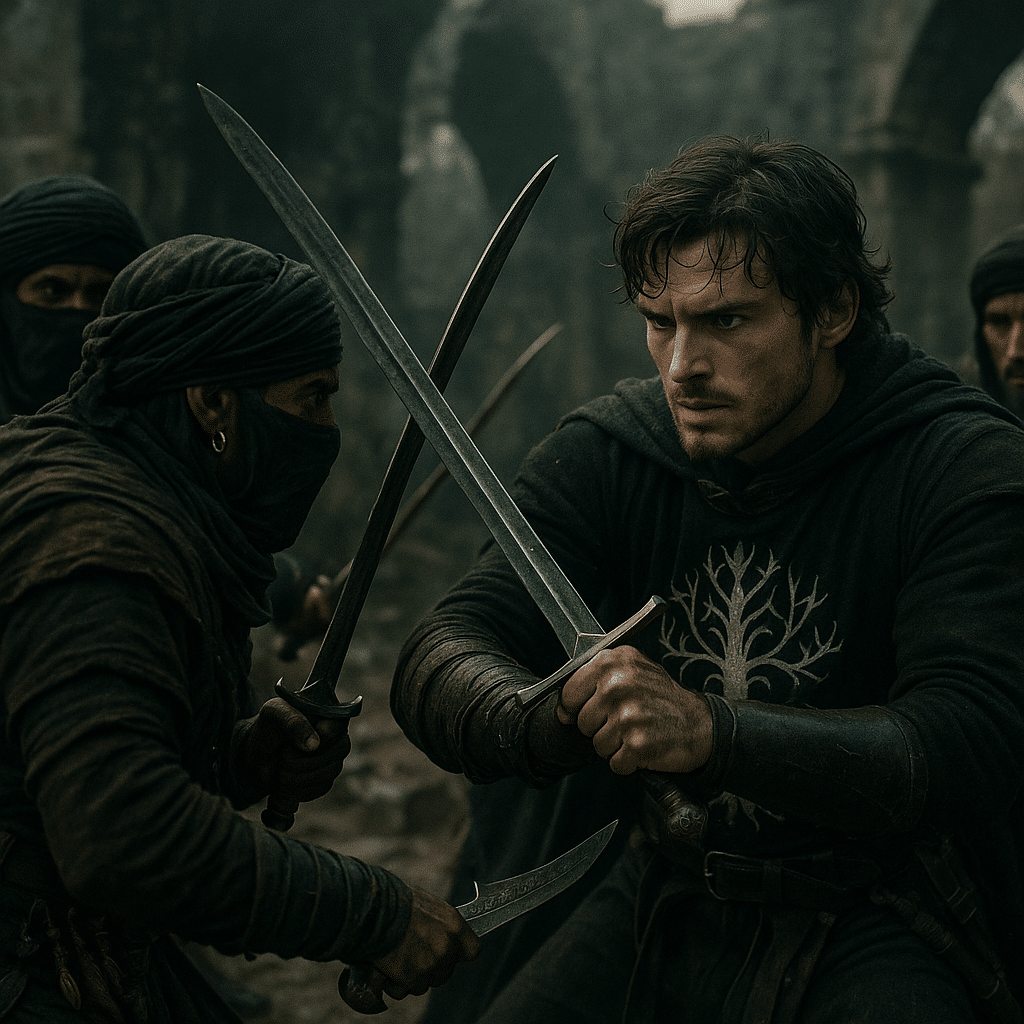
The ruined plaza had been a trap, but none of them had seen it in time. The signs had been there—the unnatural silence, the way the shadows clung too tightly to the cracks and corners of the crumbling stone—but the weight of exhaustion had dulled their instincts. The forest trail leading to the plaza had felt wrong from the beginning. No birdsong graced the canopy; even the wind seemed to hesitate, caught in the same stillness that gripped them all. Only the scrape of boots on ancient paving stones broke the stillness, each sound lingering in the air for a moment too long.
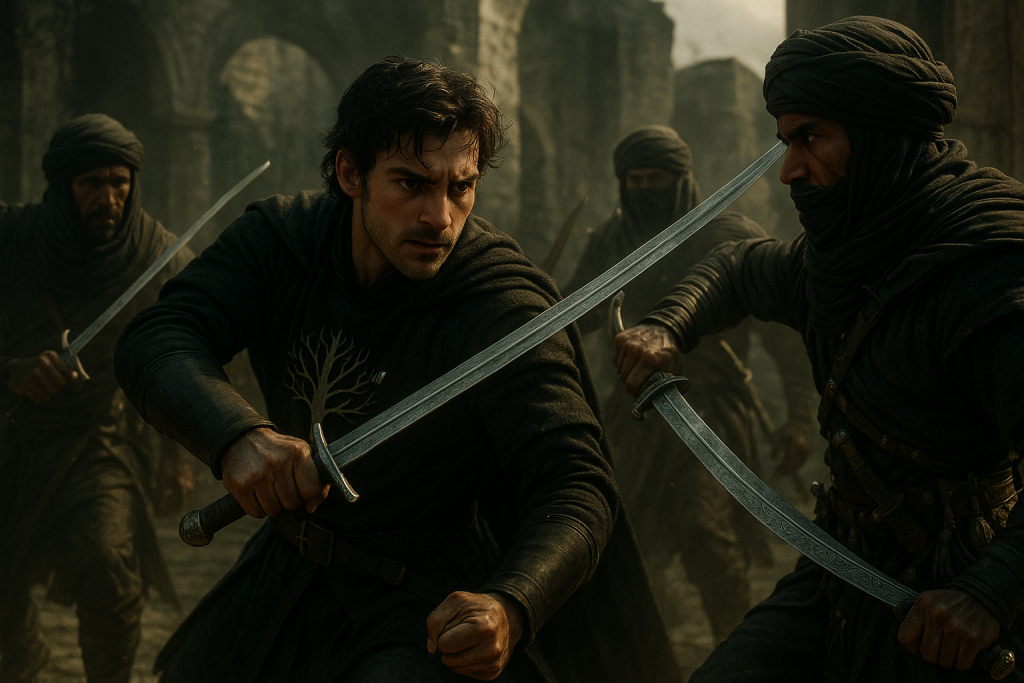
Ungoránë sensed it- the creeping wrongness that prickled at the back of his neck. The light filtered strangely through the twisted branches, creating shadows that seemed to breathe. Moss-covered Gondorian stonework peeked through the forest floor like the bones of something long buried, remnants of roads and culverts now overtaken by Ithilien’s relentless growth. He exchanged a brief glance with Thordur, recognizing his own unease mirrored in his friend’s eyes, but neither spoke. What was there to say? They were committed now, tasked with escorting the scouts to survey the ruined outpost.
Their bones still ached from the battle at Morgulduin Bridge just three days ago. Ungoránë’s shoulder burned where an enemy blade had grazed him, and Thordur slightly favored his left leg—remnants of wounds that hadn’t yet healed. What should have been a simple reconnaissance mission after their hard-won victory had turned into something far more treacherous. Hadron had assured them it would be safe ground—”Just a sweep and survey, nothing more.” But in these darkening days, nowhere in Ithilien was truly safe.
Durathon had taken point, with Tarthorn ready at his side, the warhammer’s head gleaming dully in the filtered light. The big man moved surprisingly quietly for his size, scanning the undergrowth with the wariness of a predator aware that larger hunters were nearby. Behind him, Elaran drifted like a shadow among the trees, pausing occasionally to survey the ridgeline above. His keen eyes missed nothing, but his expression revealed no concern—only the same measured calculation that characterized everything he did.
Perhaps if they had not been so weary from the battle at Morgulduin Bridge, they might have heeded the warnings. Perhaps if the scouts had not been so inexperienced and eager to prove themselves, they might have approached with greater caution. Yet exhaustion and inexperience were as lethal as any enemy blade, and when the Southrons surged from the hidden tunnels, it seemed as if the earth itself had opened its jaws to swallow them whole.
They surged like a flood, spilling from the ruins in a torrent of steel and fury. The air filled with the guttural roars of battle cries and the rhythmic drumbeat of boots on stone. The dry, cracked plaza beneath their boots became slick with blood as the first strikes fell, dark stains spreading like an infection across the fractured ground.
The first Southron emerged from a crack in the stone barely wide enough for a man, his curved blade already in mid-swing. Durathon reacted with remarkable speed for someone of his size. Tarthorn whistled through the air, the hammer’s brutal arc catching the man squarely in the chest. The impact produced a sickening crack as ribs collapsed inward, the force of the blow lifting the Southron off his feet and throwing him back into two of his comrades as they clambered from the hidden passage.
“Tunnel breach!” Durathon roared, already pivoting to meet three more warriors who scrambled up from the stone like ants from a disturbed hill. He planted his feet wide, Tarthorn whirling in a controlled figure-eight pattern that forced the attackers to yield. A Southron lunged with a spear, seeking the gap in Durathon’s defense. The big man twisted, catching the spear shaft with Tarthorn’s haft, then stepped in and drove the butt of his weapon up under the man’s chin. Bone shattered, blood sprayed, and the Southron dropped without a sound.
From his vantage point on a half-crumbled wall, Elaran’s first arrow struck a Southron through the throat before most of the squad had even registered the attack. His second found the eye-slit of another’s helm, a shot so precise it seemed impossible. His movements were economical, almost mechanical—draw, aim, release, reach for the next arrow—each motion flowing seamlessly into the next with fluid grace. When three Southrons attempted to flank around Gamil’s position, Elaran’s next three arrows punched through flesh and bone, each shot landing with ruthless, unerring force that left the enemy crumpled before they could scream.
“Second wave incoming, eastern approach,” he called, his voice steady despite the chaos unfolding below. “Seventeen hostiles. No, nineteen.” He sighed and loosed another arrow, the shaft embedding itself in a Southron’s throat with such force that it pinned the man to a wooden beam behind him. “Eighteen.”
Smoke curled into the air, acrid and sharp, mingling with the coppery tang of spilled blood. The stench of death clung to everything, enveloping them like a shroud.
“Move, now!” Hadron’s voice cut through the chaos, hoarse and commanding, with desperation sharpening each word. His blade flashed as he turned to deflect an incoming blow, sparks flying as steel scraped against steel. His shout rose above the cacophony, slicing through the din like a lifeline thrown to drowning men.
The Gondorian scouts they had been escorting stumbled toward the narrow archway that marked their only chance of escape. Their faces were pale, their steps uneven, as though the sheer weight of terror had drained the strength from their legs. They were raw recruits, boys playing at war until it became real, and the brutal reality of it was written in the tremble of their hands and the wide, uncomprehending terror in their eyes.
The squad formed a line, a desperate wall of flesh and steel against the onslaught. Gamil stood at the center, shield raised to catch the brunt of the Southrons’ advance. Each blow that struck his shield echoed like a hammer against an anvil, the force reverberating through his body. His face was a mask of sweat and grime, teeth bared in a snarl as he braced for the next impact.
To his left, Thordur’s bow sang a deadly melody, each arrow loosed with precision, finding throats and hearts even amidst the chaos. Behind them, Azrak held the rear, his shield already splintered, his sword trembling in his grip.
On Gamil’s right flank, Durathon planted his feet, his massive frame like a mountain of flesh and steel. His warhammer, Tarthorn, rose and fell in brutal arcs, each swing ending with the sickening crunch of bone or the piercing shriek of rent metal. While Gamil deflected and endured, Durathon smashed through, creating space with pure destructive force. His eyes were cold beneath his helm, and his breathing was measured and controlled despite the violence of his movements.
“Left side coming apart!” Durathon bellowed, his voice carrying over the din as he spotted a new wave of enemies breaking through the left section of the plaza. He shifted his grip on Tarthorn, the weapon’s weight feeling negligible in his massive hands.
From a half-crumbled section of wall behind them, Elaran’s arrows whistled through the air with deadly precision. Unlike Thordur’s rapid volleys, each of Elaran’s shots was patient and precise, slipping through seams in the armor as if he’d measured the gaps by hand—no rush, no waste, just the quiet certainty of a man who knew exactly where to kill. A Southron fell with an arrow through the eye-slit of his helm—an impossible shot for most, yet merely routine for Elaran. His lean form remained nearly motionless except for the fluid draw and release of his bow, positioned to provide him with the widest field of view.
“Throat exposed at your three, Durathon,” he called out, his voice quiet but somehow carrying through the chaos. Durathon pivoted without looking, Tarthorn swinging in a precise arc that caught an advancing Southron just beneath his helm. The coordination between them spoke of a growing trust on the battlefield, each man complementing the other’s strengths.
It wasn’t enough.
The Southrons emerged from two directions: one wave pressed hard against their line while another poured from a concealed passage to the left. They moved with terrible, disciplined fury, their curved blades glinting in the dim light and their faces painted with blood and war markings. For every enemy that fell, two more seemed to take their place, their bodies littering the plaza like discarded kindling.
“They’ll overrun us!” Gamil’s voice rose above the clash of steel and the guttural cries of battle- raw and desperate. His shield shuddered violently; each blow from the Southrons’ scimitars threatened to crack its battered surface. Sweat dripped from his brow, carving tracks through the grime that covered his face. His stance was a testament to pure determination, his legs braced wide as he absorbed strike after brutal strike. Yet, even his resilience had its limits. The shield splintered, cracks spreading like spiderwebs with every hammering blow.
Ungoránë’s gaze darted across the battlefield, his mind racing as he tried to make sense of the chaos. The Southrons were everywhere, a tide of bodies pressing in from two sides. The bulk of them hammered at the front line, their savage strikes chipping away at Gondorian shields and armor like a relentless battering ram. On the left, more Southrons poured through a hidden passage, their sudden appearance cutting off any chance of retreat.
His breath hitched as the realization sank into him like a dagger. They were not only outnumbered; they were trapped. The enemy had set the stage perfectly, transforming the ruined plaza into a killing ground with their ambush. Every step they took, every move they made, felt like sinking deeper into quicksand.
And then his eyes found it. The tower.
The tower loomed over the battlefield like a wounded beast, its cracked foundation groaning under the weight of decades. It leaned with agonizing deliberation, as if deciding whether to fall. The jagged stones at its base were splintered and loose, with fissures running like veins up its weathered frame. Dust drifted from its edges with every tremor of battle nearby, each grain a warning of its imminent collapse.
Beneath the tower, Ungoránë caught the faint, sour smell rising from cracks in the plaza stones—an unnatural staleness that hinted at hidden spaces below. Now he understood. The Southrons weren’t just attacking from the visible approaches; they were emerging from ancient Gondorian tunnels beneath the plaza itself, from cisterns and storage chambers dating back to a time when this outpost stood proud against the shadow in the East. The ingenuity of it filled him with cold dread. They hadn’t stumbled into an ambush; they had walked into a carefully laid trap, with the tunnels serving as both a hidden approach and an escape route for the enemy.
Ungoránë’s eyes traced the tower’s unsteady lines, his stomach twisting. It wasn’t just a structure anymore—it was a gamble, a lifeline wrapped in a death sentence. If the tower fell, it would block the narrow passage where the Southrons’ reinforcements were pouring through, cutting off their endless tide. But stone didn’t fall on its own. Someone would have to make the climb, drive steel into its fragile supports, and stay long enough to ensure it crumbled. There was no coming back from that.
The realization settled in his chest like ice. Someone would have to die so the rest might live. In that moment, the weight of his sergeant’s rank pressed down on him, heavier than any armor. Abrazân had never spoken of this aspect; perhaps he didn’t understand it. The cruel arithmetic of command, where each man’s death incurred a cost and every decision was paid in blood.
Hadron’s voice sliced through the din like a blade. “We need that tower down, Ungoránë.”
The words weighed as heavily as the stones themselves. Hadron’s face was a study in grim resolve, his eyes fixed on the tower as if willing it to collapse through sheer force of will. There was no hesitation in his tone, no room for debate. This was not a suggestion or a plea—it was an order forged from the cold necessities of war.
Ungoránë felt the battlefield narrowing around him, the sound dulling into a distant roar. Time seemed to slow, and each heartbeat stretched into eternity as he assessed their dwindling options. A part of him wanted to laugh at the cruel simplicity of it all—they needed the tower down, and someone would have to climb it, knowing they would never return. The question wasn’t if, but who.
Ungoránë’s gaze flicked to the squad, and what he saw felt like a knife twisting in his gut. Thordur and Gamil stood shoulder to shoulder, their movements a brutal dance of survival. Gamil’s shield, battered and cracked, bore the scars of countless strikes, yet it still held, deflecting the relentless onslaught. His blade flashed in short, savage arcs, each swing aimed with grim precision. Beside him, Thordur fought with feral intensity, his dagger darting like a snake, seeking every unguarded gap in the enemy’s armor. The two moved with the practiced synchronization of men who had shared too many battles, their backs brushing against one another as they fended off the tide.
Durathon had carved out a grim space around himself, Tarthorn’s bloody arc keeping the Southrons at bay through sheer brutality. But even his mighty swings were slowing, his breaths coming harder. A Southron blade had grazed his thigh, the dark stain spreading slowly across the thick wool of his breeches. He compensated by planting his wounded leg firmly, using it as a pivot point while his hammer continued its deadly work.
“Can’t hold much longer!” he growled, not in fear but in cold assessment. His voice revealed no pain, only the tactical reality of their situation. Two Southrons attempted to rush him simultaneously, and he met them with a horizontal sweep that sent them both sprawling; however, the effort took a toll. His next swing came a fraction slower.
Near the back, Elaran had abandoned his preferred perch as the Southrons closed in. His longbow was still in action, but he had been forced to shoot at near point-blank range, each arrow finding its mark with deadly precision before he was compelled to retreat another step. His quiver had grown perilously light, and his face showed the first hint of concern as he quickly glanced at his remaining arrows.
“Eight left,” he called out, the first time uncertainty had crept into his voice. A Southron lunged at him, and in one fluid motion, Elaran nocked, drew, and released; the arrow punched through the man’s throat at such close range that blood spattered across Elaran’s cheek. “Seven,” he corrected, already backing toward their last line of defense.
But even they were faltering. Sweat and blood streaked their faces, and their breaths came in ragged gasps. The Southrons pressed harder, their numbers seeming to multiply in the smoke-filled chaos. Each enemy cut down was replaced by two more, their cries a chilling crescendo that drowned out reason.
At the rear, Azrak stood apart, his figure painfully out of place amid the carnage. His shield was little more than a splintered husk, dangling uselessly from his arm, and his sword trembled in his grip like a leaf caught in a gale. He wasn’t fighting—he was barely holding himself together. His wide, terrified eyes locked with Ungoránë’s for a brief, harrowing moment.
He’s too young, Ungoránë thought, the words cold and unyielding in his mind. Too young, too green, too scared. He wasn’t ready for this, and he shouldn’t have been here. Yet here he was, thrown into the jaws of a war that devoured the unprepared without mercy.
“Ungoránë!” Hadron’s voice pierced the din, sharp and commanding. It conveyed the weight of necessity, the kind of urgency that allowed for no doubt or hesitation. “The tower!”
Ungoránë hesitated. The battlefield roared around him, a cacophony of death and desperation; yet in that moment, it felt as though the world had narrowed to a suffocating silence. His gaze darted among his men, and his mind was a frantic storm of possibilities and consequences.
Thordur and Gamil were locked in the grim rhythm of survival. Thordur moved like water over stones, each strike of his blade or twang of his bow a calculated act of precision. Blood streaked his face, and his eyes burned with a focus that bordered on feral. Gamil, solid and unyielding, stood like a wall against the Southrons, his shield raised like a fortress gate. However, even fortresses can fall under enough pressure. Gamil’s shield was splintering, the cracks spreading like spiderwebs with every hammering blow. Thordur’s quiver was nearly empty, and his knife had become an extension of his bloodied hand.
They couldn’t leave the line; they embodied the line.
His eyes moved to Durathon, whose massive form was bleeding from more than just the thigh wound now. A fresh cut along his cheek dripped blood onto his already crimson-stained armor. The big man caught Ungoránë’s gaze for a moment, a flicker of understanding passing between them. Durathon gave a barely perceptible shake of his head—he knew what Ungoránë was thinking, and his response was clear: I can barely stand, let alone climb.
Elaran had nearly backed against the wall now, his bow still singing but yielding diminishing returns. Six arrows left. Five. Each was precious and irreplaceable. His slender frame couldn’t push through the Southron line, even if Ungoránë ordered him to try. His arrows were needed here, supporting their increasingly desperate defense.
Ungoránë’s gaze shifted to Azrak, who stood at the rear like a misplaced specter. The boy clutched the remnants of his shield as if it could still protect him, though it was barely more than a jagged piece of wood. His sword trembled in his hand, the blade catching faint glimmers of light as it wavered. His face was pale, and his lips parted in shallow, ragged breaths. He resembled more a cornered animal than a soldier—a boy thrust into the maw of something far larger than himself.
The memory of the Morgulduin bridge flashed unbidden through Ungoránë’s mind—how he had broken formation to save Azrak when the boy’s shield had shattered under a Southron’s blow. How the boy had looked at him afterward, eyes filled with gratitude and something like devotion, saying “You saved me, Ungoránë. I… I won’t forget that.” The irony of it tasted like ash in his mouth. He had saved Azrak only to send him to his death days later.
Ungoránë’s mind churned, each choice surfacing then sinking like stones in a poisoned well. I could send Thordur. He’d be fast enough, precise enough, but we would lose his bow. Gamil? No. The line would collapse without him. His thoughts turned inward, a biting whisper of self-recrimination. I should go. I’m the sergeant now. I make the decisions.
But another voice, colder and more unyielding, cut through his resolve. If you go, the line breaks. They all die. The truth of it settled in his chest like a stone, crushing and immovable.
His eyes flicked back to Azrak. The boy’s terror was palpable, a living thing that clung to him like a shadow. He wasn’t ready. Ungoránë knew that. Azrak knew that. But readiness didn’t matter. Not here. Not now. The tower had to fall. Someone had to make it fall.
And no one else was present.
The decision fell like a guillotine.
“Azrak!” Ungoránë’s voice ripped through the chaos, sharp and unyielding. The boy’s head snapped toward him, his wide eyes reflecting the horror of the moment.
“What?” Azrak stammered, the single word quivering on his lips.
“The tower!” Ungoránë barked, pointing toward the crumbling structure. His tone, edged with authority, conveyed a command that allowed for no argument.
Azrak froze, caught between instinct and the crushing weight of the order. His mouth opened, but no words emerged. Ungoránë saw the war within him—fear battling duty, a boy’s heart struggling against a man’s responsibility.
From the side, Elaran loosed another arrow, buying precious seconds. “Covering the east approach,” he called, his voice calm despite the dire circumstances.
“Go!” Ungoránë roared, his voice cutting like a blade. He pointed again, his arm trembling with the force of his own resolve. “Now!”
For a moment, the battlefield seemed to hold its breath. The cries of the Southrons faded, and the clash of steel softened. It was as if the world itself had paused to bear witness. Azrak’s fear was evident on his face, with every muscle in his body screaming to flee. But then his jaw set, and something else flickered in his eyes. It was not the absence of fear, but the presence of something greater—determination.
The boy nodded once, a small but resolute movement. He turned and ran, his boots skidding on the blood-slick stone as he made his way toward the tower.
“Durathon, cover his flank!” Ungoránë commanded. The big man pivoted instantly, Tarthorn sweeping a deadly arc that cleared a path for Azrak’s desperate sprint. Despite his wounds, Durathon’s hammer struck with renewed ferocity, as if the protection of the younger soldier had awakened a second wind.
Durathon roared as he crushed a Southron’s helm, the sound more animal than human. “For him!” It wasn’t clear if he meant Azrak or some ghost from his past, but the effect was the same—Tarthorn moved with murderous efficiency, creating a momentary corridor through which the boy could pass.
A Southron captain, his armor adorned with crude iron spikes and painted with crimson war marks, barked orders to his men. Five warriors broke from the main force, their curved blades gleaming as they moved to intercept Azrak. Durathon met them head-on, Tarthorn not swinging in controlled arcs but transforming into a whirlwind of devastating force. The first attacker’s breastplate buckled under the hammer’s impact, driving the breath from his lungs. The second raised his blade to parry, only to have Tarthorn’s edge knock the weapon aside with enough power to send him staggering.
The captain himself engaged Durathon, his scimitar a blur of deadly precision that found a gap in the big man’s defense. Blood welled from a fresh cut along Durathon’s forearm, yet he seemed not to notice. He countered with a brutal overhead swing that the captain barely avoided, Tarthorn striking the stone with enough force to send chips flying. The impact staggered the Southron, throwing him off balance just long enough for Durathon to bring his weapon around in a savage backhand that connected with the man’s ribs. Even through the chaos, Ungoránë heard the crack of bone.
Ungoránë watched as Azrak bolted toward the tower, each step carving deeper into his chest like the bite of a blade. His breath hitched, a guttural sound lost in the chaos around him. He wanted to shout, to call the boy back, to undo what had just been set in motion. But it was too late. Azrak was already running toward what they both knew he wouldn’t return from.
The Southrons noticed as well. Their shouts cut through the din, guttural and savage, as several of them broke away, their weapons gleaming with intent. Ungoránë surged forward, his sword already arcing toward the first of them. “Cover him!” he roared, the words raw and desperate.
Thordur’s bow twanged, sharp as a whip crack. An arrow hissed past Ungoránë’s ear and buried itself in a Southron’s neck. The man gurgled, his scimitar falling from limp fingers as he crumpled to the blood-soaked ground. “I’ve got him!” Thordur shouted, already nocking another arrow. His face was streaked with blood and dirt, but his eyes burned with focused fury. “Keep moving, Azrak!”
From his position, Elaran had the clearest shot at the Southrons pursuing Azrak. He abandoned his methodical approach and fired rapidly, each arrow still finding its mark despite the increased pace. A massive Southron wearing a hull-shaped helm charged toward Azrak, wielding a heavy maul that could crush the boy with a single blow. Elaran drew, aimed, and released in one fluid motion. The arrow struck the man’s knee at precisely the angle needed to sever the tendon beneath the joint of his armor. The Southron went down hard, his momentum carrying him forward into a tumbling slide across the blood-slick stones.
With his quiver nearly empty, Elaran vaulted from his perch with unexpected athleticism, landing in a controlled roll and drawing his long knife in a single smooth motion. A Southron turned toward him, blade raised high, but Elaran was already inside the man’s guard. His knife flashed upward, finding the gap beneath the chin strap of the helm with surgical precision.
“Out of arrows,” he called with clinical detachment, plunging into the fight with the same measured calculation that guided his archery.
Gamil, locked in a brutal clash with an enemy twice his size, caught sight of the boy darting past. He slammed his shield into his attacker, the crunch of bone ringing out as the Southron staggered back. “Azrak!” he bellowed, his voice straining with something that wasn’t quite despair. “Don’t you stop, lad! Don’t you dare!”
Azrak did not stop. He stumbled briefly, his foot catching on uneven stone, but quickly regained his balance. The tower loomed closer, its jagged edges clawing at the gray sky. Each step brought him nearer to the task that no one else could—or would—undertake.
The tower groaned ominously as Azrak began his ascent. His hands gripped the crumbling stone, the rough edges biting into his palms and drawing blood. Dust stung his eyes, while gritty particles mixed with the sweat streaming down his face. His breath came in sharp, ragged bursts as every muscle in his body cried out, hoisting him higher.
At the top, he turned, his figure stark against the swirling chaos below. For a moment, he hesitated, his wide eyes scanning the battlefield. They landed on Ungoránë, who was locked in a savage duel, his sword flashing like a beacon amidst the storm.
“I didn’t let you down!” Azrak called, his voice cracking but resolute. He paused, then shouted again, louder, as if the words could carry him beyond the battlefield. “Tell them I mattered!”
Ungoránë’s chest tightened; the boy’s words were a jagged blade twisting deep. He couldn’t reply- not with the Southron pressing him hard, their blades locked in a screeching bind. Yet the weight of Azrak’s plea settled on him, more crushing than any blow he’d ever taken.
Elaran looked up from his own desperate combat, his face reflecting a flicker of emotion for the first time—recognition, perhaps, of the words’ significance. His knife moved like quicksilver as he fought his way closer to Ungoránë, providing cover while the sergeant battled through to a better position.
“The boy has heart,” Durathon grunted, his voice carrying only to those nearest him. It was the closest thing to praise anyone had heard from the imposing warrior. Tarthorn rose and fell, each impact clearing space for his wounded comrades to maneuver.
Azrak turned back to his task. His sword rose and fell with ferocity, striking at the weakened supports with every ounce of strength he could muster. Each swing reverberated through the stone, the cracks spreading wider and deeper, like veins under pressure. The tower groaned in protest, its structure shuddering with each strike.
At the base, the Southrons swarmed, their weapons gleaming as they began to climb after him. One man reached for the first ledge, only to be met by a brutal arrow through his wrist, pinning him to the stone. Thordur let out a bark of triumph, but his quiver was nearly empty. “Move faster, Azrak!” he shouted, his voice edged with both urgency and fear.
Durathon had forced his way to the tower’s base, his massive form creating a bulwark against the advancing Southrons. Despite the blood freely flowing from his wounds, he swung Tarthorn in sweeping arcs that cleared the lower levels. “Climb, boy!” he roared upward. “We’ll hold them back!” It was a lie—they couldn’t hold forever—but it was a necessary one.
Elaran had joined him, his slender form a sharp contrast to Durathon’s bulk. Where the larger man crushed and battered, Elaran’s knife flashed with deadly precision, targeting the weak spots in enemy armor. Together, they formed a momentary barrier, buying Azrak precious seconds that felt like an eternity.
Azrak didn’t need the encouragement. His breath came in heaving gasps now, and his arms trembled with the strain of each swing. His palms were slick with blood, the torn skin burning as he gripped the hilt of his sword. His boots slipped on the shifting stones, but he steadied himself; his resolve remained unyielding. The tower shuddered violently, and a groan like a dying beast echoed through the plaza.
The supports buckled. Dust and debris rained down in thick clouds, choking the air and obscuring the battlefield below. Azrak’s movements remained steady; each strike was deliberate, and each blow stood as a testament to his will.
The first Southron reached him, climbing through the chaos with a snarl. Azrak didn’t hesitate. He swung his sword one last time, the blade crunching through the man’s chest and sending him plummeting back to the ground.
Then the tower collapsed.
It came down with a deafening roar, the stones folding inward as though some great hand had crushed them. The sound drowned out the screams of the Southrons, the clash of blades, and even the shouts of his comrades. Azrak didn’t try to escape. He stood his ground, his sword still in his grip as the stones swallowed him whole.
The passage was sealed, and the Southrons were cut off. The squad had their opportunity.
“Fall back!” Hadron’s voice sliced through the aftermath, sharp and commanding. One by one, they withdrew, retreating from the crumbling plaza as the sounds of battle faded behind them.
Durathon was the last to move, his massive frame silhouetted against the settling dust. His eyes lingered on the pile of rubble where the tower had stood and where Azrak now lay buried. Something passed across his face—not quite grief, but a recognition, as if he were witnessing something both terrible and worthy. He turned away, Tarthorn hanging heavily at his side.
But for Ungoránë, the echoes of Azrak’s last words lingered: “Tell them I mattered.”
That night, the camp lay cloaked in silence, a heavy, suffocating presence pressing down on every man like the weight of the dead. The air, though still, felt laden with unspoken grief, each breath thick and labored. Shadows flickered across weary faces around the small fire. The men moved sparingly, their exhaustion etched into their movements. No one spoke, but the absence of Azrak—young, wide-eyed Azrak—hung among them like a ghost.
“Two scouts unaccounted for,” Hadron had reported earlier, his voice flat with forced detachment. “And the survey maps of the northern passes are gone. Three weeks of reconnaissance work lost.” The words settled like stones in Ungoránë’s gut. The missing scouts were almost certainly dead, and the partially completed maps—written in Gondorian cipher but still valuable—would ultimately yield their secrets to the enemy.
Thordur sat on a jagged stone, his bow resting against his knees, his hands idle for once. He stared at the ground, his lips pressed into a thin line. Occasionally, his fingers brushed the edge of his tunic where Ungoránë knew he kept his lute wrapped in protective cloth—a gift from his father that he’d revealed to the squad only recently. The small wooden charm of a sailing ship that hung from the neck of the instrument had become a talisman for Thordur, a connection to the home and family he might never see again. Tonight, there would be no music. The weight of loss was too heavy for even that small comfort.
Ungoránë found himself missing the soft melodies Thordur had begun playing during the quiet moments after the Morgulduin victory. That night, his music had drawn even the taciturn Durathon into their circle, the big man’s eyes closing briefly as if recalling something long lost. Now, that camaraderie, so recently forged, felt fragile in the wake of Azrak’s death.
Thordur’s fingers began to move, almost unconsciously, tracing a melody in the air. A soft, halting hum escaped his lips—just a few notes before he stopped abruptly. His eyes lifted, suddenly bright with something dangerously close to tears.
“He asked me to teach him that song,” Thordur said, his voice rough-edged. “Yesterday morning. Said he had a girl back home he wanted to impress.” He laughed, a broken sound that held no mirth. “I told him we’d start after this mission.” He fell silent then, his hands curling into fists, and said no more.
Gamil, the shield-bearer, knelt a few paces away, his fingers brushing over the shattered remnants of Azrak’s shield that he had picked up from the battlefield. He held the splintered wood like a relic, his calloused thumb tracing the jagged edges with painful reverence. Suddenly, without warning, he slammed his palm against the trunk of a nearby tree, the impact splitting his skin. Blood welled between his fingers, but his expression didn’t change—just a brief fracture in his composure before he resumed his silent vigil over the broken shield.
One of the remaining scouts murmured a soft prayer, the words barely audible over the crackling fire. The others did not join in, but their heads dipped slightly, their silence a solemn agreement. Each man was lost in his own storm, yet their grief was shared, a thread that bound them together even as it frayed.
Durathon sat apart from the others, his massive frame hunched forward as he methodically cleaned Tarthorn. The warhammer’s head was caked with dried blood and fragments of bone, which he scraped away with practiced motions. His wounds had been hastily bandaged, dark stains seeping through the linen wrappings. He worked in complete silence, his face unreadable in the shifting firelight, but his hands moved with a gentleness that belied their size and the violence they had wrought.
Nearby, Elaran knelt with his back against a tree, carefully inspecting the edge of his knife. Beside him lay a small bundle of straight branches he had gathered since making camp, along with a handful of feathers pulled from the lining of his cloak. With each slice of his blade, another crude arrow shaft took shape—far from the quality of his depleted quiver, but they would fly true enough at close range. His features were composed, almost serene, yet his eyes never settled, constantly scanning the darkness beyond their camp. When his gaze occasionally fell on the space where Azrak should have been, the slightest tightening around his mouth betrayed emotions that remained otherwise hidden.
Ungoránë sat apart, as he often did, the sword resting across his knees. Its edge, dulled by the brutality of the day, caught the faint firelight; its flickering gleam served as a cruel reminder of its purpose. Dust and blood streaked its surface, marking a weapon that had performed its duty well. Too well, Ungoránë thought bitterly. He ran his thumb along the hilt, feeling the grooves smoothed by countless hands before his own.
The fire’s warmth reached him, but it might as well have been a thousand miles away. The cold in his chest was deeper, heavier, and no flame could touch it. He stared into the embers, their glow pulling at his thoughts like a tide, drawing them to Azrak. The boy’s face rose unbidden—pale with fear, then set with grim determination as he climbed the tower. His voice echoed in Ungoránë’s mind, sharp and unrelenting: Tell them I mattered.
The words dug into him, relentless. Did he matter? Ungoránë thought, his grip tightening around the sword’s hilt. Was one life enough to tip the scales? Could anything balance the weight of all those who had fallen?
Hadron approached from the edge of the firelight, his steps deliberate yet quieter than usual. The captain’s shoulders seemed heavier than Ungoránë had ever seen; his armor was dull, marked by streaks of blood and soot. He crouched beside the fire, the flickering glow casting harsh lines across his weathered face. His gaze was steady, but something lingered behind it—something tired and worn, like a man who had carried too much for too long.
“It had to be done, Ungoránë,” Hadron said after a moment, his voice low. There was no steel in it this time, only the weight of resignation. “You know that.”
Ungoránë didn’t look at him. His jaw tightened, and his eyes were fixed on the fire as if the shifting embers might hold answers he couldn’t find. “He was a boy, Hadron,” he said, his voice flat but trembling at the edges.
Hadron sighed, the sound heavy and drawn from somewhere deep within. He leaned forward, resting his forearms on his knees. “He was brave,” Hadron replied. His tone was steady, but his eyes betrayed him—a flicker of something raw, something he had buried too many times before. “He knew what was at stake. We all do.”
From his position near the edge of the camp, Elaran’s voice carried softly through the night. “The young ones always pay.” The words were barely audible, spoken more to himself than to the others, but in the heavy silence, they seemed to pierce the darkness like arrows. He continued to inspect his knife, his face inscrutable, yet something in his tone suggested a personal knowledge of that loss.
Durathon paused in his cleaning of Tarthorn, his massive shoulders tensing at Elaran’s words. For a moment, it seemed he might speak, but instead, he merely nodded once- a sharp, almost angry gesture of agreement- before returning to his task with even greater intensity.
“He trusted me,” Ungoránë said, the words escaping with a harsh rasp. His throat tightened, each syllable dragging barbs against his chest. “I sent him to die.”
Hadron didn’t flinch. Instead, he placed a hand on Ungoránë’s shoulder, his grip firm but gentle. “I’ve sent men to die too,” he said, his voice quieter now, almost a whisper. “Good men. Men who trusted me. It never gets easier. But it has to be done.”
The fire crackled between them, filling the silence as Ungoránë struggled to find words that seemed to elude him. Hadron continued, his tone soft yet resolute. “Azrak saved us. He gave us this chance to breathe, to keep moving, to fight another day. Don’t let that be for nothing. Don’t let his sacrifice drown you.”
Ungoránë nodded stiffly and reluctantly. Hadron lingered a moment longer, his hand offering a steadying presence before he rose to his feet and walked back into the shadows.
Durathon watched Hadron leave, then set Tarthorn aside, the weapon now free of the residue of battle. He reached into a small pouch at his belt and withdrew a smooth stone, which he began to glide along the hammer’s edge with methodical strokes. The scraping sound cut through the silence, oddly comforting in its rhythm.
“The boy showed courage,” he said without looking up, his voice low and graveled. “More than some veterans I’ve known.” Coming from Durathon, it was high praise indeed. “In Lossarnach, we remember our dead by their final act.” He paused, the whetstone momentarily still. “His final act was worthy of remembrance.”
Elaran had finished his inspection and sat with his back against the tree, knife now sheathed. “It wasn’t just courage,” he added, his voice carrying the quiet authority of observation. “It was choice. When it mattered most, he chose.” He glanced toward Ungoránë, his gaze steady. “That’s why he asked you to tell them he mattered. Because he did.”
Ungoránë’s gaze returned to the fire. The flames had burned lower, their light casting faint, wavering shapes against the darkness. His thoughts churned, chaotic and unrelenting.
The camp was cloaked in a heavy silence, the kind that follows a day steeped in blood and death. Around the dying fire, the squad lay scattered like broken pieces of a once-whole thing. Men huddled in their cloaks, the faint rise and fall of their breathing the only sign that they still lived. The steep walls of the ravine rose around them, broken stone ridges and twisted vegetation looming jagged and unmoving, like sentinels witnessing their grief. A half-buried column base, a remnant of Gondor’s earlier presence, stood like a tombstone at the edge of their meager light.
Ungoránë sat apart, his back against a low wall that had long since crumbled to half its height. The fire’s faint glow cast his face in half-light, its warmth a feeble balm against the chill creeping into his bones. Across his lap lay the sword, its weight as familiar now as it was alien. The blade was dull and nicked from the day’s fighting, its edge streaked with dried blood that caught the light like tarnished silver. He rested one hand on the hilt, the leather rough and worn under his palm, but he did not move.
Azrak’s face loomed before him, stark against the haze of smoke and chaos. Ungoránë tried to blink it away, but the memory was sharper with his eyes closed—the boy’s wide, pale expression as he turned toward the tower, the tremor in his hands as he gripped his sword. Then, fear gave way to something else: the determination in his jaw, the unshakable resolve that compelled him to move toward his death.
“He mattered,” Ungoránë whispered, his voice barely carrying over the faint crackle of the flames.
The fire did not answer. It merely sputtered and popped, its light flickering faintly against the surrounding stones.
But someone else did.
“Of course he mattered,” came Elaran’s quiet voice from the darkness. The slender archer had moved silently, now sitting just within the circle of firelight. His face remained composed, but his eyes reflected the flames with unusual intensity. “Every choice matters. Especially the final ones.”
Elaran shifted slightly, his movements precise even in rest. “My father once told me that there are three deaths,” he said, his voice measured and calm. “The first when the body fails. The second when you’re buried.” He paused, his fingers tracing a small pattern on the hilt of his knife. “The third is when your name is spoken for the last time.”
He turned his gaze to Ungoránë, something almost gentle in his usually detached expression. “As long as we remember why Azrak climbed that tower, he’ll never face the third death.”
Durathon stirred from his seat, his massive form rising with surprising grace despite his injuries. He moved to the fire and added a small piece of wood, causing the flames to lick upward with renewed vigor. The sudden flare of light caught the contours of his face, revealing a hardness that seemed carved from stone rather than flesh.
“At home in Lossarnach,” he said, settling his bulk down closer to Ungoránë than he had ever sat before, “my people have a saying: ‘The strength of the hammer is measured by what it builds, not what it breaks.’” He gazed at his weapon, which now lay neatly beside him. “The boy built us a path out. With his own blood.”
The words hung in the air, heavier than the silence they replaced. It was the most profound thing any of them had heard Durathon say, and it carried the weight of personal understanding. Ungoránë recalled the rumors about Durathon’s past—how he had survived an ambush that claimed his previous squad and how the scar on his arm came from that day. The burden of survival was something the big man understood intimately.
Hadron emerged from the shadows, his steps heavy with exhaustion. He paused at the edge of the firelight before speaking for a moment.
“I sent… others. Before him.” His voice wavered, exposing an unexpected crack in his commanding presence. “I remember each one.”
He didn’t elaborate, but the weight of those unspoken names hung in the air between them. When he moved away again, his shoulders seemed to carry a burden that no armor could shield against.
Ungoránë rose and took the shield fragment from Gamil’s hands. The other man relinquished it without protest, his split palm leaving a smear of blood on the splintered wood. Using the tip of his knife, Ungoránë began to etch Azrak’s name into the wood with care, each stroke deliberate and reverent.
“What terrifies me,” he said as he worked, his voice barely above a whisper, “is that I’d make the same choice again. I’d send him to die again.” The admission felt like poison on his tongue, but it was true. “What kind of man does that make me?”
Thordur, who had been silent since his broken confession, finally looked up. “It makes you a leader,” he said simply. “You carried the burden so the rest of us didn’t have to.”
“I knew a commander once,” Durathon said, his voice rumbling low, “who never ordered a man to do what he wouldn’t do himself. We buried him in the first week.” His eyes met Ungoránë’s over the fire. “Leading means staying alive when others don’t. It’s the hardest part.”
Ungoránë finished carving and stood up, moving to the edge of the camp. He gathered stones—not many, just enough to create a small cairn beside a twisted ash tree at the hollow’s edge. He placed the carved shield fragment on top of it, with Azrak’s name facing the sky. It wasn’t much, but it was something—a marker, a memory, a promise.
When he returned to the fire from the hollow’s edge, one of the young scouts approached, water skin in hand. Their eyes met, and something hardened in the scout’s face. The boy deliberately turned away, leaving his water unfilled, and walked back to the far side of the camp. The silent accusation struck Ungoránë like a physical blow. He didn’t blame the boy; after all, two of his companions were dead, lost in the tunnels beneath the plaza.
He didn’t cry. He just breathed slowly and raggedly, as if something were trying to crawl out of him and die at his feet.
Ungoránë tightened his grip on the sword, the leather digging into his palm. The image of Azrak atop the crumbling tower resurfaced, vivid and inescapable. The boy stood his ground, his sword striking the stone with desperate, defiant purpose. His voice, steady despite the chaos, cut through the noise like a war horn’s cry.
“You mattered, Azrak,” Ungoránë whispered, his voice barely audible and cracking beneath the immense weight of guilt. “You mattered. And I’ll carry this for you. For all of them.”
He closed his eyes, letting the silence settle over him like a shroud. The fire burned lower, its light growing fainter as the night deepened. Around him, the camp remained still, the men lost in sleep or their own private grief. Yet, Ungoránë stayed awake, the sword an unyielding presence across his lap, reminding him of the burden he carried.
When he finally opened his eyes, the fire had dwindled to little more than embers, its warmth nearly gone. He lifted his gaze to the stars once more, their light cold yet steady. They were so distant, untouched by the world below, yet they endured.
For the first time that night, he drew strength from their steadiness.
Always for them.
In the darkness beyond the fading embers, Thordur moved silently to the small cairn. He knelt before the shield fragment bearing Azrak’s name, touching his fingers to the carved letters. From a small leather pouch at his belt, he withdrew a wooden carving he’d been working on since they left the battle—a small shield with a raised White Tree of Gondor etched into its surface, crafted from a piece of lebethron wood he had found in the forest. Its surface was polished smooth, with each detail rendered with the precision that marked his archery. He placed it beside the shield fragment, a craftsman’s tribute to a fallen comrade who had found his courage at the end, before returning to his place by the fire.